Ministry of Housing and Urban-Rural Development | 'Technical Guidelines for Smart Construction (Trial)' (Full Text)
WeChat Sync · Xiaowei · 2025-10-22
The following article is sourced from the official website of MOHURD, published by Ruyi Smart Construction
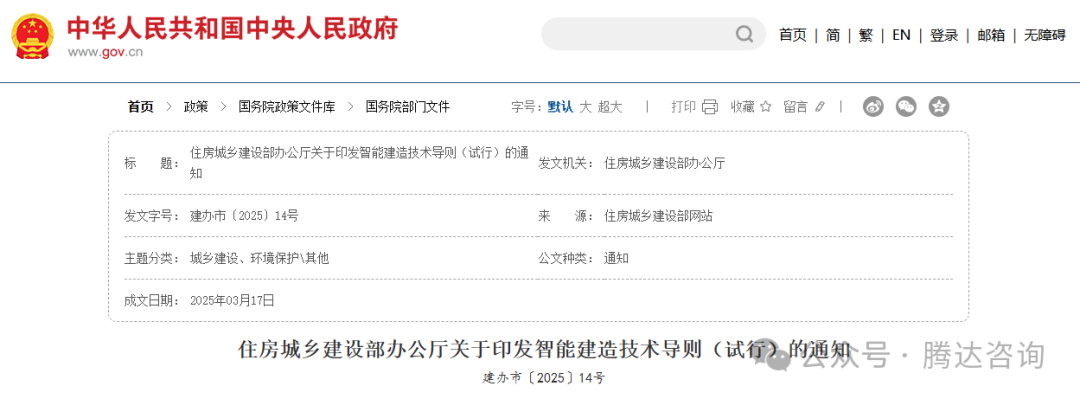
Notice of the General Office of the Ministry of Housing and Urban-Rural Development on Issuing the
Technical Guideline for Smart Construction (Trial)
Jian Ban Shi [2025] No. 14
To the housing and urban-rural development departments of all provinces and autonomous regions, the housing and urban-rural development (administration) commissions of municipalities directly under the Central Government, the Beijing Municipal Commission of Planning and Natural Resources, and the Housing and Urban-Rural Development Bureau of the Xinjiang Production and Construction Corps:
In order to implement the requirements of the Opinions of the General Office of the CPC Central Committee and the General Office of the State Council on Promoting New Urban Infrastructure Development and Building Resilient Cities and other documents, accelerate the application of smart construction technologies throughout the full lifecycle of engineering projects, and promote high-quality development of the construction industry, the Ministry of Housing and Urban-Rural Development has organized the compilation of the Technical Guideline for Smart Construction (Trial). It is hereby issued to you for reference and implementation in accordance with local conditions.
For any issues or suggestions during implementation, please contact the Department of Building Market Regulation of the Ministry in a timely manner.
Contact person and telephone: Yang Guang, 010-58933327
General Office of the Ministry of Housing and Urban-Rural Development
March 17, 2025
Technical Guideline for Smart Construction (Trial)
I. General Provisions
(1) Scope of Application
This guideline applies to construction activities carried out using smart construction methods during the survey, design, production, construction, and O&M stages of new building projects. Renovation and expansion of existing buildings and municipal infrastructure construction may refer to this guideline for implementation.
(2) Terminology
1. Smart construction (intelligent construction): A human-machine collaborative construction method formed by the deep integration of next-generation information technology and industrialized construction technology.
2. Digital survey: Engineering survey activities that utilize digital technologies for mapping, exploration, testing, and experimentation to produce comprehensive digitized survey results for in-depth application.
3. Digital design: Design activities that utilize digital technologies for parametric design, collaborative design, and intelligent assisted design to form digital representations of project information for in-depth application.
4. Intelligent manufacturing: Activities that utilize digital technologies and intelligent control systems to integrate production equipment units into intelligent production systems according to manufacturing process requirements for the smart production of building components and parts.
5. Intelligent construction operation: Construction activities that utilize digital technologies to upgrade construction techniques and equipment, assist in carrying out construction operations at each process stage, and intelligently organize and manage on-site personnel, machinery and equipment, materials and supplies, construction methods, and site environment.
6. Smart operation and maintenance (smart O&M): O&M activities that utilize digital technologies and intelligent sensing equipment to perform smart monitoring and control of structural safety, functional performance, and safety risks during the building operation phase.
(3) General Requirements
1. With the goal of “improving quality and reducing costs,” integrate and apply key technology products at each stage including digital survey, digital design, intelligent manufacturing, intelligent construction, and smart O&M according to local conditions, to achieve a construction process with high efficiency, high quality, low consumption, and low emissions, and to enhance the level of industrialization, digitalization, and green development in the construction industry.
2. Integrate digital technologies such as Building Information Modeling (BIM), digital twin, IoT, big data, and artificial intelligence (AI) into the construction industry to promote digital transformation of major engineering processes and methods and digital representation of key resource elements, forming a coordinated and unified data system to comprehensively enhance the digitalization level of engineering construction.
3. Adopt smart construction equipment such as construction robots, intelligent jack-up integrated construction platforms, smart construction elevators, and 3D laser scanning to promote human-machine collaborative operations in hazardous, complex, dirty, and heavy-duty scenarios, improving the industrialization and intelligent level of engineering construction.
4. Utilize IoT, big data, cloud computing, and other technologies to build project-level, enterprise-level, and industry-level construction industry internet platforms, connecting all project participants, progressively establishing industry basic databases and business resource databases, linking upstream and downstream industrial chains, and achieving resource sharing, supply-demand matching, business collaboration, and management coordination among all parties in the construction industry chain.
5. Apply digital design technologies to carry out forward collaborative design across architectural, structural, and M&E disciplines, explore AI-assisted design, and achieve data-driven systematic integrated design.
6. In the production of building components and parts, adopt digital management technologies, intelligent production lines, and smart logistics management systems to promote industrialized, digitized, and intelligent production methods based on standardized dimensions of major components, achieving efficient production.
7. Promote comprehensive data sharing and collaboration of production elements (“personnel, machinery, materials, methods, and environment”) and management elements (quality, safety, and schedule) on the construction site, coordinate with construction robots and other smart construction equipment, and achieve data-driven, human-machine collaborative intelligent construction operations.
8. Establish a smart O&M platform for scenarios such as building structural health monitoring, building functional operation and maintenance, and safety risk emergency management, carrying out automatic sensing, intelligent analysis, decision support, and smart control of key elements including structural safety, personnel behavior, equipment operating status, and building energy consumption, to help achieve a safer, more comfortable, greener, and smarter building user experience.
9. Adopt whole-process digital delivery, clearly defining the delivery content, workflow, and responsibilities at each stage and link, unifying data storage, exchange, and delivery standards, complying with intellectual property protection and network data security regulations, achieving data continuity throughout the full lifecycle of building projects, and breaking down information silos.
10. Establish a digital archive management system for construction projects, transfer completion archives to the urban construction archives as required, and explore the inclusion of data assets on balance sheets, forming controllable and measurable enterprise data assets.
11. In large-scale public buildings and critical infrastructure projects, adopt independently controllable smart construction technologies, strengthen network and information security management, and prevent and mitigate cybersecurity risks.
12. Promote and apply new project delivery models such as EPC, whole-process engineering consulting, and the architect responsibility system, integrating digital technologies to further enhance construction management capabilities and ensure investment returns, engineering quality, and operational efficiency.
13. Intensify efforts in cultivating smart construction talent, strengthen the development of smart construction programs in universities, improve the vocational skills training system for construction workers, and accelerate the formation of a new-era construction industry workforce.
14. Accelerate the development of digital regulatory systems suitable for government services and decision-making, explore the establishment of big data and AI large model-assisted regulatory mechanisms, and develop a sound construction market and engineering quality and safety regulatory model adapted to smart construction.
II. Digital Survey
(1) General Requirements
1. Apply digital technologies for data collection, deliverable preparation, quality control, deliverable application, and service extension in engineering surveys, achieving rapid and accurate data collection, efficient sharing, and integrated application throughout the entire engineering survey process.
2. Follow unified survey data formats to meet the requirements for application and delivery of digitized survey results during the design and construction stages, supporting scheme analysis, optimization, and decision-making.
(2) Survey Data Collection and Processing
1. Apply digital technologies in engineering geological investigation, exploratory sampling, geophysical exploration, in-situ testing, laboratory testing, and hydrogeological testing to efficiently and accurately collect data on survey operation time, personnel, location, imagery, and results.
2. Apply orthophoto technology, surveying aerial photography, photogrammetry, and remote sensing technologies to generate Digital Orthophoto Maps (DOM), Digital Elevation Models (DEM), Digital Line Graphs (DLG), and Digital Raster Graphics (DRG).
3. Apply oblique photogrammetry technology to collect multi-angle image data at acquisition points, perform multi-angle imaging through post-processing, and generate highly overlapping images or reality-based 3D models supporting three-dimensional spatial measurement.
4. Apply digital technologies such as satellite navigation systems, oblique photogrammetry, and 3D laser scanning to collect data on topography and landforms, 3D spatial elements, elevations, and appearance imagery.
5. Apply 3D laser scanning technology to collect and generate point cloud data describing the surface spatial information, texture, and reflectivity of measured objects, establishing 3D models of the measured targets along with line, surface, and solid primitive data.
6. Use intelligent drilling rigs for engineering survey drilling operations, detecting and collecting data on rotational speed, drill bit temperature, drill bit pressure, etc. in real time.
7. Use equipment and systems with data collection, IoT sensing, real-time positioning, and wireless transmission capabilities for in-situ testing in engineering surveys.
8. Apply IoT technologies such as QR codes for full-process coded management of laboratory soil test specimens, linking geological characteristics, sampling location and depth, sampler, and sample type during specimen collection, as well as specimen receipt, testing methods, testing environment, and testing results during the testing process.
9. Apply automatic loading, automatic stress and strain collection, and automatic observation methods for data collection and retention in laboratory soil testing.
10. Apply map navigation and interaction technology to define the “starting position” of survey data collection and accurately record location trajectory information.
(3) Survey Data Application
1. Utilize survey data to create geotechnical engineering information models for site environment simulation analysis, geological condition analysis, geotechnical engineering design and optimization, etc., providing reference basis for project site selection as well as design and construction.
2. Utilize geotechnical engineering information models for visualization applications, including model browsing, attribute querying, virtual boreholes, virtual cross-sections, fence diagram analysis, model sectioning, foundation pit excavation, tunnel excavation, and walkthrough functions.
3. Utilize geotechnical engineering information models for analysis and evaluation applications, including geological hazard stability analysis, underground space adaptability assessment, site geotechnical condition evaluation, construction scheme feasibility assessment, foundation scheme analysis, and geotechnical design and construction scheme optimization analysis.
(4) Survey Data Delivery
1. Perform digital delivery based on unified information sharing and exchange methods, using open-source universal data formats, structurally decomposing data, or making separate arrangements according to geotechnical engineering information model application requirements, to meet the data recognition, conversion, and translation needs of the delivery platform.
2. Delivery content includes geographic information data, engineering drilling data, geophysical exploration data, in-situ testing data, hydrogeological data, laboratory testing data, and other raw data related to engineering surveys, geotechnical survey reports, as well as video and image materials of major processes including drilling, sampling, in-situ testing, and laboratory testing.
3. Geographic information data includes spatial location, attribute characteristics, and temporal characteristics.
4. Engineering drilling data includes penetration data, stratum description data, and drilling attribute data.
5. Geophysical exploration data includes exploration methods, characteristic indicators, and inversion conclusions.
6. In-situ testing data includes cone penetration test data, in-hole in-situ test data, and field prototype test data.
7. Hydrogeological data includes hydrogeological methods, test conditions, and parameters.
8. Laboratory testing data includes test data, test conditions, attribute characteristics, and characteristic indicators.
III. Digital Design
(1) General Requirements
1. Integrate the requirements of architectural, structural, M&E, interior fit-out, and landscape disciplines, coordinate across survey, design, production, construction, and O&M stages, improve overall design integrity and coordination, and ensure that the design depth meets production, construction, and O&M requirements.
2. Apply forward design methods using BIM, AI, and other data models as carriers to achieve digital delivery of project design deliverables, promoting efficient data transfer and sharing across all disciplines and among all project participants.
(2) BIM Application
1. Promote the application of BIM throughout the full lifecycle of building projects, achieving collaborative work and information sharing among all project participants.
2. During the planning and schematic design stage, apply BIM technology to perform simulation analysis on site environment, physical environment, entrances and exits, pedestrian and vehicle flow, and building performance, to demonstrate and optimize design schemes from four aspects: functionality, economy, sustainability, and aesthetics.
3. During the design communication and presentation stage, apply BIM technology for virtual simulation walkthroughs of design schemes, creating interior and exterior virtual animations along walkthrough routes, enabling decision-makers to intuitively experience the 3D spatial environment of the building, supporting design review and scheme optimization.
4. During the preliminary design stage, apply BIM technology to conduct feasibility studies of technical schemes, demonstrating the applicability, reliability, and economic rationality of technical solutions through structural safety analysis, building performance analysis, M&E pipeline analysis, and other tasks.
5. During the construction drawing design stage, embed discipline-specific design codes and technical requirements into the BIM model, carry out clash detection and drawing verification, promptly identify design errors, resolve spatial conflicts, and improve construction drawing design quality.
6. During the detailed design stage, apply BIM technology for specialized detailed design of steel structure joints, concrete component joints, precast component connections and installation, M&E pipelines, and interior fit-out, integrating construction operation standards and methods into the detailed design model to meet construction operation requirements.
7. Apply BIM technology for automatic optimization, mold configuration, numbering, and drawing generation of precast components, and generate production and processing lists to support component manufacturing and on-site assembly.
8. Apply BIM technology for M&E detailed design, using specialized design software to produce 3D construction drawings including embedment and reservation drawings, M&E coordination layout drawings, pipeline section drawings, and mechanical room equipment and pipeline layout drawings, as well as prefabricated unit fabrication drawings, resolving issues of equipment and pipeline arrangement, M&E coordination clash conflicts, and system compatibility.
9. Apply BIM technology for interior fit-out design, using specialized design software to produce interior floor layout schemes, renderings, construction drawings, and material schedules, and perform real-time 3D rendering to optimize design schemes.
(3) Collaborative Design
1. Establish a collaborative design mechanism covering different stages including design, production, and construction, enabling early involvement of all project participants, and coordinating the management of schematic design, preliminary design, construction drawing design, and detailed design.
2. Conduct collaborative design across multiple disciplines including architecture, structure, water supply and drainage, HVAC, electrical equipment, fire protection, curtain wall, and interior fit-out, to avoid “errors, omissions, clashes, and deficiencies” caused by poor communication within and between disciplines.
3. All participants shall use standardized file storage and exchange formats for data interaction, ensuring usability, completeness, and interoperability during the exchange process, and achieving efficient application of data models throughout the full lifecycle of building projects.
4. Adopt an intelligent collaborative design platform, clearly defining personnel roles, operation permissions, and management protocols for digital design participants, ensuring data sharing and interconnection among all project participants, managing collaborative design resources throughout the entire process, and achieving whole-process, all-discipline collaborative design.
(4) Intelligent Assisted Design
1. Use AI large models to assist in generating conceptual planning schemes for planning design and development decision-making, enabling intuitive multi-scheme comparison, real-time verification and modification, linked indicator data calculation, and project collaborative interaction to improve design quality.
2. Apply intelligent design methods such as parametric design and generative design to assist in creating and optimizing design schemes, producing construction drawing design documents, and generating manufacturing information.
3. Utilize intelligent review software to assist in reviewing design quality, performing online intelligent review, online annotation, and rapid positioning of design documents, and issuing review reports.
(5) Design Data Delivery
1. Use data models for digital delivery. Delivery content includes design data files for architectural, structural, water supply and drainage, electrical, HVAC, and outdoor water supply and drainage disciplines, along with data model creation information.
2. Architectural design data is jointly exported from the architectural and necessary structural construction drawing information models, including floor plans for each level, building elevations, and design change information.
3. Structural design data is exported from structural analysis and calculation models and flat-method reinforcement drawings, including structural design change information, overall structural information, structural component information, section information, and load information.
4. Water supply and drainage design data is exported from the water supply and drainage construction drawing information model, including floor plans for each level and design change information.
5. Electrical design data is jointly exported from the electrical and intelligent systems construction drawing information models, including floor plans for each level and design change information.
6. HVAC design data is exported from the HVAC construction drawing information model, including floor plans for each level and design change information.
7. Outdoor water supply and drainage design data is exported from the outdoor water supply and drainage construction drawing information model, including design change information.
IV. Intelligent Manufacturing
(1) General Requirements
1. In key factory production processes including rebar fabrication and installation, mold assembly and disassembly, concrete casting, steel component fabrication, prefabricated envelope systems and integrated fit-out, and M&E prefabricated unit processing, promote the digitalization of building component and part production workflows and the application of construction robots, build intelligent production lines for building components and parts, and achieve integrated production data, flexible manufacturing, and intelligent management.
2. Establish a specialized, modular, and digital production system based on standard components and parts, achieving factory-based, digitized, and intelligent production of common building components and parts such as structural steel components, precast concrete wall panels, composite floor slabs, precast staircases, fit-out wall panels, M&E supports and hangers, and M&E prefabricated units, meeting standardized design selection requirements.
3. Establish intelligent production lines through industrial networks, intelligent control systems, and production management systems, coordinating production management including finite capacity scheduling, manufacturing execution, automatic material delivery, product identification, status tracking, optimization control, intelligent dispatching, equipment operating status monitoring, and quality traceability, promoting lean management of key production links such as design, procurement, scheduling, and logistics, and achieving data-driven production, visual management and control, precise delivery, and optimal inventory management.
(2) Digital Production Management
1. Use identification technologies such as barcodes, QR codes, and RFID to classify and code components and parts, giving them a transferable, shareable, and appendable digital identity, achieving digital management of the entire process including production and processing, warehousing, storage, transfer, dispatch, transportation, and on-site acceptance of components and parts.
2. Use data conversion plugins or functional modules to transform design data from data models into data required by intelligent production equipment, and through the manufacturing execution system, automatically parse bill of materials, generate management data, and transmit it to various functional modules for production management including scheduling, material management, and yard management.
3. Enable data exchange between the Enterprise Resource Planning (ERP) system and the Manufacturing Execution System (MES). The ERP system transmits production tasks, procurement information, inventory information, and material delivery plans to the MES, while the MES transmits production completion status, material reprocessing, material delivery status, exception information, and production process quality data to the ERP system, achieving integrated management of production and business operations.
4. Promote interconnection between the manufacturing execution system and the production demand plan of construction projects, achieving real-time synchronization of actual production progress of building components and parts with the project site. The production management system performs automated scheduling based on orders and project requirements, supporting rapid rescheduling, quick supplementary orders, and rapid response.
5. Adopt a factory material management system to achieve full-cycle management of batch-based material warehousing and dispatch, linking material supply with component and part production consumption information, providing data support for accounting of actual consumption costs in component and part production.
6. Use an intelligent factory dashboard to achieve online, visual, and transparent digital display of factory elements and business operations, including modules for capacity statistics, takt time statistics, component and part statistics, and equipment status statistics.
7. Adopt a building component and part quality management system, automatically collecting quality data through inspection equipment, establishing digital quality archives, and carrying out identification of product quality influencing factors, defect analysis and prediction, and quality optimization and improvement.
(3) Intelligent Production Lines
1. Precast concrete component intelligent production line: use plotting and oiling robots that, based on design data, drive CNC plotting and oiling equipment on a per-mold-table basis, achieving automatic component outline plotting and automatic mold table oiling.
2. Precast concrete component intelligent production line: use mold stripping and setting robots that, based on design data, drive the robots to complete the gripping, placement, and storage of side molds.
3. Precast concrete component intelligent production line: use automatic rebar mesh production equipment that, based on rebar bill of materials data, drives automatic production, storage, gripping, and placement of rebar meshes and trusses according to plan.
4. Precast concrete component intelligent production line: use a concrete intelligent dispatching system that, based on the concrete mix ratio, component production volume, and required delivery time calculated according to production takt issued by the central control system, automatically plans the concrete production timeline, drives the batching plant control system to prepare materials according to the mix ratio, and drives conveying equipment to receive materials on time and deliver them punctually.
5. Precast concrete component intelligent production line: use an intelligent concrete placing machine that, based on component outline, thickness, and volume information issued by the central control system, plans the optimal path, employing multi-loop closed-loop adaptive control technology for component position, placement weight, speed, and acceleration to achieve automatic uniform placement of concrete with different slump values, automatically avoiding rebar, openings, and accessories while precisely filling corners and gaps.
6. Precast concrete component intelligent production line: use intelligent quality inspection equipment that, through high-precision 3D laser scanning, feature recognition, and rapid point cloud computation technologies, achieves automated quality inspection for concealed acceptance processes, compares results with data models, and automatically generates inspection results.
7. Steel component intelligent production line: use plate processing centers, laser cutting centers, and fully automatic straight-line cutting machines to achieve automatic positioning and calibration, automatic spacing, and automatic cutting, efficiently completing material cutting for parts and main members.
8. Steel component intelligent production line: use intelligent beveling robots, strip plate bevel forming machines, and flat drilling equipment, completing various types of bevel preparation automatically through offline programming and 3D laser scanning technology.
9. Steel component intelligent production line: use 3D laser scanning technology for part identification, inspection, and classification, and complete intelligent delivery of parts to designated workstations through “5G + ultra-wideband” positioning technology.
10. Steel component intelligent production line: establish an integrated assembly and welding workstation equipped with automatic loading and unloading jack-up devices, welding positioners, and other equipment, achieving unmanned production of steel structure assembly and welding processes, with automatic part identification, automatic assembly position calibration, and automatic completion of assembly and welding tasks.
11. Rebar product intelligent processing line: use automatic rebar processing equipment and digital systems to intelligently optimize workflows including rebar cutting and nesting optimization, rebar forming and finished product processing, and quality inspection and packaging/delivery, achieving digital management and control of rebar product ordering, processing, and delivery while reducing material waste.
12. Interior fit-out panel intelligent production line: use a digital production management system to drive gantry manipulators, powered rollers, panel flipping machines, intelligent transfer cars, and rail-guided vehicles, achieving automatic transportation of components and parts to the next process according to production takt time.
13. Interior fit-out panel intelligent production line: use a panel wrapping system to achieve precise panel positioning and automated gluing, laminating, and cutting, improving wrapping efficiency.
14. Interior fit-out panel intelligent production line: integrate loading and unloading manipulators, infrared leveling machines, high-precision printers, and drying equipment to achieve intelligent coating operations including automatic panel loading and unloading, digital inkjet printing, and roller coating.
15. M&E supports and hangers, M&E prefabricated units: use digitalized centralized material feeding, cutting, alignment, connection welding, and intelligent storage systems to achieve intelligent production of M&E prefabricated units from raw materials to semi-finished and finished products.
(4) Intelligent Logistics Management
1. Adopt an intelligent logistics management system to coordinate logistics operations including component and part ordering and receiving management, logistics status tracking, intelligent dispatching, delivery confirmation, and data traceability.
2. Use intelligent yard equipment such as automatic palletizers, automatic panel stacking equipment, and dedicated self-loading/unloading transport vehicles for components to complete automatic gripping, transfer, and placement of products within the factory, achieving automated warehouse logistics operations.
3. Apply intelligent transportation dispatching technology to achieve logistics delivery management and centralized dynamic control of vehicles and cargo, integrating road traffic information, route guidance, and weather conditions to provide a decision-making basis for optimizing transportation plans.
4. Use component and part identification technology: by scanning QR codes, identify components and parts at the yard and load them onto vehicles to generate shipping documents; at the construction site, identify component and part information, obtain installation position data through lightweight models, and support scan-based work reporting.
5. Use transport equipment such as Automated Guided Vehicles (AGV), Rail-Guided Vehicles (RGV), Intelligent Guided Vehicles (IGV), and programmable overhead cranes for logistics transportation of raw materials, parts, and components.
(5) Production Data Delivery
1. Establish complete digital delivery standards for production information, define the association between data and models, link product production process data through models, specify requirements for delivery content and depth, data interfaces, data security, workflows, and deliverable formats, and construct data models according to the standards, achieving integrated delivery, acceptance, and archiving of data and models.
2. Delivery content includes product manufacturing contracts, production process documentation, certificates of conformity, and product information.
V. Intelligent Construction
(1) General Requirements
1. Prepare a specialized intelligent construction implementation plan, specifying the application plan for smart construction technologies and equipment at major process stages, track and guide the construction process based on the plan, and evaluate the implementation effectiveness after construction completion.
2. Apply new technologies including BIM, big data, cloud computing, IoT, mobile communications, AI, and blockchain to carry out construction simulation analysis, construction organization design, and other tasks, strengthen construction process management, and improve the digitalization and intelligence level of construction.
3. Promote human-machine collaborative construction operations in hazardous, complex, dirty, and heavy-duty construction stages, vigorously promote the application of smart construction equipment and construction robots with high technological maturity and obvious implementation benefits, improve construction quality and efficiency, and safeguard the personal safety and occupational health of construction workers.
(2) Data-Driven Construction Management
1. Further develop a construction data model based on the design-stage data model and production-stage data model to drive construction-related operations and management.
2. Apply BIM technology for simulation analysis and optimization of construction organization schemes, including overall site layout planning, construction sequence simulation and optimization, construction schedule simulation and resource allocation optimization, and specialized construction scheme comparison and selection, achieving rational construction site layout and smooth transition of construction sequences.
3. Comprehensively apply data models, 3D scanning, image recognition, radar imaging, and other technologies to perform construction precision simulation and virtual pre-assembly of complex structures, fit and match with data models, obtain target control values, and guide construction.
4. Use a digital management platform for electronic work assignment of construction labor personnel, automatically verify work record data and real-name attendance data, automatically generate payrolls, and upon online confirmation by workers, the project, and the enterprise, process online salary payments to ensure full monthly payment directly to each worker’s bank account.
5. Integrate technologies such as attendance turnstiles, electronic fencing, and high-definition facial recognition cameras, automatically verifying entry permissions of personnel entering the site through smart access control, linking to personnel work records during construction, validating on-site presence information from multiple dimensions, and ensuring the authenticity and reliability of real-name management data for construction labor personnel.
6. Apply positioning technology by embedding chips into wearable devices such as on-site personnel work badges, construction safety vests, and hard hats, achieving location sharing and trajectory recording functions for on-site personnel, improving the controllability of on-site personnel.
7. Apply video surveillance, computer vision, and image processing technologies to detect and patrol the safety behavior of on-site personnel, issue reminders and alerts for behaviors such as failure to wear hard hats and unauthorized hazardous operations, and strengthen construction site safety management.
8. Apply IoT, big data, AI, and other technologies to monitor the location and operating status (fuel consumption, tower crane tilt angle, wind speed, load, etc.) of construction machinery and equipment in real time, strengthen cloud-based data storage, analysis, and risk early warning, and achieve intelligent management of construction machinery and equipment.
9. Apply BIM and other digital technologies for construction cost management, assisting in simulation and analysis of on-site material usage, and combining with actual quantities during construction to achieve precise management of cost data including work quantities, material quantities, and labor quantities.
10. Add material reports, schedules, and change content data to the data model, automatically output material consumption lists for completed works and future material requirement lists, achieving collaborative management of materials and construction schedule.
11. Apply IoT technologies such as QR codes to identify incoming materials through scanning, perform automatic inventory counting of incoming materials, and achieve full-process management of scan-based material warehousing, dispatching, and stocktaking.
12. Use an intelligent weighbridge system to automatically record the quantity and time of bulk materials such as concrete entering and leaving the site, print weighing vouchers, and settle bulk materials based on actual usage, reducing material losses and waste caused by wastage and poor management.
13. Install intelligent environmental monitoring devices to monitor parameters such as smoke, noise, and dust at the construction site, with automatic alarms and activation of related linked measures.
14. Install automatic sprinkler control devices to monitor and analyze collected environmental data in real time, intelligently control the start and stop of sprinkler systems, and reduce dust pollution at the construction site.
15. Install intelligent water level monitoring devices to monitor and analyze deep foundation pit water levels and upstream/downstream water levels, achieving automatic alarms.
16. Install intelligent lighting systems to achieve timed, positioned, and quantified illumination of on-site work areas, reducing energy consumption and controlling project costs.
17. Install smart electricity meters to monitor and analyze data on residual current, overcurrent, voltage, temperature, etc.
18. Install hazardous gas monitoring instruments in densely populated areas to monitor toxic and harmful gases, achieving automatic alarms.
(3) Intelligent Construction of Foundations
1. Apply surveying technologies such as oblique photogrammetry, laser measurement, and 3D laser scanning, combined with UAVs and other equipment, to assist in foundation engineering surveying, construction setting-out, automatic elevation point extraction, and automatic calculation of excavation and backfill volumes.
2. Use smart construction equipment and construction robots for assisted construction operations including surveying and setting-out, pile foundation construction, earthwork excavation, and rebar processing, improving construction quality, efficiency, and safety.
3. Use intelligent monitoring equipment to monitor adaptive forces, deformation control forces, concrete temperature, and groundwater levels of foundation pits and slopes, and perform real-time analysis, anomaly diagnosis, and risk early warning of monitoring data.
(4) Intelligent Construction of the Main Structure
1. Use smart construction equipment and construction robots for assisted construction operations including surveying and setting-out, component hoisting, rebar tying, concrete placement, concrete finishing, automatic grouting, steel structure construction, masonry structure construction, timber structure construction, and formwork processing and installation, improving construction quality, efficiency, and safety.
2. Use an intelligent jack-up integrated construction platform that integrates smart tower cranes, smart construction elevators, intelligent transport vehicles, suspended concrete placers, horizontal transport equipment, sound insulation and noise reduction devices, IoT sensing and communication equipment, construction robots, and equipment control and monitoring platforms for main structure construction, achieving collaborative operations of rebar tying, formwork jack-up, formwork installation, concrete casting and curing, and other auxiliary processes.
3. Use intelligent inspection tools such as field measurement robots and smart rebound hammers for quality inspection of main structure works, achieving automated data collection, analysis, early warning, circulation, and archiving.
4. Use intelligent safety monitoring equipment to monitor high formwork supports, scaffolding, unloading platforms, mass concrete, tower cranes, construction hoists, concrete pumping equipment, concrete placers, and vibration equipment, collecting their operating data in real time, achieving information exchange and sharing with other systems, work coordination, intelligent decision analysis, and risk pre-control.
5. Use automatically sensing equipment and systems such as intelligent safety ropes to ensure the safety of workers operating at height.
6. Use convenient, automated, and intelligent concrete casting equipment systems to effectively improve concrete casting efficiency and quality.
7. Use mechanized, automated, and intelligent installation equipment and management systems to achieve rapid positioning and precise installation of precast components.
8. Use intelligent grouting equipment and management platforms to connect grout sleeves of precast components, achieving automatic detection of grouting quality.
9. For steel structure construction, comprehensively utilize 3D laser scanning, image processing technologies, and data models to perform pre-installation analysis of steel structure components, improving on-site installation accuracy.
10. For steel structure construction, apply 3D laser scanning, image processing, and other technologies to monitor and control deformation during the steel structure construction process, ensuring construction quality.
11. For masonry structure construction, apply BIM technology to obtain spatial position information of secondary structural elements including blocks, ring beams, structural columns, guide walls, top bricks, door and window openings, and lintels, and perform layout checking and optimization to reduce rework and shorten the construction period.
12. For masonry structure construction, use mobile intelligent masonry equipment to assist construction operations, improving masonry construction efficiency.
13. For timber structure construction, use intelligent tools such as smart torque wrenches to precisely control torque, angle, rotational speed, and other parameters during timber structure construction, ensuring engineering quality.
14. For formwork processing and installation, apply BIM technology for detailed design and layout of timber formwork, and use intelligent equipment for automatic processing based on detailed design outputs, improving formwork processing and installation efficiency and ensuring concrete construction quality.
(5) Intelligent Construction of the Envelope
1. Apply BIM and other digital technologies for detailed design, clash detection, layout, material cutting, construction simulation, and other tasks to improve construction quality and efficiency.
2. Use smart construction equipment and construction robots for assisted construction operations including surveying and setting-out, material handling, masonry, plastering, tiling, spraying, component transportation and installation, work at height, and exterior wall construction.
3. Use intelligent inspection tools such as field measurement robots to inspect the physical quality of envelope works, achieving automated data collection, analysis, and safety risk early warning.
(6) Intelligent Construction of M&E Engineering
1. Apply BIM and other digital technologies for M&E construction drawing detailing, including M&E coordination detailing, clash detection, reservations and embedments, prefabricated support and hanger selection, mechanical calculation verification, and construction simulation, ensuring that equipment and pipeline systems are safe, reliable, and durable.
2. Apply M&E prefabrication technology, using prefabricated and modular construction methods as appropriate for equipment room construction, standard floor M&E installation, and riser pipe group installation, improving construction efficiency and engineering quality.
3. Use smart construction equipment and construction robots for assisted construction operations including pipeline welding, equipment positioning and installation, pipe group hoisting, modular unit installation, pipeline coating and marking, positioning and drilling, and bracket installation, improving installation efficiency.
4. Use intelligent inspection equipment such as spectral color illuminance detection and airflow volume, pressure, and velocity detection to inspect the physical quality of M&E works, achieving automated data collection, analysis, and early warning.
5. Use duct inspection and cleaning robots, online pipeline monitoring, and other technologies to achieve intelligent inspection and monitoring management of M&E construction.
(7) Intelligent Construction of Interior Fit-out
1. Apply BIM, AI, and other technologies for scheme detailing, clash detection, fit-out layout, construction simulation, material cutting, and other tasks.
2. Based on BIM detailed design model data, drive the industrialized and modular production and processing of materials related to interior fit-out works.
3. Apply prefabricated interior fit-out component integration technology, mainly including integrated bathroom systems, integrated kitchen systems, raised access floor systems, partition and wall systems, integrated ceiling systems, and equipment and pipeline systems.
4. Use construction robots for assisted construction operations including surveying and setting-out, plastering, tiling, floor grinding, floor painting, putty application, and latex paint spraying.
5. Use intelligent inspection tools to inspect the physical quality of interior fit-out works, achieving automated data collection, analysis, and early warning.
6. Apply BIM, VR, AR, and other technologies to achieve 3D visualization of interior fit-out effects for project acceptance.
(8) Application of Smart Construction Equipment and Construction Robots
1. Coordinate the application of smart construction equipment and construction robots throughout the entire construction process, comprehensively considering factors such as technical applicability, cost investment, and benefit output of various equipment and robots, and clearly defining application requirements and mobilization plans.
2. Use BIM models as the foundation for collaborative operations, path planning, navigation, and dispatching of smart construction equipment and construction robots, improving the level of automation.
3. Use UAVs for aerial photography, performing automated measurement and calculation of site grading, foundation pit excavation, and fill volumes, periodically generating 3D reality models of the construction site at different time periods to visually display construction site progress.
4. Use intelligent piling equipment for pile foundation construction on soft soil ground, achieving automatic positioning and construction path planning, optimizing construction sequences and pile position layout.
5. Use a follow-up concrete placing machine that automatically controls the movement of the main and auxiliary boom arms through algorithms, assisting construction personnel in operating the placing machine.
6. Use panel installation robots for large-format panel installation, achieving fully automated installation operations including panel gripping, lifting, rotating, traveling, alignment, and mortar extrusion.
7. Use handheld intelligent rebar tying machines to assist manual rebar tying operations.
8. Use pipeline welding robots for welding construction of larger-diameter pipelines, achieving automated and intelligent pipe butt welding.
9. Apply sensing technologies such as 5G, LiDAR, visual cameras, BeiDou positioning, and contact sensors for intelligent management and control of tower cranes, achieving scene perception, automatic modeling, path planning, remote operation, intelligent hazard avoidance, and emergency braking.
10. Use intelligent construction hoists for vertical transportation of construction personnel and materials, with enhanced operational safety monitoring, achieving overload and overweight identification, cage-top anti-collision, landing door anti-pinch, dual-cage linkage, and fault diagnosis alerts.
11. Use material handling robots for automated material transportation operations, networking with intelligent hoists for automatic navigation, pallet fork engagement, and obstacle recognition, achieving efficient coordination between vertical and horizontal transportation.
12. Combine the use of screeding robots, floating robots, and troweling robots for large-area ground concrete casting, achieving fully automated operations and high-precision construction through intelligent laser leveling algorithms, smart swing-arm algorithms, and other technologies.
13. Use floor grinding, floor coating, and parking space line-marking robots for large-area epoxy floor coating construction, achieving automatic path planning and navigation, mixing and dispensing, precise material distribution, autonomous obstacle avoidance, automatic cable retraction, and automatic dust collection.
14. Use wall surface treatment robots for large-area interior wall construction, achieving automated operations of wall substrate sanding, putty application, and paint spraying.
15. Use spraying robots for building exterior facade paint application, achieving automatic work path planning and automated spraying of primer, intermediate coat, topcoat, and clear coat.
16. Use waterproofing membrane construction robots for relatively regular large-area roofing and underground waterproofing membrane installation, achieving automated paving that integrates control, travel, trajectory correction, membrane and substrate heating, and compaction.
17. Set up supporting facilities including storage rooms, charging stations, cleaning stations, transport transfer stations, travel corridors, and designated stacking areas based on the operational needs of smart construction equipment.
(9) Construction Data Delivery
1. Develop a digital delivery plan. Delivery content includes models (architectural, structural, M&E, fit-out, curtain wall, etc.), drawings, bills of quantities, and project environment information, clearly defining data requirements, responsibilities and authorities, and delivery schedules for digital delivery.
2. Use BIM software for digital delivery, including model element classification, geometric information, attribute information, attribute values, and information sources. The data format, model architecture, and level of detail of the models shall meet the archiving and O&M requirements of the project owner, ensuring model data security and controllability.
3. Use an information platform for centralized storage and management of construction process documentation, ensuring that project documentation is generated in synchronization with construction progress, achieving functions such as automatic classification, archiving, and query/access, using electronic seals and signatures as certificates as required, and achieving full-process data delivery of project archive management.
VI. Smart O&M
(1) General Requirements
Establish a smart O&M platform that automatically collects key data on project personnel, equipment, and energy consumption, provides management capabilities for personnel management, equipment monitoring, and energy consumption monitoring, and is used for building structural health monitoring, building functional operation and maintenance, and safety risk emergency management, achieving data carrying, risk perception, decision support, and automatic control of end devices.
(2) Smart O&M Platform
1. Based on the completion acceptance data model, combined with O&M-related information, update and derive the O&M data model for building the smart O&M platform.
2. Based on digital twin technology and combined with the City Information Modeling (CIM) platform, comprehensively utilize IoT, intelligent sensing, big data, AI, and other technologies, linking widely distributed smart IoT devices within buildings to achieve real-time collection, aggregation, and analysis of on-site personnel, equipment, and environmental data, providing functions such as indoor pedestrian flow distribution monitoring, equipment fault early warning and diagnosis, and energy consumption anomaly alarms.
3. Based on BIM models, integrate intelligent systems including building fire protection systems, security systems, building equipment management systems, building automation systems, video surveillance systems, and smart parking systems, strengthening full-process management and control during the building O&M phase.
4. Comprehensively utilize 3D graphics engine and other technologies to achieve basic functions such as visual display of systems and equipment, supporting remote access and viewing by users, engineers, and O&M management personnel through terminals.
(3) Building Structural Health Monitoring
1. Based on the building’s functional positioning, structural characteristics, seismic resistance and disaster prevention requirements, surrounding environment characteristics, and monitoring requirements, define monitoring objectives and content, and prepare a building structural health monitoring plan.
2. Monitoring content includes strain, deformation and cracking, vibration, seismic response, cable force, and corrosion. Monitoring parameters shall be classified into static and dynamic parameters and shall meet the requirements for structural condition monitoring, early warning, and evaluation.
3. Collect building structural information using on-site, non-destructive, and real-time methods, analyze various characteristics of structural response, and identify changes in structural condition caused by environmental factors, damage, or deterioration.
4. For building structural strain, use monitoring elements such as electrical resistance strain gauges, vibrating wire strain gauges, and fiber optic strain gauges.
5. For building structural deformation, determine monitoring items and methods based on the deformation characteristics of structural components, establish a reference network, and apply BeiDou satellite navigation, big data, computer vision, 3D laser scanning, and other technologies to monitor building structural deformation.
6. For surface cracks in building structures, apply UAVs, computer vision, 3D laser scanning, and other technologies for monitoring, recording and continuously tracking changes in crack width.
7. For building structural vibration response, use vibration sensors to acquire structural vibration signals, and analyze and process them through specialized software to assess the structural safety of buildings.
8. Apply big data, AI, and other technologies for building structural safety hazard early warning and rapid post-disaster health assessment.
9. Build a building structural health monitoring system, perform operation, maintenance, and management of structural health monitoring instruments and equipment, ensure that monitoring records are authentic and complete, and conduct on-site verification or re-measurement when abnormal data occurs.
(4) Building Functional Operation and Maintenance
1. Through video surveillance systems, manage visitor access, personnel attendance, real-time monitoring, and movement trajectory tracking.
2. Integrate geometric information, inherent information, and operational information of building equipment (lighting, power supply and distribution, air conditioning, ground-source heat pump units, water meters, etc.), enabling equipment information viewing, maintenance and repair, fault alerting, and handling.
3. Use smart power monitoring systems, smart water meters, and other monitoring systems and equipment for real-time monitoring of building energy consumption, enabling energy consumption data analysis for specific areas, periods, floors, and rooms, issuing real-time alerts for energy consumption anomalies, and performing timely remote regulation and management.
(5) Safety Risk and Emergency Management
1. Establish a building public safety system including automatic fire alarm systems, security technology protection systems (intrusion alarm systems, video security surveillance systems, access control systems, electronic patrol systems, visitor intercom systems, and parking management systems), and emergency response systems.
2. Comprehensively utilize building automation, fire protection, security, energy, elevator control, parking, lighting, access control, and numerous other systems and equipment to monitor system and equipment status in real time and achieve automatic alarms for abnormal conditions.
3. Apply digital technologies such as IoT, big data, and cloud computing, combined with automatic fire alarm equipment, electrical fire monitoring equipment, smoke detectors, and other devices, to collect fire protection information in real time and dynamically, achieving intelligent fire alerting and management.
4. Use a smart power distribution monitoring system, connecting intelligent distribution panels and electrical equipment through networks, to achieve intelligent monitoring, analysis, electrical risk identification, and control of indoor building power usage.
END
The views expressed are the author's own Copyright © Zhuwei Architectural Technology
Reproduction without authorization is prohibited
Please credit the source when reposting: Zhuwei Architectural Technology
Zhuwei Architectural Technology is a new-type technical services company specializing in integrated design optimization, BIM consulting and prefabricated construction design consulting. Our team brings together senior engineers from leading design institutes, former executives of real-estate companies, BIM engineers and prefabrication engineers, delivering integrated design optimization, refined drawing review, BIM consulting with MEP detailing, and prefabricated design services.
Design optimization consulting: Positioned as an extension and complement to the design management of real-estate developers, we focus on consulting and optimization for civil buildings. Across the whole process — or at key stages required by the client — we control the economy, rationality and safety of the design, eliminating unnecessary cost while measurably improving drawing quality, achieving "lower cost, higher efficiency".
BIM consulting: Through digital construction technology we help designers reduce errors and improve quality in the design phase, help contractors save cost and plan high-quality MEP installation in the construction phase, and extend BIM models into facility management for the operation phase — in collaboration with mainstream software vendors.
Prefabricated design consulting: Whole-process design on BIM platforms, using Revit and Tekla for PC detailing. Component geometry and reinforcement are linked parametrically — what you see is what you get. We deliver Industry 4.0-ready drawings with cut-length data for every rebar, and IoT-enabled support for production, storage, transport and installation of PC components.
Our expert team comes from leading design institutes, with deep technical grounding and extensive experience in dual-track design and optimization; its technical capability and control are industry-leading.
—— This article is auto-synced from the WeChat Official Account “Zhuwei Architectural Technology”. Read the original ——