What Are the Typical Application Scenarios of Digital Twin Cities?
WeChat Sync · Xiaowei · 2024-04-25
The following article is sourced from Digital City Industry Research
A digital twin city is a virtual digital city created in the digital world that mirrors the physical city in appearance, behavior, and reasoning, enabling monitoring, diagnosis, backtracking, prediction, and decision-making control of the real world. It is used for whole-life-cycle management of the physical city—including planning, construction, governance, and optimization—to improve urban operational efficiency and residents' living experience.
Digital twins bring together multiple cutting-edge technologies, including the Internet of Things (IoT), big data, BIM, GIS, and artificial intelligence.
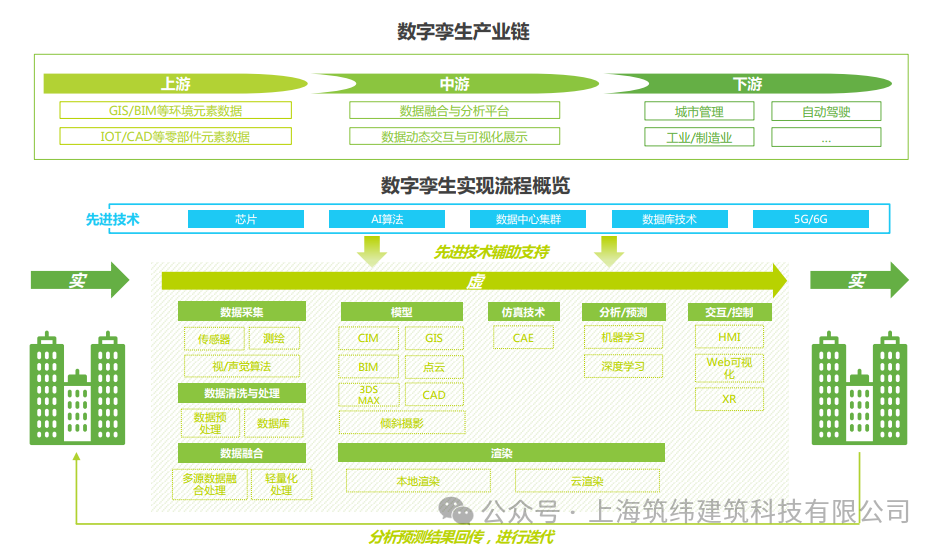
What are the typical application scenarios of digital twins?
01Urban Management
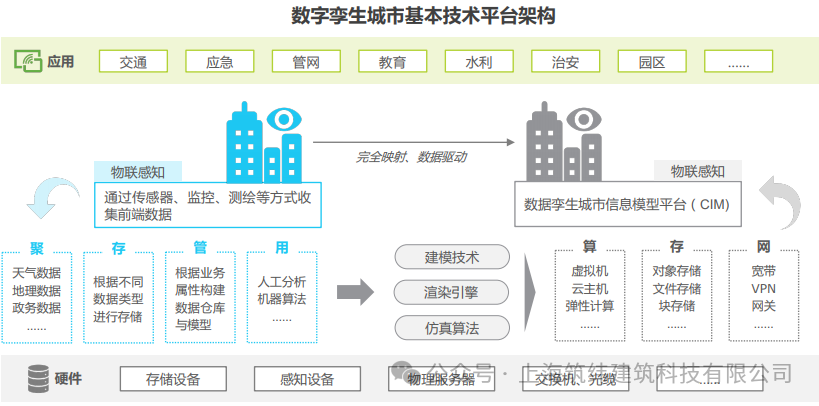
A digital twin city uses IoT, geographic information technology, and intelligent building city models to convert the physical city into a virtual digital city model. By simulating operations through the model, it achieves real-time monitoring and, in turn, enables prediction, analysis, optimization, and other functions.
The traditional smart city concept only makes individual urban functions smart in isolation. In contrast, a digital twin city integrates the virtual and the physical from the top-level design onward: on a foundation of digitalization and informatization, it overlays physical entities with their corresponding twins to enable virtual-physical interaction.
Digital twins have a wide range of application scenarios. At present, there are already fairly mature practical cases in fields such as transportation, industrial parks, and urban emergency response.
02 Urban Traffic
The digital transformation of the transportation industry has been underway for many years, and the operational efficiency of road traffic has improved significantly, but some problems remain to be solved.
With the rise of digital twin technology, building on the virtual space of the digital twin city and combining traffic information data with high-precision maps to construct a new smart transportation system—one that is real-time, simulable, predictable, and capable of controlling physical entities—will be the new direction for future transportation development.
In smart city transportation scenarios, digital twin technology can be applied to three sub-scenarios: holographic intersections, highways, and transportation hubs (subways, stations, airports, etc.).
Holographic intersections rely on sensing devices such as radars and cameras for monitoring, but they suffer from unstable monitoring of traffic events across all weather conditions and wide areas, as well as poor detection of pedestrians and equipment. They are mainly presented from a two-dimensional perspective, which cannot meet the simulation and decision-making needs of certain scenarios (such as emergency command and transportation planning).
03 Highways
Traditional smart highways rely mainly on surveillance cameras with limited point density, covering only key areas. They lack the means to grasp road conditions and incidents along complete stretches of road, leaving blind spots in supervision and making it difficult to form effective full-domain awareness. Data is collected but not used, offering little value for decision support.
04 Transportation Hubs
At present, the data systems in hub scenarios are complex, massive, and not interconnected. Data processing still follows single-dimension statistical methods, resulting in weak prediction and judgment capabilities. Scheduling relies almost entirely on staff experience, and during peak periods and holidays, passengers are often stranded due to forecasting errors and insufficient staffing.
05 Zero-Carbon Industrial Parks
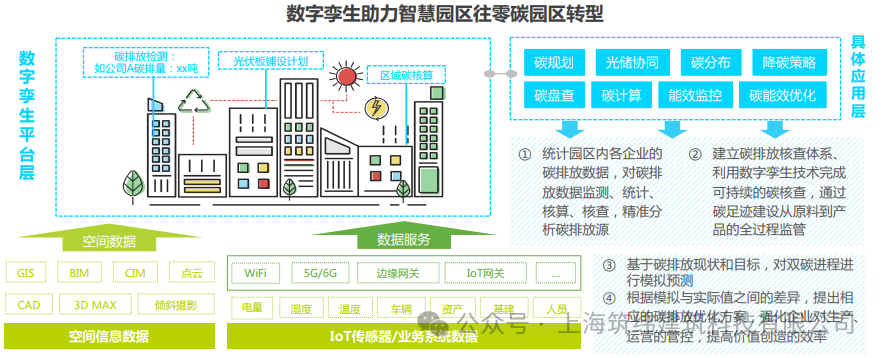
Digital twins fully empower zero-carbon smart industrial parks, helping to achieve the dual-carbon goals
Digital twins can empower smart industrial parks, assisting park managers with operations, security, business, and other management tasks, reducing costs and improving efficiency while optimizing employees' work and life experience.
With the advancement of China's “dual-carbon” strategy, zero-carbon industrial parks have emerged accordingly. According to data from the International Energy Agency, energy consumption in China's industrial parks accounts for about 69% of the whole society's total energy consumption, and carbon emissions account for about 31% of the nation's total emissions, and both continue to grow. The importance of building zero-carbon industrial parks is therefore self-evident, and they represent the next development direction for smart industrial parks.
Digital twins empower the construction of zero-carbon industrial parks: building on the digital twin park, sensing technologies collect carbon-emission-related data, and combined with AI algorithms they simulate and predict work such as carbon-emission planning, carbon accounting, and energy-efficiency monitoring. By building efficient, safe, and smart zero-carbon parks, this helps parks achieve their dual-carbon goals sooner.
06 Urban Emergency Response
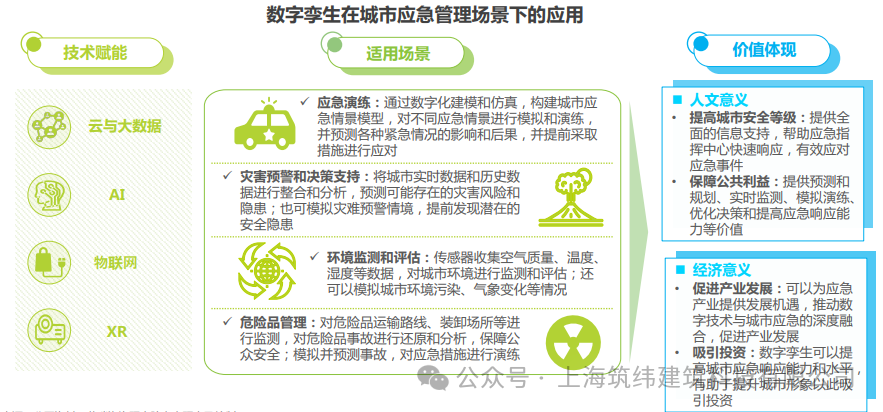
Digital twins empower intelligent emergency response, building a strong line of defense for urban safety
The application of digital twin technology in the field of urban emergency response has begun to demonstrate its advantages and potential. Through real-time monitoring and analysis of data and information, various emergencies can be responded to promptly. Digital twins can be applied to urban emergency scenarios such as emergency drills, disaster warning and decision support, environmental monitoring and assessment, and hazardous materials management.
This can improve urban management and rescue efficiency and reduce losses. As the technology continues to evolve and application scenarios continue to expand, digital twin technology will help urban managers build a smarter, more efficient urban emergency management system, carrying significant humanitarian and economic value.
07 Smart Industry
Digital twins originated in industry. As digital twin technology matures, industry will also become one of the scenarios where digital twins are most widely applied.
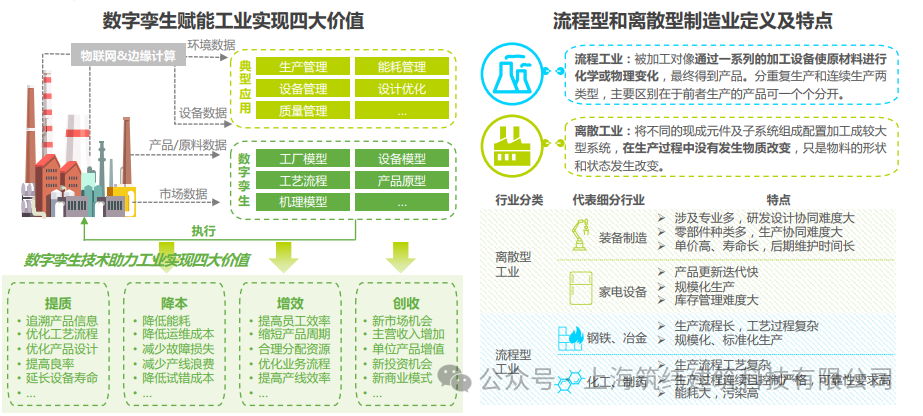
After industrial enterprises upload relevant data via IoT and edge computing, digital twin technology can be used to carry out production, energy consumption, equipment, design, and manufacturing management, thereby delivering four key values: improved quality, reduced cost, increased revenue, and greater efficiency.
Depending on the operations involved in the production process, industry can be divided into process-type and discrete-type industry. The following sections introduce the application of digital twins in each of these two types of industry.
08 Autonomous Driving
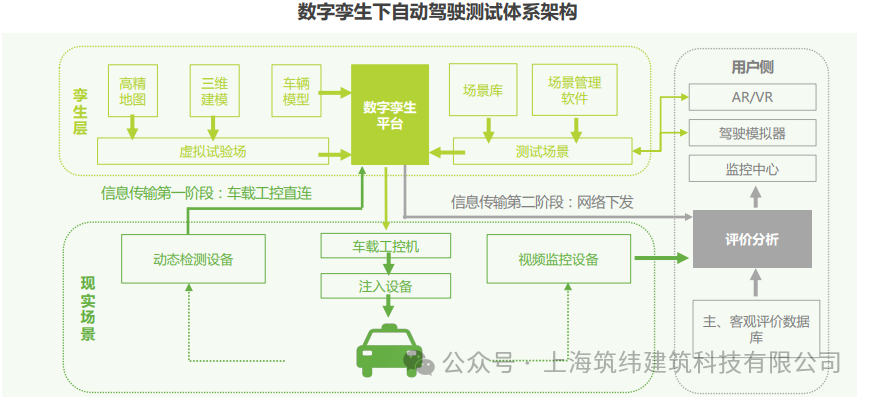
In the digital twin testing system, real test vehicles can transmit data collected in real time to the digital twin platform to drive the virtual vehicle model, completing the processing and analysis of real dynamic data and evaluating vehicle behavior based on evaluation dimensions and databases.
At the same time, the digital twin platform sends scenario data down to the controllers of real test vehicles, and the vehicles make decisions based on their own algorithms. By combining the virtual and the physical, the construction of virtual vehicle models and the setup of test scenarios are simplified, improving the efficiency of autonomous driving tests.
09Smart Healthcare
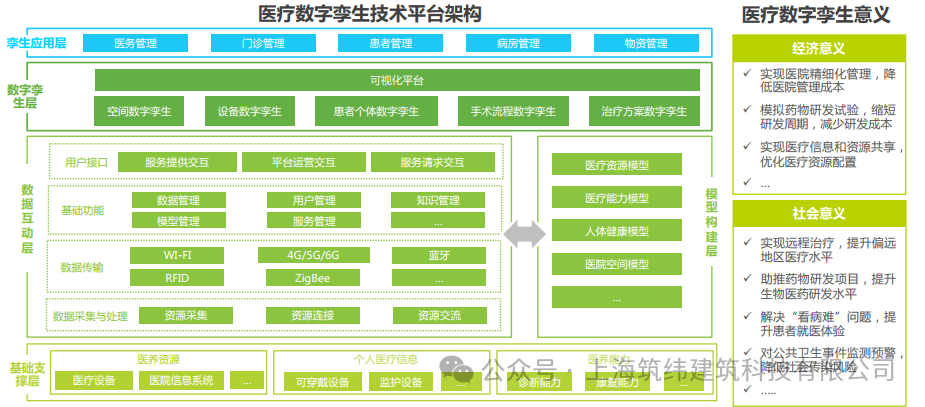
Medical digital twin technology collects and computes real, multi-dimensional, and diverse data from medical equipment and medical information systems in real time. Based on AI modeling and combined with technologies such as BIM and CIM, it converts the hospital's physical space into a hospital twin model, using prediction, analysis, and other functions to carry out refined management tasks such as medical administration, outpatient management, and equipment management.
In addition, based on DICOM data reconstruction technology, high-precision human body models are built to create twins of surgical procedures, treatment plans, and more.
The application of medical digital twins has positive economic and social significance. However, digital twin technology in the medical field is not yet mature and still faces challenges such as data security and privacy, and moral and ethical issues.
END
The views expressed are the author's own Copyright © Zhuwei Architectural Technology
Reproduction without authorization is prohibited
Please credit the source when reposting: Zhuwei Architectural Technology
Zhuwei Architectural Technology is a new-type technical services company specializing in integrated design optimization, BIM consulting and prefabricated construction design consulting. Our team brings together senior engineers from leading design institutes, former executives of real-estate companies, BIM engineers and prefabrication engineers, delivering integrated design optimization, refined drawing review, BIM consulting with MEP detailing, and prefabricated design services.
Design optimization consulting: Positioned as an extension and complement to the design management of real-estate developers, we focus on consulting and optimization for civil buildings. Across the whole process — or at key stages required by the client — we control the economy, rationality and safety of the design, eliminating unnecessary cost while measurably improving drawing quality, achieving "lower cost, higher efficiency".
BIM consulting: Through digital construction technology we help designers reduce errors and improve quality in the design phase, help contractors save cost and plan high-quality MEP installation in the construction phase, and extend BIM models into facility management for the operation phase — in collaboration with mainstream software vendors.
Prefabricated design consulting: Whole-process design on BIM platforms, using Revit and Tekla for PC detailing. Component geometry and reinforcement are linked parametrically — what you see is what you get. We deliver Industry 4.0-ready drawings with cut-length data for every rebar, and IoT-enabled support for production, storage, transport and installation of PC components.
Our expert team comes from leading design institutes, with deep technical grounding and extensive experience in dual-track design and optimization; its technical capability and control are industry-leading.
—— This article is auto-synced from the WeChat Official Account “Zhuwei Architectural Technology”. Read the original ——