Shenzhen Bao'an District's 2025 Plan for National Economic and Social Development Released
WeChat Sync · Xiaowei · 2025-07-02
The following article is sourced from Yanyu Architectural Technology
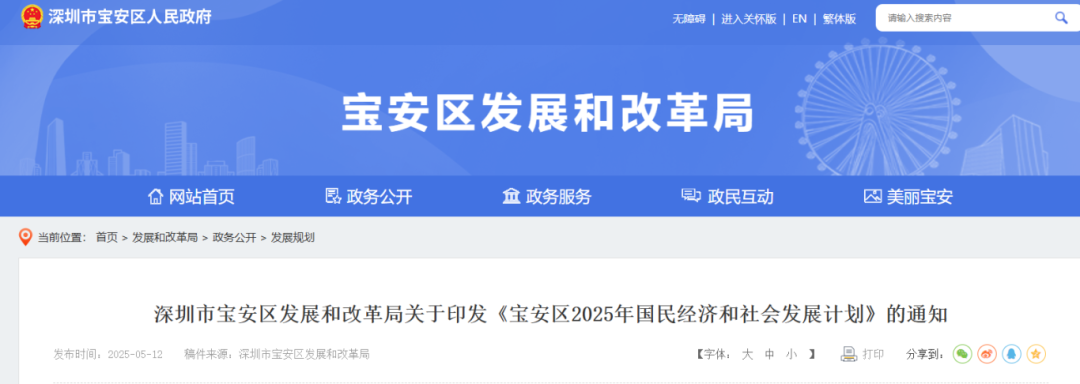
Notice of the Development and Reform Bureau of Bao'an District, Shenzhen on Issuing the Bao'an District 2025 National Economic and Social Development Plan
To all sub-district offices and departments:
The Bao'an District 2025 National Economic and Social Development Plan was reviewed and approved at the Fifth Session of the Seventh District People's Congress. It is hereby issued to you; please conscientiously organize its implementation.
Development and Reform Bureau of Bao'an District, Shenzhen
April 17, 2025
BIM-Related Content I. Implementation of the 2024 National Economic and Social Development Plan
(6) Urban planning and construction reach a new level
The quality and capacity of urban district planning continued to improve. The approval of the Bao'an District territorial and spatial sub-district plan was advanced, and the municipal planning for Bay Area Chip City as well as the municipal and transport special plans for Ocean New City were completed and submitted for approval. Work was carried out on the implementation plan for the Bay Chip plot in the eastern cluster of the Bao'an central district, the planning and design research for the contiguous consolidated land in the western cluster, and the international consultation on the urban design of the Tantou-Houting area of the western center. The new "integrated mining-land coordination" development model for the Tantou quarry was selected as a typical provincial case for territorial and spatial ecological protection and restoration. The functions of the integrated transport hub were strengthened. The Shenzhen-Zhongshan Link, a landmark project of the century, officially opened to traffic, bringing cities on the west bank of the Pearl River Estuary into a "half-hour economic and living circle". The "91530" action for high-quality road network development continued to advance: 168 roads totaling 46 km were newly built and 136 km of non-motorized vehicle lanes were added, 21,000 new parking spaces were created, and 529 ground-collapse hazard points were rectified. The reconstruction and expansion of the Jihe Expressway commenced smoothly, and key projects such as the Shenzhen-Dapeng intercity railway, the Airport East integrated transport hub, and Line 15 were accelerated. Digital Bao'an was developed at a faster pace.The district-level CIM platform was continuously deepened to create a visualization application scenario for urban spatial consultation, aggregating 53 planning deliverables, updating real-scene 3D models for more than 3,500 buildings, and achieving BIM modeling of nearly 10 million square meters of existing important buildings.The IoT+CIM flood-control command and dispatch system was launched, integrating meteorological, geographic, and transport data to deliver full-process "smart" emergency command covering AI-powered intelligent detection, intelligent dispatching, and on-site handling; it provided services more than 360 million times in total, and the related achievements were reported by CCTV. Green and Beautiful Bao'an was renewed at an accelerating pace. The Mountains-and-Sea Connected City Green and Beautiful Bao'an ecological initiative was implemented in depth, and planning research was launched on the landscape and greening design upgrade for the Shiyan Lake Wetland Park and the greenway around Shiyan Lake. The alternative route for the airport section of the coastal cycling path and the through-connection project for the Bao'an Boulevard fitness trail were advanced in an orderly manner. A total of 164 km of greenways, waterfront greenways, and fitness trails were added, achieving a district-wide "fitness trail within 15 minutes". "Five-park" connectivity was realized for Jiangan Mountain Park, Bao'an Park, and others; Xin'an Park reopened with a refreshed look; 10 parks including Fuhai River Park were newly built or renovated; and 15 co-built gardens were completed, exceeding the target.
III. Main tasks for economic and social development in 2025
(6) Focus on improving urban district management and exploring new models of urban governance
1. Build a model urban district led by planning.
(1) Accelerate the planning and construction of key areas such as the Airport East hub. Complete the drafting of the industrial development and spatial layout plan for the Shiyan-Baiwang Smart Manufacturing City.
(2) Launch the drafting of the regulatory detailed plan for the Jiuwei International Headquarters District, building the area into a "new super-headquarters" that leads the opening-up of the Guangdong-Hong Kong-Macao Greater Bay Area.
(3) Issue the Regulatory Detailed Plan for Ocean New City, complete the land acquisition and reserve for the first-phase plots of Ocean New City, and build the initial development zone to high standards.
2. Build a green, ecological, and livable urban district.
(1) Continue to advance the Mountains-and-Sea Connected City Green and Beautiful Bao'an ecological initiative, build the "one ring, seven corridors, six zones" slow-traffic system, complete Phase I of the central district's urban roaming trail (excluding the demonstration section), accelerate the construction of projects such as the Four Seasons Greenway, the Pingluanshan-Tiezaishan-Bihaiwan slow-traffic through-connection project, and hiking and country trails, complete 10 km of greenways and 60 km of fitness trails, and connect them into a 70 km slow-traffic network.
(2) Accelerate the "eight-park connectivity" initiative, complete and open Phase I of Youth Park, advance the preliminary work for projects such as the South District Park of the central district's coastal green axis and the Children's Park (Nanchang Park), build or renovate 5 parks, and achieve park service-radius coverage of over 80% within 500 meters.
(3) Complete the landscape and greening design upgrade plan for the Shiyan Lake Wetland Park and the greenway around Shiyan Lake, plan and build the Shiyan Lake racing cycling loop and a high-standard Greater Bay Area international cycling race track, and optimize and upgrade the Shiyan Lake "one ring, ten scenes" scientifically, in an orderly manner, and in phases.
(4) Improve the mechanisms for building a park city, step up the park-style transformation of small and micro spaces and spaces under bridges, and plant an additional 16,000 trees.
3. Build a resilient urban district with a solid foundation.
(1) Implement the three-year flood-control and waterlogging-treatment action in depth, accelerate the upgrading and renovation of aging drainage pipe networks and drainage pumping stations, accelerate the preliminary work for 8 key projects such as the Bao'an Central District Drainage Project (Phase I) and the Western Central District Waterlogging Treatment Project, and continue to rectify 105 historically at-risk waterlogging-prone points.
(2) Strive to start projects such as the pipe-network hazard and defect rectification works in five major areas and Phase I of the flash-flood interception and retention works before the end of the year.
(3) Accelerate the construction of the Pearl River Delta Water Resources Allocation Project, advance the quality drinking water to-door project for 80 residential communities (Phase IX), and add or renovate 60,000 households in residential communities.
(4) Accelerate the construction of power facilities such as the 220 kV China Resources Substation and the 220 kV Shiyan East Substation to ensure a safe and reliable power supply for the area.
4. Build a well-connected hub urban district.
(1) Vigorously advance the construction of the 311 projects under the "91530" action plan, and accelerate major construction projects such as the reconstruction and expansion of the Jihe Expressway and the Guangzhou-Shenzhen Expressway.
(2) Accelerate the construction of major projects such as the airport's third runway, Terminals T1 and T2, the Airport East integrated transport hub, the municipalization of National Highway 107, the Shenzhen-Jiangmen Railway, and Phase II of Fuzhou Avenue, and put the No. 1 International Transshipment Cargo Terminal in the airport's eastern area into service.
(3) Improve the rail transit network and station layout, and carry out research on the adjustment plan for near-term urban rail construction and the upgrade plan for the rail network layout in the northern area.
(4) Support Shenzhen Airlines, Donghai Airlines, and others in expanding the scale of their aircraft leasing businesses, accelerate the construction of the new China Southern Airlines base, and help build a national-level airport-type logistics hub.
5. Build an efficiently operating smart urban district.
(1) Consolidate the smart city data foundation, carry out the construction of refined BIM models, and complete refined building modeling of more than 2 million square meters.Carry out change detection on the district's spatial base map and advance the dynamic updating of 3D models for buildings, transport facilities, and the like.
(2) Build CIM+AI intelligent voice query capabilities to empower typical application scenarios such as urban spatial consultation and IoT+CIM video command and dispatch.
(3) Build more than 900 new 5G communication base stations and create the city's first "10-gigabit business district".
END
The views expressed are the author's own Copyright © Zhuwei Architectural Technology
Reproduction without authorization is prohibited
Please credit the source when reposting: Zhuwei Architectural Technology
Zhuwei Architectural Technology is a new-type technical services company specializing in integrated design optimization, BIM consulting and prefabricated construction design consulting. Our team brings together senior engineers from leading design institutes, former executives of real-estate companies, BIM engineers and prefabrication engineers, delivering integrated design optimization, refined drawing review, BIM consulting with MEP detailing, and prefabricated design services.
Design optimization consulting: Positioned as an extension and complement to the design management of real-estate developers, we focus on consulting and optimization for civil buildings. Across the whole process — or at key stages required by the client — we control the economy, rationality and safety of the design, eliminating unnecessary cost while measurably improving drawing quality, achieving "lower cost, higher efficiency".
BIM consulting: Through digital construction technology we help designers reduce errors and improve quality in the design phase, help contractors save cost and plan high-quality MEP installation in the construction phase, and extend BIM models into facility management for the operation phase — in collaboration with mainstream software vendors.
Prefabricated design consulting: Whole-process design on BIM platforms, using Revit and Tekla for PC detailing. Component geometry and reinforcement are linked parametrically — what you see is what you get. We deliver Industry 4.0-ready drawings with cut-length data for every rebar, and IoT-enabled support for production, storage, transport and installation of PC components.
Our expert team comes from leading design institutes, with deep technical grounding and extensive experience in dual-track design and optimization; its technical capability and control are industry-leading.
—— This article is auto-synced from the WeChat Official Account “Zhuwei Architectural Technology”. Read the original ——