Building Structures | Behind the 5.9% Growth: The Impact of Smart Construction Pilot City Policies on the Development of New Quality Productive Forces in the Construction Industry
WeChat Sync · Xiaowei · 2025-07-09
This article is reprinted from the WeChat official account "Building Structure" for learning and exchange purposes only. Copyright belongs to the original authors.
Research on the Impact of the Smart Construction Pilot City Policy on the Development of New Quality Productive Forces in the Construction Industry
By Liu Meixia, Zhang Shibin, Yu Dehu, Yu Xianhui, Liu Hong'e, Shao Di, Zheng Haichao, Lu Zhongde
Abstract
Abstract

Based on panel data of 24 smart construction pilot cities and 24 non-pilot cities in China from 2019—2023, this paper uses a difference-in-differences model to verify the promoting effect of the smart construction pilot city policy on improving the total factor productivity of the construction industry, and further analyzes its impact on the development of new quality productive forces in the construction industry. The results show that: compared with non-pilot cities, the total factor productivity of the construction industry in smart construction pilot cities increased by 5.9%, reflecting that the smart construction pilot city policy significantly promoted the improvement of the total factor productivity of the construction industry and drove the development of new quality productive forces in the construction industry; the policy mainly improves the total factor productivity of the construction industry by reducing energy consumption in the construction industry and increasing government support. Heterogeneity tests show that the smart construction pilot city policy exhibits significant heterogeneity across urban administrative levels, that is, the policy has a more pronounced promoting effect on cities with higher administrative levels.
0 Introduction
General Secretary Xi Jinping called for accelerating the formation of new quality productive forces, pointing out that new quality productive forces take a substantial increase in total factor productivity as their core marker, are characterized by innovation, hinge on quality, and are in essence advanced productive forces. Total factor productivity (TFP) refers to the residual of total output that cannot be explained by the growth of factor inputs such as capital and labor, and is an important indicator of high-quality economic development [1]. Currently, many scholars study the formation and development of new quality productive forces in various industries from the perspective of total factor productivity. Zhang Haipeng et al. [2] argued that new agricultural technologies, new models, and new business forms are important means of improving agricultural total factor productivity and forming new quality productive forces in agriculture; Ling Chen et al. [3] held that the improvement of total factor productivity in manufacturing relies on enterprise digital transformation, which promotes the formation of new quality productive forces in manufacturing. In July 2020, the Ministry of Housing and Urban-Rural Development (MOHURD) and 13 other departments jointly issued the Guiding Opinions on Promoting the Coordinated Development of Smart Construction and Building Industrialization, explicitly proposing the development of smart construction. Academician Ding Lieyun [4] pointed out that smart construction is an innovative engineering construction model formed by the integration of new information technologies and engineering construction; through standardized modeling, networked interaction, visual cognition, high-performance computing, and intelligent decision support, it achieves integrated, highly efficient collaboration across project initiation and planning, planning and design, construction and production, and O&M services driven by a digital chain. Smart construction is a typical representative of new quality productive forces in the construction industry, and is crucial for improving the total factor productivity of the construction industry and driving its digital and intelligent development [5].
As one of the important means by which China promotes the development of smart construction, the smart construction pilot city policy warrants an evaluation of its implementation effect. In October 2022, in order to vigorously develop smart construction, MOHURD announced a list of 24 smart construction pilot cities and launched the smart construction pilot city policy. The pilot program started on the date of announcement and lasts for 3 years. Each pilot city is required to strictly implement its pilot work plan and adhere to the working principle of "overall planning and adapting to local conditions". Four mandatory tasks were arranged—improving the policy system, fostering the smart construction industry, building pilot demonstration projects, and innovating management mechanisms—while four optional tasks were also provided for localities to choose independently in light of actual conditions, namely building smart factories for components and parts, promoting technology R&D and the transformation of achievements, improving the standards system, and cultivating professional talent. Pilot cities may also propose new task directions in line with the pilot goals. Since the policy was implemented, as of December 2023, MOHURD had approved 7 smart construction pilot projects of 6 enterprises with a total investment exceeding 9 billion yuan, and summarized and disseminated 130 replicable practices; the 24 smart construction pilot cities carried out work around the main tasks such as improving the policy system and fostering the smart construction industry, issued a series of supporting policies on land, planning, fiscal affairs, and science and technology, supported relevant institutions in building 39 smart construction science and technology innovation platforms, included 506 backbone smart construction enterprises, announced 758 smart construction pilot demonstration projects, and promulgated and implemented 47 smart construction-related standards, quotas, and guidelines, thus driving the development of smart construction. Scholars have already studied the relationship between smart construction and new quality productive forces in the construction industry. Niu Weirui et al. [6] pointed out that smart construction plays an important role at every stage of the evolution of new quality productive forces and is a powerful lever and technical support for building new quality productive forces in the construction industry; Yu Jing and Zhang Chunwei et al. [7-8] proposed that research on and application of smart construction technologies is an important support for promoting the transformation and upgrading of the traditional construction industry, and that smart construction science and technology innovation empowers new quality productive forces in the construction industry.
At present, there are relatively few studies on smart construction and new quality productive forces, and most of them are qualitative analyses with few quantitative studies. Based on panel data of 24 smart construction pilot cities and 24 non-pilot cities in China from 2019—2023, this paper uses a difference-in-differences model to verify the promoting effect of the smart construction pilot city policy on improving the total factor productivity of the construction industry, examines the influence of urban administrative level on the implementation effect of the smart construction pilot city policy, analyzes the roles of the policy in reducing energy consumption and increasing government support, and puts forward targeted countermeasures and suggestions for each.
1 Research Hypotheses
Total factor productivity refers to the portion of economic growth that cannot be explained after deducting the contributions of factor productivity such as capital input and labor; it shows the contribution to economic growth of factors other than input factors such as physical capital and labor [9], and its significant improvement is the core marker of new quality productive forces. This paper sets the total factor productivity of the construction industry as the dependent variable [10]. Based on the above analysis, Hypothesis 1 is proposed: the smart construction pilot city policy can improve the total factor productivity of the construction industry, thereby promoting the formation and development of new quality productive forces in the construction industry.
At the same time, drawing on the studies of Wang Guangming, An Min, et al. [11-12], this paper examines the impact of the smart construction pilot city policy on the total factor productivity of the construction industry from two aspects: reducing energy consumption in the construction industry and increasing government support. On the one hand, energy consumption in the construction industry is a key indicator measuring the ratio of the gross output value of the construction industry to its total energy consumption [13]. Smart construction pilot cities can significantly reduce energy consumption through green technology R&D and the transformation of scientific and technological achievements, thereby improving the total factor productivity of the construction industry and promoting the development of new quality productive forces in the construction industry. This paper measures the energy consumption of the construction industry by energy consumption per unit of building floor area, calculated by converting the energy consumed by buildings into the total amount of standard coal and then dividing it by the building floor area, in units of 10,000 t/m2 [12]. On the other hand, smart construction pilot cities can improve the total factor productivity of the construction industry through supporting policies such as fiscal subsidies and tax incentives [14], thereby promoting the development of new quality productive forces in the construction industry. This paper measures the government support of each city for promoting the development of smart construction by the word frequency of "smart construction" in municipal government work reports from 2019—2023 [15]. Based on the above analysis, Hypothesis 2 is proposed: the smart construction pilot city policy improves the total factor productivity of the construction industry by reducing energy consumption in the construction industry and increasing government support, promoting the formation and development of new quality productive forces in the construction industry.
2 Model Construction
A difference-in-differences model is constructed to verify the impact of the smart construction pilot city policy on the total factor productivity of the construction industry. Here, the dependent variable is the "total factor productivity of the construction industry", the core explanatory variable is the "smart construction pilot city policy", and the control variables include "population density", "urbanization level", etc.
2.1 Study Sample
This paper sets a treatment group and a control group to study the differences in changes of the total factor productivity of the construction industry between the two groups of cities from 2019—2023. The 24 smart construction pilot cities form the treatment group, of which 16 cities including Beijing and Tianjin belong to the eastern economic belt, 4 cities including Changsha and Wuhan belong to the central economic belt, and 4 cities including Chongqing and Urumqi belong to the western economic belt. Considering the similarity between the control group and the treatment group in terms of regional distribution, city size, economic development level, and construction industry development level, as well as the comparability and availability of data, the control group consists of 16 eastern economic belt cities including Jinan and Shijiazhuang, 4 central economic belt cities including Yueyang and Jingzhou, and 4 western economic belt cities including Zigong and Turpan. The panel data of the above 48 cities from 2019—2023 are used as the research objects, including the total assets of the construction industry, the number of employees and enterprises in the construction industry, the gross output value and completed floor area of the construction industry, population density, and the gross regional product of each city. The data come from the National Statistical Yearbook, municipal statistical yearbooks, and communiqués on national economic and social development, etc.
(1) Dependent variable. New quality productive forces take a substantial increase in total factor productivity as their core marker; therefore, the improvement of the total factor productivity of the construction industry is an important manifestation of the formation and development of new quality productive forces. Referring to existing research, this paper uses the DEA-Malmquist (DEA) index to measure the total factor productivity of the construction industry [16-17], taking the total assets, number of employees, and number of enterprises of construction enterprises in each city as input indicators, and the completed floor area and gross output value of the construction industry as output indicators. The data come from "the number of enterprises, year-end employees, gross output value of the construction industry, and completed floor area in the basic information of construction enterprises" and "total assets in the main financial indicators of construction enterprises" in the municipal statistical yearbooks.
(2) Core explanatory variable. This paper takes the "smart construction pilot city policy" as the policy shock variable. If a city was designated as a smart construction pilot city in 2022, the impact coefficient variable for the total factor productivity of the construction industry Treat is assigned a value of 1 for that year and thereafter, and 0 otherwise.
(3) Control variables. The selection of control variables aims to eliminate or reduce the influence of other potential factors on the dependent variable, so as to more accurately estimate the impact of the smart construction pilot city policy on the total factor productivity of the construction industry. Referring to existing research [18-20], this paper selects the following control variables: the population density, urbanization level, construction scale, per capita gross domestic product (GDP), and industrial output value of each city. The data come from the National Statistical Yearbook, municipal statistical yearbooks, and communiqués on national economic and social development, etc.
Population density is the number of people per unit of land area; its growth directly drives the growth of urban demand for housing, commerce, and infrastructure. This indicator is assessed by the ratio of the permanent resident population to the administrative area of each city, in units of persons/km2, with data taken from "permanent resident population density" under population and employment in the municipal statistical yearbooks. An increase in the urbanization level means the agglomeration of population and economic activities in towns and cities, and the volume of urban construction works will increase accordingly. This indicator is assessed by the ratio of the urban population to the total population, calculated from "urban population" and "total population" in the municipal statistical yearbooks. Construction scale involves the quantities of building materials, equipment, and labor required for the development of the construction industry. This indicator is assessed by the ratio of the gross output value of the construction industry to regional GDP, calculated from the ratio of "gross output value of the construction industry in the basic information of construction enterprises" to "gross regional product in national economic accounting" in the municipal statistical yearbooks. Per capita GDP represents residents' living standards and consumption capacity, as well as the degree of demand for improving the living environment and urban infrastructure construction, in units of yuan, with data taken from "per capita gross regional product in national economic accounting" in the municipal statistical yearbooks. Growth in industrial output value will drive the development of related industries such as building materials and equipment, and has a close industrial-chain relationship with the construction industry [21]. This indicator is assessed by the ratio of the gross industrial output value of each city to regional GDP, calculated from the ratio of "gross industrial output value of enterprises above designated size" to "gross regional product in national economic accounting" in the municipal statistical yearbooks.
2.2 Model Specification
The difference-in-differences model is a statistical analysis method based on natural experiments. The quasi-natural experiment in this paper refers to "the issuance of the smart construction pilot city policy". Before and after the experiment, the sample is divided into two groups: at the time point of the quasi-natural experiment t those affected by the policy form the treatment group, and those not affected form the control group. The impact of the policy is evaluated by comparing the changes in the treatment group and the control group before and after the quasi-natural experiment [22]. Drawing on the studies of Wei Dongming and Masayuki et al. [15,23], this paper uses a difference-in-differences model to analyze the impact of the smart construction pilot city policy on the total factor productivity of the construction industry. The specific specification is as follows:

where: β 0 is the constant term; β 1 is the coefficient of the effect of the smart construction pilot city policy; Yit is the total factor productivity of the construction industry of city i in year t; Treatit is the policy dummy variable for "smart construction pilot city"; Xit represents the control variables; λi and ηt are the individual and year fixed effects, respectively (eliminating differences among cities and across years); εit is the random error term (randomly distributed influencing factors not covered by the explanatory variables of the model).
To verify the theoretical mechanism, drawing on the studies of Che Maoran and Mao Qilin et al. [24-25], an impact mechanism model is constructed for testing. The specific specification is as follows:

where: IMit is the mechanism variable; in this paper the mechanism variables are government support intensity and energy consumption of the construction industry; γ 1 is the estimated coefficient of the interaction term between the smart construction pilot policy shock and the mechanism variable ( Treat × IM).
γ 1 is tested in the following steps: First, based on Equation (1), the promoting effect of the smart construction pilot city policy on the improvement of the total factor productivity of the construction industry is verified. Second, Equation (2) is regressed; for the interaction term between the smart construction pilot policy shock and the mechanism variable ( Treat × IM) , if the estimated coefficient γ 1 is significant, it indicates that the mechanism variable is an influence channel through which the smart construction pilot city policy promotes the improvement of the total factor productivity of the construction industry, and the sign of γ 1 shows whether the total factor productivity of the construction industry is promoted by raising or by lowering the mechanism variable.
3 Empirical Analysis
The empirical analysis applies the constructed difference-in-differences model to the panel data of the 24 smart construction pilot cities and 24 non-pilot cities, so as to verify the hypotheses in Section 1, including the baseline regression, robustness tests, heterogeneity tests, and impact mechanism tests. The baseline regression is to verify that the smart construction pilot city policy can promote the improvement of the total factor productivity of the construction industry; the robustness tests are to verify the reliability of the model in this paper; the heterogeneity tests are to verify that the smart construction pilot city policy exhibits significant heterogeneity across urban administrative levels; and the impact mechanism tests are to verify that the smart construction pilot city policy can improve the total factor productivity of the construction industry by increasing government support and reducing energy consumption in the construction industry.
3.1 Baseline Regression
The baseline regression results are shown in Table 1. According to the regression results of Model (1), when no control variables are introduced, the impact coefficient of the smart construction pilot city policy on Treat is 0.061 and passes the 10% significance test, indicating that compared with non-pilot cities, the total factor productivity of the construction industry in smart construction pilot cities increased by 6.1%, reflecting the development of new quality productive forces in the construction industry of the pilot cities; according to the regression results of Model (2), after the control variables are introduced, the impact coefficient of the smart construction pilot city policy on Treat is 0.059 and passes the 10% significance test, indicating that after eliminating the influence of control variables such as population density, urbanization level, and construction scale, the total factor productivity of the construction industry in smart construction pilot cities still increased by 5.9% compared with non-pilot cities, once again demonstrating that the smart construction pilot city policy can significantly improve the total factor productivity of the construction industry and thereby promote the development of new quality productive forces in the construction industry. Therefore, Hypothesis 1 holds.
Table 1 Baseline Regression
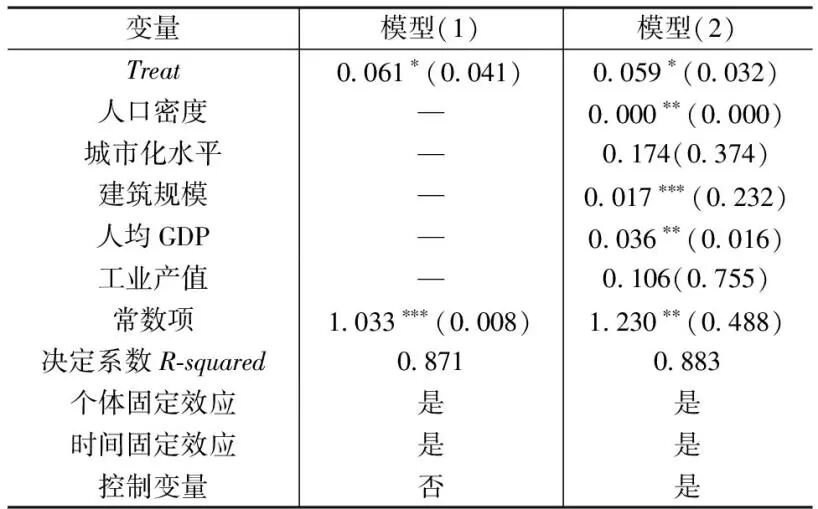
Note: \*\*\*, \*\*, and \* indicate significance at the 1%, 5%, and 10% levels, respectively; standard deviations are shown in parentheses; the same applies below.
3.2 Robustness Tests
To verify the validity of the model, this paper uses Stata17 to analyze the panel data of the 24 smart construction pilot cities and 24 non-pilot cities, including a parallel trend test, a placebo test, and an alternative dependent variable test for the model, so as to reduce existing errors and verify the reliability of the model.
3.2.1 Parallel Trend Test
The treatment group and the control group must share a common development trend in the total factor productivity of the construction industry to ensure that the two are comparable. That is, assuming that the smart construction pilot city policy had not been implemented, the total factor productivity of the construction industry in pilot cities and non-pilot cities should have shown a common trend of change; therefore, a parallel trend test is conducted. Drawing on the study of Shi Shaobin et al. [26], this paper introduces the interaction terms between the year dummy variables for each year before the policy implementation and the group dummy variable for testing, using the regression coefficients of the interaction terms to indicate the degree of difference between the two groups, with the difference increasing as the regression coefficients increase. The test results are shown in Figure 1, in which the rectangular points represent the regression coefficients at each time point. The regression coefficients at all time points before the policy shock year of 2022 are insignificant and fall within the 95% confidence interval, indicating that there was no significant difference in the total factor productivity of the construction industry between pilot cities and non-pilot cities before the pilot policy was implemented, which satisfies the parallel trend assumption.
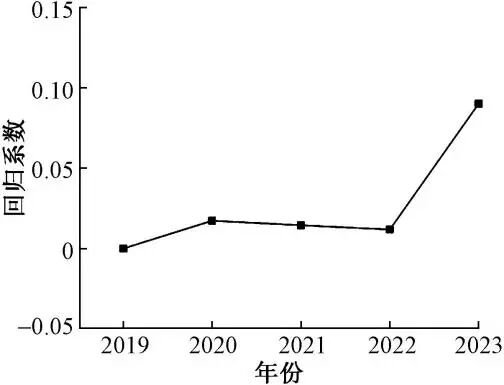
Figure 1 Parallel Trend Test
3.2.2 Placebo Test
The omission of other hard-to-observe factors may lead to bias in the estimation results; therefore, a placebo test is conducted. If the test is passed, it indicates that the regression results of the smart construction pilot city policy on the total factor productivity of the construction industry are not affected by other hard-to-observe factors. Drawing on the study of Zhao Peng et al. [27], this paper repeated the regression simulation of Equation (1) 500 times. The test results are shown in Figure 2: the regression estimated P values basically follow a normal distribution and most are greater than 0.1, passing the placebo test, which shows that the baseline regression of this paper is stable.
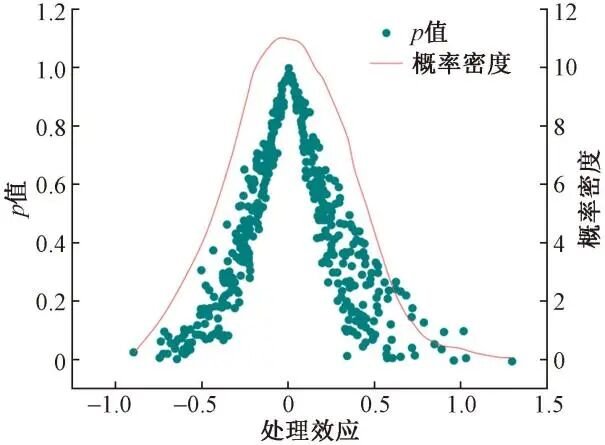
Figure 2 Placebo Test
3.2.3 Alternative Dependent Variable Test
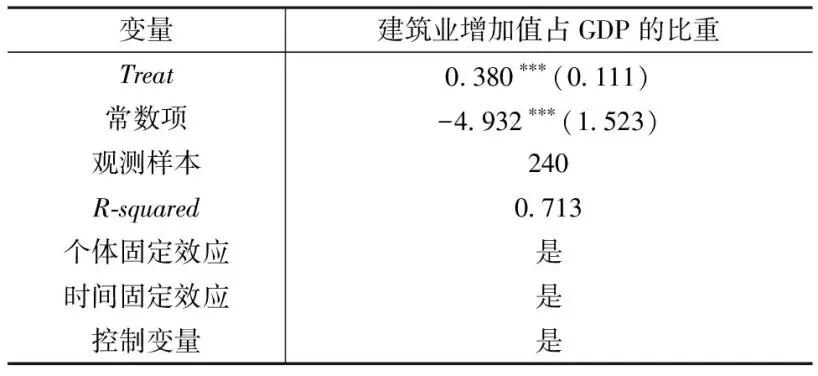
Replacing the dependent variable tests whether the model overly relies on a specific dependent variable and further verifies the validity of the empirical results. The share of construction industry value added in GDP is also an important indicator for measuring the development of the construction industry; therefore, drawing on the studies of Li Zhan and Chen Zhihui et al. [28-29], this paper takes it as the alternative dependent variable for the total factor productivity of the construction industry, with data calculated as the ratio of "the value added of the construction industry in the basic information of construction enterprises" to "gross regional product in national economic accounting" in the municipal statistical yearbooks. The regression results are shown in Table 2: the estimated coefficient of the smart construction pilot city policy is 0.380 and passes the 1% significance test, indicating that the positive effect of the smart construction pilot city policy on improving the total factor productivity of the construction industry still exists, which further verifies the stability of the results in Section 1 of this paper.
Table 2 Alternative Dependent Variable Test
3.3 Heterogeneity Tests
There are obvious differences in administrative authority among cities of different levels in China, and the policies and measures adopted by different pilot cities also vary. Therefore, to gain a deeper understanding of the impact of the smart construction pilot city policy on the total factor productivity of the construction industry in different cities, drawing on the study of Chen Xinxin [30], this paper divides the sample into two categories based on urban administrative level: one is municipalities directly under the central government and provincial capitals, and the other is general cities, and analyzes the differences in the effect of the smart construction pilot city policy among different cities. The test results are shown in Table 3.
Table 3 Heterogeneity Tests
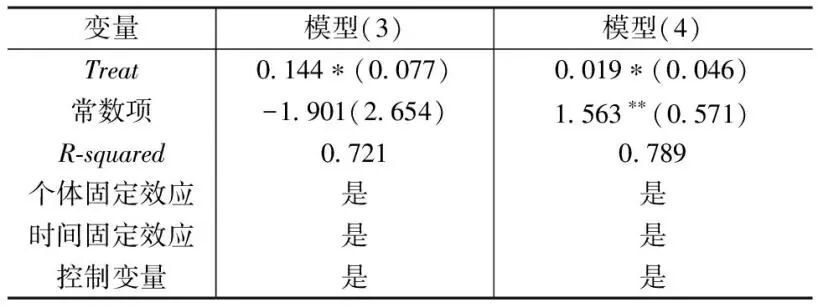
The results of Model (3) show that after the implementation of the pilot city policy, compared with municipalities directly under the central government and provincial capitals in non-pilot cities, the total factor productivity of the construction industry in municipalities directly under the central government and provincial capitals among the pilot cities increased by 14.4%. The results of Model (4) show that after the implementation of the pilot city policy, compared with general cities in non-pilot cities, the total factor productivity of the construction industry in general cities among the pilot cities increased by 1.9%. This reflects that, compared with general cities, the improvement of the total factor productivity of the construction industry is more significant in municipalities directly under the central government and provincial capitals. The reason may be that these cities enjoy advantages such as a larger city size, a higher level of industrial agglomeration, and a greater concentration of talent, and thus obtain relatively more dividends from the smart construction pilot city policy.
3.4 Impact Mechanism Tests
The impact mechanism tests answer the question of which key variables the smart construction pilot city policy affects in order to improve the total factor productivity of the construction industry. The test results are shown in Table 4. On the one hand, for the mechanism analysis of government support intensity, according to the test results of Model (5), the estimated coefficient of the smart construction pilot city policy and government support intensity ( Treat × IM) is 3.422 and passes the 1% significance test, indicating that government support intensity is an influence channel through which the smart construction pilot city policy improves the total factor productivity of the construction industry, and the positive interaction coefficient shows that the smart construction pilot city policy improves the total factor productivity of the construction industry by increasing government support. On the other hand, for the mechanism analysis of energy consumption in the construction industry, according to the test results of Model (6), the estimated coefficient of the smart construction pilot city policy and energy consumption in the construction industry ( Treat × IM) is -0.068 and passes the 5% significance test, indicating that energy consumption is an influence channel through which the smart construction pilot city policy improves the total factor productivity of the construction industry, and the negative estimated coefficient shows that the smart construction pilot city policy improves the total factor productivity of the construction industry by reducing energy consumption.
Table 4 Impact Mechanism Tests
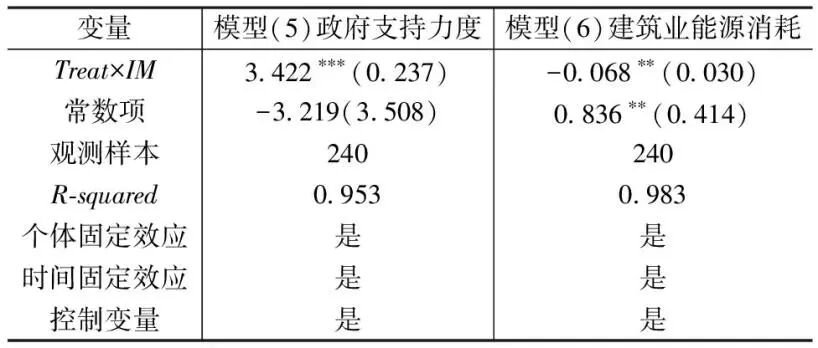
In summary, both mechanisms—increasing government support and reducing energy consumption in the construction industry—are verified, and Hypothesis 2 holds.
4 Conclusions
Based on the panel data of 24 smart construction pilot cities and 24 non-pilot cities in China from 2019—2023, this paper uses a difference-in-differences model to verify the promoting effect of the smart construction pilot city policy on improving the total factor productivity of the construction industry, and further analyzes its impact on the development of new quality productive forces in the construction industry. The main conclusions are as follows:
(1) The smart construction pilot city policy promoted the significant improvement of the total factor productivity of the construction industry and drove the formation and development of new quality productive forces in the construction industry. Around improving the policy system, fostering the smart construction industry, building pilot demonstration projects, and innovating management mechanisms, the 24 smart construction pilot cities formulated their respective Implementation Plans for Smart Construction Pilot Cities in light of their own development conditions, promoting the improvement of the total factor productivity of the construction industry and driving the development of smart construction. According to statistics, as of December 2023, the pilot cities had actively fostered the industry, and 506 enterprises had been included in the cultivation list of backbone smart construction enterprises.
(2) The smart construction pilot city policy improves the total factor productivity of the construction industry by reducing energy consumption in the construction industry and increasing government support. In terms of energy consumption, enterprises can optimize design and construction processes through technology R&D and the transformation of achievements—for example, introducing smart construction equipment such as construction robots, integrating technologies such as multi-information sensing, fault diagnosis, and high-precision positioning and navigation, and providing networked interaction and intelligent decision support for engineering projects—thus effectively improving construction efficiency and quality, reducing energy consumption, and saving resources. In terms of government support, as of June 2023, all pilot cities had formulated implementation plans in light of their own conditions and successively issued a series of supporting policies. For example, Hefei provides financial rewards to construction enterprises that invest in smart construction-related software R&D, equipment procurement, and information technology services; Guangzhou has legislated that BIM can be used in the declaration and approval of construction projects, and has issued local standards and specifications around industrialized and digital construction processes.
(3) The smart construction pilot city policy exhibits significant heterogeneity across urban administrative levels, that is, the policy has a more significant effect on improving the total factor productivity of the construction industry in cities with higher administrative levels. Cities with higher administrative levels usually have a better foundation for smart construction development, including a stronger industrial base, better construction levels and capabilities, and sufficient project owners and construction projects, and can therefore better give play to the role of the smart construction pilot city policy. For example, leveraging the agglomeration advantages of large enterprises and research institutes, Wuhan has developed and applied a batch of iconic smart construction technology products such as building machines, bridge erection machines, and tower construction machines, and has deployed a full-process approval and management system for engineering projects based on BIM, striving to explore new models of engineering construction.
5 Countermeasures and Suggestions
(1) Implement promotion strategies adapted to local conditions. Summarize the replicable experience of the smart construction pilot cities and gradually promote the policy in more qualified cities. Meanwhile, considering the influence of urban administrative levels, the promotion of the smart construction pilot city policy should adapt to local conditions, and suitable promotion strategies should be formulated in light of factors such as urban administrative level, economic development level, and technological and industrial foundations. For cities with higher administrative levels, the government can continue to issue incentive policies in areas such as land, planning, public finance, financial services, and scientific and technological innovation, giving play to the demonstration and leading role of these cities to promote the efficient development of smart construction; for cities with lower administrative levels, the government should consolidate the foundation for smart construction development, support their continuous development in economic construction and other aspects, formulate clear development plans, goals, and tasks for smart construction, and establish a sustainable smart construction development model, thereby promoting the development of smart construction.
(2) Optimize the energy structure of the construction industry. Smart construction pilot cities have effectively improved the total factor productivity of the construction industry by reducing energy consumption in the construction industry. Therefore, it is suggested that the government vigorously issue relevant supporting policies, encourage construction enterprises to adopt clean energy and green energy-saving materials, and step up the promotion of advanced energy-saving technologies and equipment. Meanwhile, deepen the application of renewable energy in the construction field, improve the electrification level of buildings, support the development of building photovoltaics, promote the reduction of fossil-energy heating in buildings, and build green low-carbon buildings.
(3) Increase government support. Drawing on the innovative practices of different pilot cities, formulate effective supporting measures. First, formulate overall plans: cities should learn from the implementation plans and measures of the pilot cities and formulate key tasks and implementation paths suitable for their own smart construction development. Second, issue local standards and specifications, and accelerate the improvement of the regulatory and institutional system of the construction industry adapted to smart construction. Third, give full play to the role of cross-departmental coordination mechanisms, guide policy resources in scientific research, finance, and talent toward the field of smart construction, strengthen policy synergy, and jointly promote the development of smart construction.
(4) Accelerate the formation of new production relations adapted to new quality productive forces. Deepen the reform of the economic system and the science and technology system, strive to remove the blockages and bottlenecks constraining the development of smart construction, establish a high-standard market system, innovate the allocation of production factors for smart construction, and through pilot demonstrations, accelerate the smooth flow of various advanced, high-quality production factors toward the development of new quality productive forces. Meanwhile, facilitate the virtuous cycle of education, science and technology, and talent, and improve the working mechanisms for talent cultivation, recruitment, use, and rational mobility.
References

END
The views expressed are the author's own Copyright © Zhuwei Architectural Technology
Reproduction without authorization is prohibited
Please credit the source when reposting: Zhuwei Architectural Technology
Zhuwei Architectural Technology is a new-type technical services company specializing in integrated design optimization, BIM consulting and prefabricated construction design consulting. Our team brings together senior engineers from leading design institutes, former executives of real-estate companies, BIM engineers and prefabrication engineers, delivering integrated design optimization, refined drawing review, BIM consulting with MEP detailing, and prefabricated design services.
Design optimization consulting: Positioned as an extension and complement to the design management of real-estate developers, we focus on consulting and optimization for civil buildings. Across the whole process — or at key stages required by the client — we control the economy, rationality and safety of the design, eliminating unnecessary cost while measurably improving drawing quality, achieving "lower cost, higher efficiency".
BIM consulting: Through digital construction technology we help designers reduce errors and improve quality in the design phase, help contractors save cost and plan high-quality MEP installation in the construction phase, and extend BIM models into facility management for the operation phase — in collaboration with mainstream software vendors.
Prefabricated design consulting: Whole-process design on BIM platforms, using Revit and Tekla for PC detailing. Component geometry and reinforcement are linked parametrically — what you see is what you get. We deliver Industry 4.0-ready drawings with cut-length data for every rebar, and IoT-enabled support for production, storage, transport and installation of PC components.
Our expert team comes from leading design institutes, with deep technical grounding and extensive experience in dual-track design and optimization; its technical capability and control are industry-leading.
—— This article is auto-synced from the WeChat Official Account “Zhuwei Architectural Technology”. Read the original ——