'Digital Dictionary' Released: Unifying BIM Data Standards to Drive Intelligent Design Delivery
WeChat Sync · Xiaowei · 2026-01-28
Standardization · Structuring · Intelligence—Reconstructing a New Paradigm for BIM Delivery
Introduction
In the design, delivery, and review processes of Building Information Modeling (BIM), the standardization of component naming, attribute parameters, and classification has always been a core challenge affecting the efficiency and quality of data flow. Under the traditional model, naming rules vary across disciplines, teams, and even regions, parameter systems are not unified, and standard versions are numerous and complex, leading to chaotic model data, delayed delivery schedules, and difficulties in passing reviews; cross-project and cross-regional collaboration is even harder to advance.
For this reason, we are launching “Digital Dictionary” — a BIM data governance platform driven by standardization, supported by data, and empowered by intelligence, committed to building a unified data standards management system that runs through the entire process of design, delivery, and review. It is not just a tool, but an important piece of infrastructure driving the construction industry’s digitalization toward standardization, structuring, and automation.
01
Three Pillars Reconstruct BIM Data Standards
Digitalization of Standards: Making Codes Executable and Iterable
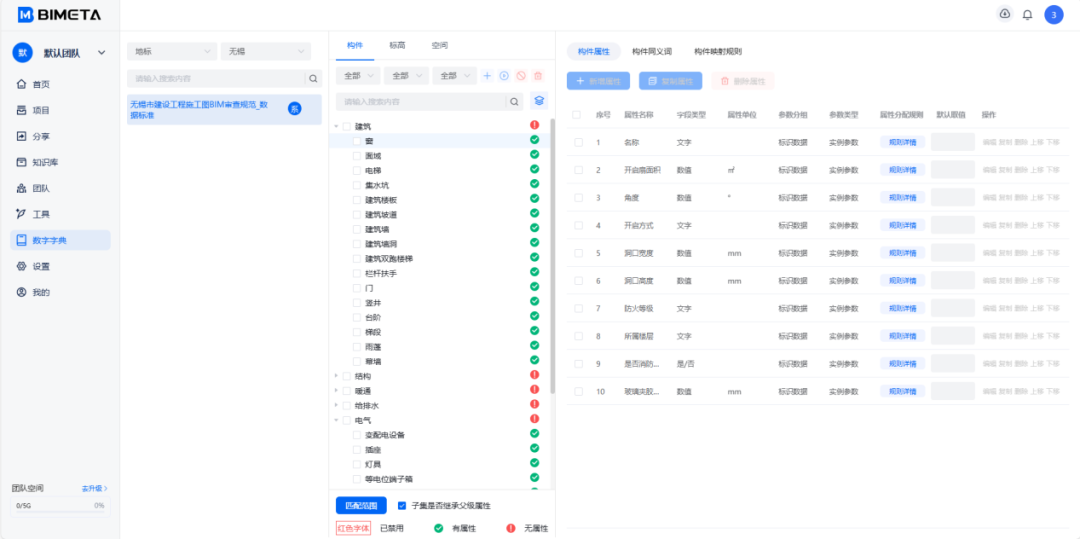
The “Digital Dictionary” builds a structured rule engine that transforms discrete review codes, enterprise standards, and project agreements into automatically executable digital rules. The platform has already integrated more than 20 delivery-type standards, including Shenzhen’s key existing modeling and delivery technical guidelines, the Shenzhen Building Engineering Information Model Modeling Manual, the Shenzhen Quantity Takeoff Standard, the Chengdu BIM Construction Drawing Review Modeling Manual (Building/Municipal), the Data Delivery Standards of the Xiong’an New Area Planning and Construction BIM Management Platform, the Shijiazhuang Declaration and Delivery Standards, and the Wuxi Review Code, and it supports flexible extension to national standards and local codes.
The system can automatically match applicable rules based on the project’s location and review stage, synchronizing in real time via the web and plugin interfaces to ensure that standards are seamlessly implemented in the design workflow, ultimately achieving the goal of “design equals compliance” through “standards as code, compliance as automation.”
Data Structuring: From “Naming Chaos” to “Semantic Unity”
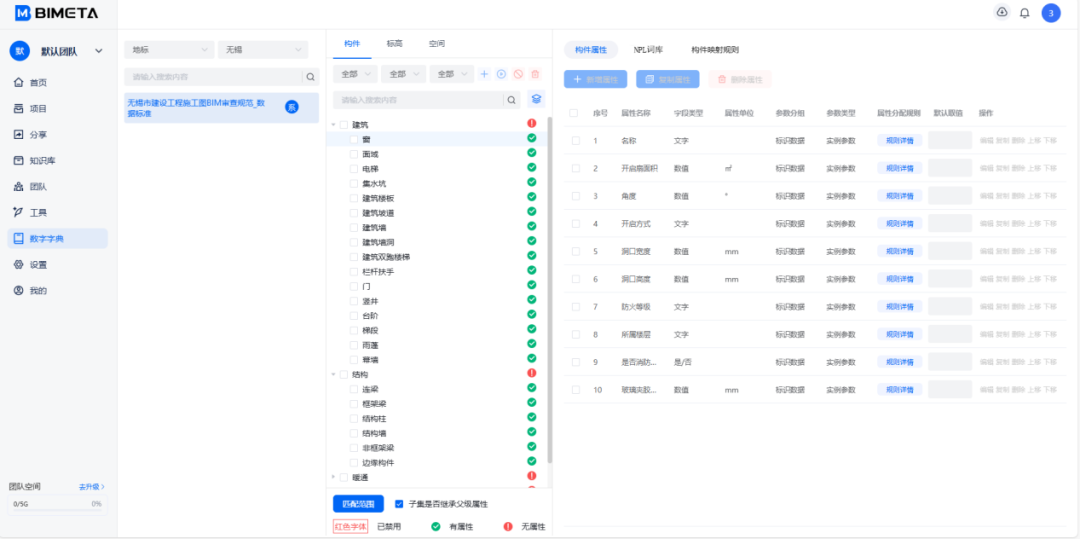
The “Digital Dictionary” establishes a unified semantic framework based on an attribute ontology model and a component identification system, bringing messy component names and parameter information into a clear and consistent data structure. This not only makes family, type, and instance data from different BIM software interoperable, but also, through the three-tier rule mechanism of “individual → team → system,” ensures the consistency and inheritability of enterprise-level data models while maintaining flexibility. The structured standard data can flow seamlessly through the design, review, and delivery stages, achieving “define once, reuse throughout.”
AI-Driven: Intelligent Matching and Adaptive Learning
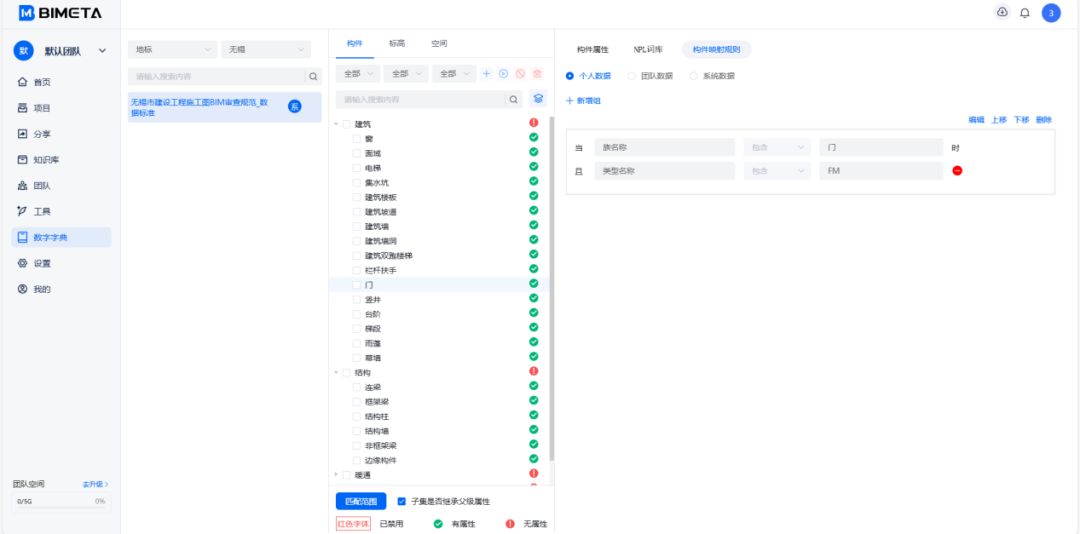
The “Digital Dictionary” introduces an intelligent mapping engine that not only supports precise keyword-based matching, but also enables automatic attribute assignment and component identification in complex scenarios through a rule engine and conditional logic (such as equals, contains, and excludes). The system supports rule priority management (individual > team > system) and can gradually accumulate into an enterprise knowledge base, driving continuous optimization and adaptive iteration of standards.
02
Five Functional Scenarios with Immediate Results upon Implementation
01
One-Click Code Adaptation:
Select the project location, and the system automatically loads the corresponding review standard, supporting multi-version management;
02
Intelligent Component Classification
Based on preset rules, it automatically completes component identification matching, supporting batch processing and real-time synchronization;
03
Automatic Attribute Assignment
Based on structured templates, it enables batch parameter filling and logical validation, eliminating manual omissions;
04
Cross-Platform Data Synchronization
Configure on the web and execute via the plugin, with rules distributed in real time to ensure data consistency and process continuity;
05
Enterprise Knowledge Accumulation
Individual rules can be submitted as team standards, gradually building a dedicated enterprise BIM data asset library.
03
Target Users
Architectural design, construction, and consulting firms that need to establish or improve a BIM implementation standards system;
Cross-regional project teams running multiple standards in parallel that seek unified codes and rapid adaptation;
BIM managers and data administrators committed to improving model data quality and delivery efficiency;
Drivers of enterprise digital transformation seeking a standardized, structured, and intelligent data governance path.
04
Driven by Standards, Empowered by Data, Building a Smart Future
We believe that standardization is the cornerstone of digital buildings, structuring is the prerequisite for data flow, and intelligence is the future of efficiency improvement.
Choosing the “Digital Dictionary” means choosing a more standardized, coherent, and intelligent way of working with BIM. Let us work together to move the construction industry from the “manual era” to the “digital era,” and from “project delivery” to “data delivery.”

END
The views expressed are the author's own Copyright © Zhuwei Architectural Technology
Reproduction without authorization is prohibited
Please credit the source when reposting: Zhuwei Architectural Technology
Zhuwei Architectural Technology is a new-type technical services company specializing in integrated design optimization, BIM consulting and prefabricated construction design consulting. Our team brings together senior engineers from leading design institutes, former executives of real-estate companies, BIM engineers and prefabrication engineers, delivering integrated design optimization, refined drawing review, BIM consulting with MEP detailing, and prefabricated design services.
Design optimization consulting: Positioned as an extension and complement to the design management of real-estate developers, we focus on consulting and optimization for civil buildings. Across the whole process — or at key stages required by the client — we control the economy, rationality and safety of the design, eliminating unnecessary cost while measurably improving drawing quality, achieving "lower cost, higher efficiency".
BIM consulting: Through digital construction technology we help designers reduce errors and improve quality in the design phase, help contractors save cost and plan high-quality MEP installation in the construction phase, and extend BIM models into facility management for the operation phase — in collaboration with mainstream software vendors.
Prefabricated design consulting: Whole-process design on BIM platforms, using Revit and Tekla for PC detailing. Component geometry and reinforcement are linked parametrically — what you see is what you get. We deliver Industry 4.0-ready drawings with cut-length data for every rebar, and IoT-enabled support for production, storage, transport and installation of PC components.
Our expert team comes from leading design institutes, with deep technical grounding and extensive experience in dual-track design and optimization; its technical capability and control are industry-leading.
—— This article is auto-synced from the WeChat Official Account “Zhuwei Architectural Technology”. Read the original ——