Intelligent Design Should Adopt Building Information Modeling (BIM) and Other Technologies; Beijing Releases 57 Local Standards to Advance Beijing-Tianjin-Hebei Coordinated Development
WeChat Sync · Xiaowei · 2025-05-14
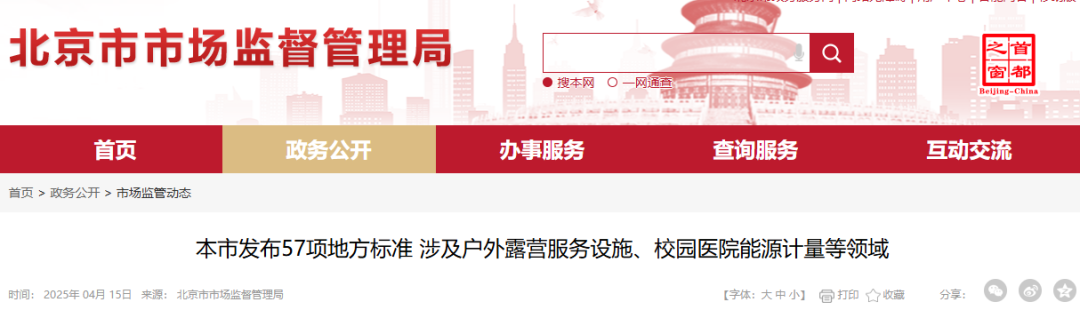
To implement the Capital Standardization Development Outline 2035, advance the key tasks in the 2025 Municipal Government Work Report, and build a high-quality development standards system for the capital, the city recently issued 57 local standards, of which 20 were formulated for the first time and 37 were revised. The key standards in this batch are as follows:
First, promoting the coordinated development of Beijing, Tianjin, and Hebei
Two Beijing-Tianjin-Hebei regional coordinated local standards were issued, including: the newly formulated Technical Specification for Smart Construction of Building Engineering, the first smart-construction standard for building engineering officially released in China, which regulates smart construction technologies covering the intelligent survey, design, production, construction, and O&M of building engineering. For example:In the design stage, it stipulates that smart design should preferably adopt technologies such as artificial intelligence and parametric generation, Building Information Modeling (BIM), simulation, and intelligent drawing review, and that simulation should preferably achieve a digital twin by combining BIM with cloud computing, the Internet of Things, and simulation algorithms.
In the production stage, it stipulates that smart production should adopt intelligent technologies and equipment such as smart production management platforms, intelligent detailed design technologies, smart production lines, digital quality-inspection technologies, smart loading equipment, and smart transportation equipment, and that the smart production management platform should be capable of automatically parsing models, generating data, and transmitting it to the various production modules. The issuance and implementation of this standard will help advance the application and development of smart construction technologies in the Beijing-Tianjin-Hebei region and support the development of smart-construction pilot cities and the digital transformation and upgrading of the construction industry.
The revised Standard for Acceptance of Green Building Engineering further improves the basis for the acceptance of green building engineering, clarifies the relationship between green building acceptance and the quality acceptance of sub-divisional and sub-item works, and updates the green building acceptance record forms and summary tables, with a focus on verifying the implementation of the five major performance indicators: safety and durability, health and comfort, living convenience, resource conservation, and environmental livability. After the standard is issued and implemented, it will help further safeguard the green performance of buildings across Beijing, Tianjin, and Hebei and improve the quality of green building engineering.
Second, helping to expand service consumption
The newly formulated Specifications for Facilities and Services of Tent Campgrounds regulates in detail the technical content of tent campgrounds, covering site selection and layout, infrastructure, service facilities, and service requirements. For example: regarding site selection and layout, it stipulates that sites should be located in open areas with a slope of less than 15 degrees, avoid pollution sources such as toxic and hazardous substances and radioactive materials, and stay clear of hazardous areas such as wind farms, high-voltage power lines, and storage sites for flammable and explosive materials, and that featured functional zones such as dining areas, leisure and sports areas, and children's play areas should preferably be provided.
Regarding infrastructure, it stipulates that traffic facilities convenient for visitors to enter and leave the campground should be provided, wireless mobile internet access should preferably be available, tent campgrounds should be marked on the electronic maps commonly used by tourists, and business hours should be clearly indicated. Regarding service requirements, it stipulates that reception services should be staffed around the clock to respond to visitors' service requests and handle various emergencies.
After the standard is issued and implemented, it will help further regulate the construction and operation of tent campgrounds in the city, improve service quality, and promote the development of camping tourism and leisure as a new business format.
Third, promoting green and low-carbon development
The newly formulated series of Specifications for the Equipping and Management of Energy Metering Instruments, covering 2 parts for universities and hospitals, specifies the types and scope of energy metering for universities and hospitals in Beijing, the principles for equipping energy metering instruments, the equipping requirements for energy metering instruments, energy metering management requirements, and energy metering data requirements. In particular, beyond the requirements for metering instruments for basic energies such as electricity, water, natural gas, and heat, the standards extend the requirements to energy metering instruments for energy-consuming working media.
The implementation of these standards will help improve the refined energy-metering management of universities and hospitals, enabling them to accurately monitor all types of energy consumption by equipping and managing energy metering instruments properly and providing reliable data support for energy management.
The newly formulated Technical Guide for Food Loss Reduction in the Catering Industry provides catering practitioners with comprehensive operational recommendations covering pre-meal preparation, the dining process, and post-meal handling. These include: starting from menu design and optimization, guiding catering service providers to develop small-portion dishes, design set-menu combinations for different party sizes, and establish dish quality standards and processing standards, while encouraging enterprises to prepare one dish in multiple ways, use one ingredient across multiple dishes, refine the preparation of humble dishes, and perfect the preparation of premium ones; during the dining process, catering service providers should guide consumers to order reasonably and consume rationally through pairing recommendations and reminders about ordering quantities; and measures such as “clean-plate” discounts and “clean-plate” points should reward consumers who waste no food. The Guide also places corresponding requirements on food-delivery platforms: online food-ordering services should establish anti-waste guidance systems, remind consumers to order according to need and in appropriate amounts, and avoid bundled marketing and inducements to over-order.
The issuance of the Guide will provide strong guidance for the catering industry, helping enterprises better fulfill their social responsibilities, driving the reduction of food waste at the source, and enhancing service quality and the sustainable development of the industry.
Fourth, improving the intrinsic safety of the city
The newly formulated series of Work Safety Credit Evaluation standards regulates all aspects of work-safety credit evaluation, including the general principles, evaluation content and methods, grade classification, evaluation process, report preparation, evaluation information sources, and management. For example: it clearly stipulates that the work-safety credit evaluation process comprises 7 steps — evaluation preparation, preliminary evaluation, grade determination, issuance of the evaluation report, grade notification, objection handling, and evaluation termination; and that work-safety credit grades and their notation follow the national standard GB/T 22116 Notation Method for Enterprise Credit Grades, dividing work-safety credit into four grades, A, B, C, and D, from highest to lowest score, with a note that the work-safety credit grades may be appropriately adjusted or expanded according to actual needs.
After the standards are issued and implemented, they will help strengthen the development of the work-safety credit system, advance work-safety credit evaluation toward informatization, standardized processes, and intelligence, enable real-time sharing, dynamic monitoring, and real-time early warning of the credit information of production and business entities, and improve credit information services and credit management.
The revised Safety Management Requirements for Hazardous Chemicals in Medical Institutions further improves the specific management requirements for hazardous chemicals in medical institutions and highlights the safety management of high-risk locations such as liquid oxygen storage tanks. Specifically: the basic requirements stipulate the organizations, personnel, and systems for hazardous-chemical management in medical institutions, together with general management requirements; and, centered on full-process, full-life-cycle safety management of hazardous chemicals in medical institutions, the standard sets out in detail the safety requirements to be followed at each stage of hazardous-chemical storage, use, and disposal, as well as for liquid oxygen tanks. This will further enhance the intrinsic safety of medical institutions.
The implementation of this standard can effectively guide and drive hazard-elimination work in medical institutions, reduce the rate of hazardous-chemical accidents and mitigate potential accident consequences, and shift the hazardous-chemical safety management model in medical institutions from reactive, after-the-fact response to proactive prevention, contributing to the building of a Safe Beijing.
END
The views expressed are the author's own Copyright © Zhuwei Architectural Technology
Reproduction without authorization is prohibited
Please credit the source when reposting: Zhuwei Architectural Technology
Zhuwei Architectural Technology is a new-type technical services company specializing in integrated design optimization, BIM consulting and prefabricated construction design consulting. Our team brings together senior engineers from leading design institutes, former executives of real-estate companies, BIM engineers and prefabrication engineers, delivering integrated design optimization, refined drawing review, BIM consulting with MEP detailing, and prefabricated design services.
Design optimization consulting: Positioned as an extension and complement to the design management of real-estate developers, we focus on consulting and optimization for civil buildings. Across the whole process — or at key stages required by the client — we control the economy, rationality and safety of the design, eliminating unnecessary cost while measurably improving drawing quality, achieving "lower cost, higher efficiency".
BIM consulting: Through digital construction technology we help designers reduce errors and improve quality in the design phase, help contractors save cost and plan high-quality MEP installation in the construction phase, and extend BIM models into facility management for the operation phase — in collaboration with mainstream software vendors.
Prefabricated design consulting: Whole-process design on BIM platforms, using Revit and Tekla for PC detailing. Component geometry and reinforcement are linked parametrically — what you see is what you get. We deliver Industry 4.0-ready drawings with cut-length data for every rebar, and IoT-enabled support for production, storage, transport and installation of PC components.
Our expert team comes from leading design institutes, with deep technical grounding and extensive experience in dual-track design and optimization; its technical capability and control are industry-leading.
—— This article is auto-synced from the WeChat Official Account “Zhuwei Architectural Technology”. Read the original ——