Shanghai Housing and Construction Commission: BIM Listed as a Key Task for the Next Three Years!
WeChat Sync · Xiaowei · 2024-10-08
The following article is sourced from the official website of the Shanghai Municipal Commission of Housing and Urban-Rural Development, author: Jiatu BIM
Official Notice
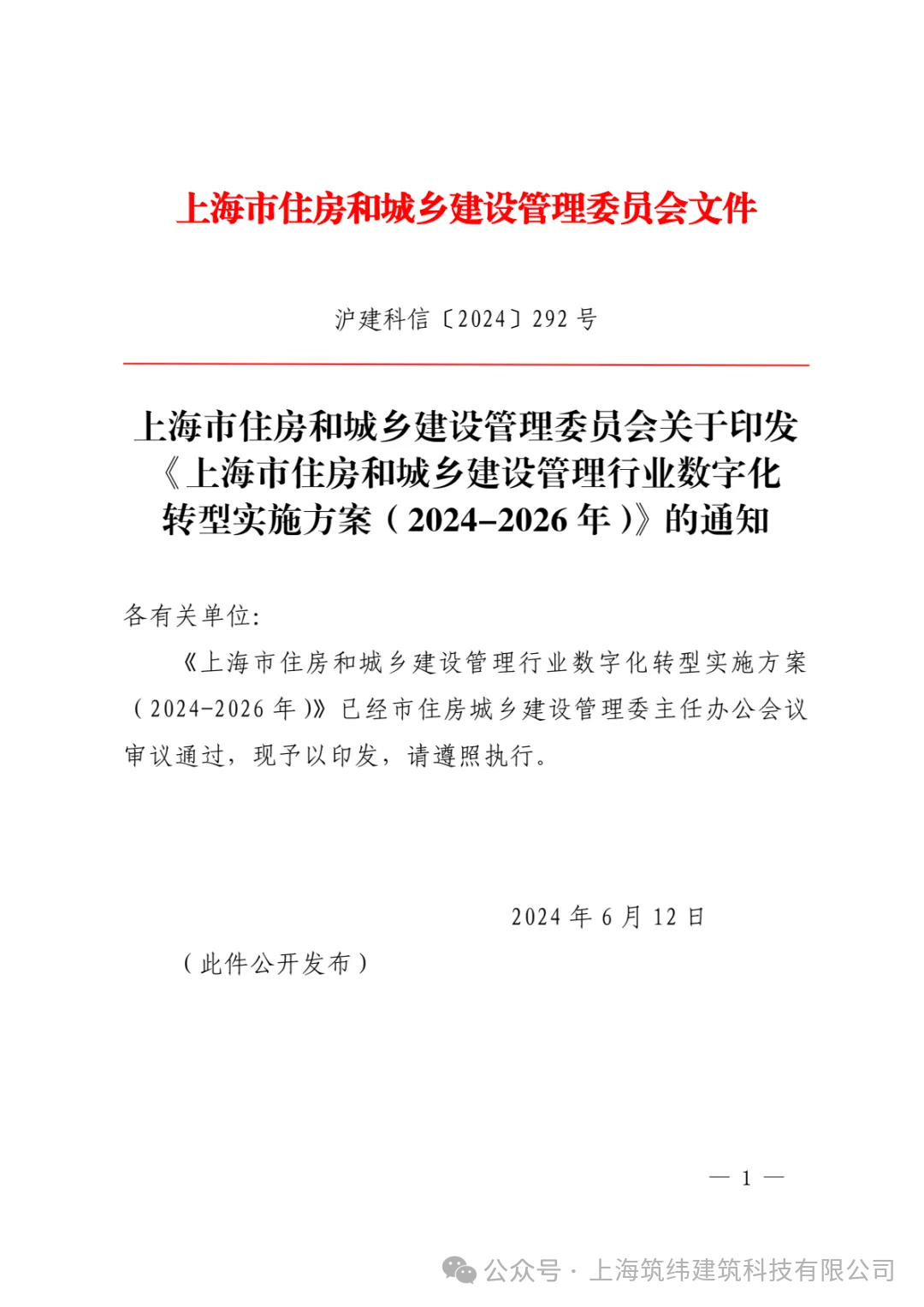
Notice of the Shanghai Municipal Commission of Housing and Urban-Rural Development on Issuing the Implementation Plan for Digital Transformation of the Shanghai Housing and Urban-Rural Development Sector (2024-2026)
Reference No.: 3589258689/2024-00073
Document No.: Hu Jian Ke Xin [2024] No. 292
Issuing Authority: Shanghai Municipal Commission of Housing and Urban-Rural Development
To all relevant units:
The Implementation Plan for Digital Transformation of the Shanghai Housing and Urban-Rural Development Sector (2024-2026) has been reviewed and approved at the executive meeting of the directors of the Municipal Commission of Housing and Urban-Rural Development Management, and is hereby issued. Please implement it accordingly.
June 12, 2024
Implementation Plan
Implementation Plan for Digital Transformation of the Shanghai Housing and Urban-Rural Development Sector (2024-2026)
In order to thoroughly implement the guiding principles of the 20th National Congress of the Communist Party of China, fully practice the people’s city concept, and implement the Overall Layout Plan for Building a Digital China issued by the CPC Central Committee and the State Council, the Overall Layout Plan for Building “Digital Housing and Construction” issued by the Ministry of Housing and Urban-Rural Development, and the Opinions on Comprehensively Advancing Digital Transformation issued by the CPC Municipal Committee and the Municipal Government; to continuously advance the digital transformation of the city’s housing and urban-rural development management sector; to serve Shanghai’s building of the “Five Centers” and the integrated development strategy of the Yangtze River Delta; and, following the strategic path of consolidating the foundation, empowering the overall picture, strengthening capabilities and optimizing the environment, to comprehensively improve the holistic, systematic and coordinated nature of digital development in the housing and construction sector, drive the transformation of urban construction and governance through digitalization, promote high-quality development of the industry, cultivate new quality productive forces, achieve joint building, governance and sharing by government, society and enterprises, and inject strong vitality into urban development on the path of Chinese modernization, this Implementation Plan is formulated.
I. Overall Considerations
By 2026, Shanghai will basically form the overall “4321” framework of “Digital Housing and Construction” and preliminarily achieve an “IoT + Data + Intelligence” development pattern in the housing and construction sector that is horizontally connected, vertically integrated and powerfully coordinated. The “4” means accelerating the deep integration of digital technologies with the housing and construction sector and deeply advancing development and progress in the four major fields of digital engineering, digital housing, digital city, and digital towns and villages; the “3” means strengthening a digital layout guided by three orientations — services that benefit enterprises and the public, efficient coordinated development, and digital-intelligent innovation; the “2” means building a trustworthy and controllable information security assurance system together with an advanced and applicable standards and specifications assurance system; and the “1” means building an integrated CIM platform that drives the whole-domain digital transformation of the housing and construction sector through technology integration, data fusion and business collaboration.
II. Key Tasks
To achieve the development goals of “Digital Housing and Construction”, 36 specific tasks in four aspects will be completed with priority by 2026:
(1) Deeply advancing the improvement actions in the four major fields of digital engineering, digital housing, digital city, and digital towns and villages
— Taking industrial transformation and upgrading as the focus, carrying out the improvement action in the field of digital engineering
1. Comprehensively advancing the in-depth application of BIM. Further improve policies and systems, pilot BIM model-assisted review of construction drawing design documents in building construction projects, and explore acceptance based on BIM as-built models. Further promote integrated innovation and accelerate the in-depth application of BIM technology in prefabricated buildings and green energy-efficient buildings, and promote the whole-process application of BIM technology in construction and O&M. Further deepen regional BIM technology application and explore establishing regional-level and project-level BIM technology application evaluation systems. Continuously advance the promotion and application of independently controllable BIM software.
2. Vigorously cultivating smart construction industrial bases. Driven by industrialization, digitalization and green upgrading, build an integrated smart construction industrial system covering the whole industrial chain, and develop industrial bases for digital design, intelligent production and intelligent construction. Accelerate the development of a digital design system and promote integrated design. Targeting the typical “hazardous, complex, dirty and heavy” scenarios in building construction, vigorously promote the application of construction robots and smart construction equipment.
3. Advancing whole-life-cycle digital management of construction projects. Gradually establish a citywide unified data sharing and application mechanism and data resource repository for construction projects, and promote whole-life-cycle digital management covering the design, construction, acceptance and operation of construction projects. Advance the linkage between the construction market and the construction site, and build a full-volume, full-element, cross-regional and cross-level digital supervision system covering enterprises, projects, personnel and equipment.
4. Building smart construction site scenario laboratories. Establish a development model for smart site scenario laboratories featuring municipal-district coordination and government-enterprise collaboration, achieve citywide coverage and data access for multiple scenarios, form site profiles, and promote differentiated supervision inspections and tiered management. Strengthen supporting policy guidance and excellence incentives, accelerate the promotion and coverage of smart scenario applications, and drive the transformation and upgrading of site safety governance.
5. Advancing the synergistic application of low-carbon and digital technologies in buildings. Around the goals of peaking carbon emissions and achieving carbon neutrality in the urban and rural construction sector, build and improve a building carbon emission supervision system, develop carbon emission calculation models, strengthen scientific monitoring of building energy consumption and intelligent management of equipment operation, and create a batch of smart buildings and low-carbon smart buildings. Explore building an identification and resolution system for the building internet.
6. Improving the informatization platform for the management of major municipal engineering construction. Continuously optimize the municipal major project management system to carry out whole-process target management and all-round tracking evaluation of projects. Build a merit competition management system to achieve whole-process digital management of selection information. Set up a practical-projects management system and further improve management scenarios. Build a “3+1” whole-life-cycle management system and create an integrated digital display dashboard.
— Taking livability and housing security as the foothold, carrying out the improvement action in the field of digital housing
7. Drawing a citywide “one map” of housing security. Achieve map-based recording of subsidized housing sources of all types, and form all-round in-depth analysis and service guides on project distribution and on rental and sale allocation. Carry out in-depth data analysis of the situations of families applying for the various types of housing security, profile applicants, and expand data analysis and application of results on the information platform. Build the dedicated business scenario of “Homes for Urban Builders and Managers in the New Era”.
8. Improving housing management service application scenarios. Continuously advance the optimization and improvement of application scenarios such as comprehensive governance of residential communities, elevator retrofitting, monitoring of commercial and office buildings, and operational safety of residential elevators; enrich the health profiles of residential community operating indicators; build safety risk assessment and early warning models for existing housing; and form tiered, visualized risk levels. Continuously advance the pilot work of building “digital homes”.
9. Achieving whole-process digital supervision of the real estate market. Advance the extension of the real estate market regulation platform to both the supply and demand sides, achieving whole-process and full-chain supervision from land transfer, projects under construction and launch sales to subsequent transactions. Promote the integrated “one-thing” service for home purchase and sale.
10. Strengthening the digital protection of outstanding historic buildings. Build a digital twin dynamic database of outstanding historic buildings and, in combination with the upgrading of the historic preservation system, use 3D model results to empower protection and management work. Strengthen the management of dismantling works on historic buildings, develop dynamic management programs, and integrate archives of key elements.
— Taking urban resilience and safety as the breakthrough point, carrying out the improvement action for the digital city
11. Promoting digital empowerment of urban physical examination and renewal actions. Based on the CIM platform, aggregate and share thematic data of all kinds to achieve automatic calculation and intelligent analysis of physical examination indicator data at the four levels of “city—district—sub-district/town—community”, achieve whole-process management of urban renewal projects from reserve to implementation to evaluation, achieve whole-process digital control of sponge city planning, construction and assessment, advance the digitalization of inspection and appraisal before changes to building structures or changes to the designed use of buildings, and strengthen the effective linkage among the urban physical examination, urban renewal and sponge city information systems.
12. Accelerating the construction of urban lifeline safety projects. Focusing on public municipal infrastructure such as pipelines of all kinds and utility tunnels, and giving priority to the retrofitting of aging gas pipe networks, the prevention of third-party external damage accidents to gas facilities, and early warning of road collapse, further strengthen pipeline disclosure, advance the digital management of the retrofitting of in-building gas risers and secondary water supply systems, develop intelligent models for safety risk assessment and early warning of lifeline projects, monitor the operating status of urban lifelines accurately in real time, comprehensively improve capabilities in information integration, comprehensive analysis and coordinated governance, and efficiently prevent and respond to major and especially serious safety accidents.
13. Deeply advancing “one-network unified management” in the housing and construction sector. Around the four categories of grid-based management items — public safety, administrative law enforcement, social management and specialized management — further upgrade and improve the grid-based management information system and explore building a broad urban construction hotline platform. Accelerate the development of an urban operation management service system for the housing and construction sector, and strengthen real-time monitoring, dynamic analysis, overall coordination, command supervision and comprehensive evaluation of urban operation management service conditions. Accelerate the construction of an emergency information platform that is horizontally interconnected and vertically integrated under the framework of comprehensive security and comprehensive emergency response. Research classified analysis and prediction models for urban infrastructure maintenance needs, and upgrade and improve the Shanghai Urban Infrastructure Construction and Maintenance Project Management Information System.
14. Building an efficient urban management law enforcement assurance system. Continue to consolidate the functions of the command center of the Municipal Bureau of Urban Management and Law Enforcement, continuously advance the construction of model district-level command centers, strengthen the application of squadron duty command platforms, and constantly improve the three-tier duty command and dispatch system at the municipal, district and sub-district/town levels. Strengthen system connectivity with relevant management departments and deepen cross-departmental, cross-regional and cross-level online linkage between management and enforcement. Taking “two networks + law enforcement” as the breakthrough point, build diverse and efficient application scenarios such as efficient supervision of construction waste, comprehensive supervision of residential communities, coordinated supervision of the urban appearance and environment, and digital governance of unlicensed buildings. Focusing on joint support for major events, joint supervision of key sectors, joint disciplinary action against key targets and joint handling of difficult problems, build a digital application for law enforcement cooperation in the Yangtze River Delta.
— Relying on rural revitalization, carrying out the improvement action in the field of digital towns and villages
15. Building a full-element digital base map for digital towns and villages. Build a unified cluster of thematic databases on rural construction, including thematic databases for road and bridge infrastructure, rural houses and centralized residence projects. Build a full-element digital base map platform for the digital countryside. Actively expand the development of the thematic database cluster for town and village construction and of the full-element digital base map platform for towns and villages.
16. Improving digital roads and bridges. Build and improve the road and bridge management information system within villages. Achieve one-map management of road and bridge facilities, whole-process tracking of project progress and closed-loop handling of problems. Expand on-site management functions and special rectification functions, extend data profiling functions, and assess and display the health status of road and bridge facilities, star-rated villages for long-term maintenance and management, and the red and black lists of road conditions in townships and towns.
17. Building digital rural houses. Establish a management and service information system for rural house construction to achieve closed-loop management covering the reporting of construction information before commencement, supervision during construction and filing of completion acceptance, together with online selection, management and other service functions for design drawings, rural architects and rural construction craftsmen.
18. Advancing the digital management of relatively concentrated residence for farmers. Build a digital management system for the relatively concentrated residence of farmers to achieve full-process digital management of the stock database, implementation plans, signed agreements, project progress, project design and project acceptance, as well as visualized display of business data.
19. Building a management information system for the protection and renewal of historic and cultural towns and villages. Advance surveying and modeling of historic and cultural protection areas, protected buildings and components; supplement and improve the thematic database of historic and cultural towns and villages; establish archives for protected objects; set up routine protection and management workflows; and explore digital management of renewal and utilization.
(2) Strengthening the development layout of services benefiting enterprises and the public, efficient coordinated development, and digital-intelligent innovation
— Improving the digital government service system for the public
20. Further advancing “one-network handling” of government services in the housing and construction sector. Around key areas such as housing provident fund management, housing management and construction industry management, continuously promote the optimization and upgrading of “efficiently getting one thing done”, proactively identify more high-frequency matters to explore “smart and easy handling” and “enjoyment without application”, deeply expand the application of digital service management scenarios for the “Suishenma” code, and vigorously advance cross-provincial handling of government services.
21. Continuously deepening online approval for construction projects. Improve the online approval, service and supervision functions of the construction project approval management system and vigorously advance full-process digital approval for construction projects. Promote comprehensive interconnection and collaborative application between the construction project approval management system and the construction market management information platform to enhance management efficiency in the engineering construction field.
— Supporting efficient coordinated development
22. Advancing the integrated development of digital science and technology in the housing and construction sector of the Yangtze River Delta. Using the Shanghai Science and Technology Conference for the Housing and Urban-Rural Development Sector and the Yangtze River Delta Construction Science and Technology Development Forum as a platform, take the innovative application of BIM and CIM related technologies as the breakthrough point, build a regional linkage mechanism for the Yangtze River Delta, and strengthen strategic cooperation among government departments, universities and enterprises.
23. Strengthening the opening and shared application of government, enterprise and social data. Actively promote the sharing and opening of government data, public data and social data in the housing and construction sector, open up two-way sharing channels among the municipal, district and sub-district/town levels, and explore promoting the authorized use of industry data resources in project guarantees, housing insurance, credit evaluation and cross-industry applications.
— Promoting digital-intelligent innovation
24. Deeply implementing the “open call for leaders” program for application scenarios. Regularly survey, select and publish lists of core scenario requirements, and encourage market entities to form teams to take on the challenges through models such as laboratory incubation and industry-university-research cooperation. Support activities such as industry-research matchmaking, and guide market entities to participate in the construction of digital transformation projects and the operation of scenarios.
25. Strengthening the research, development and application of key core technologies. Carry out research on key technologies and equipment for digital transformation, and establish and improve technology systems for information base data and smart construction. Promote the research, development and application of basic common technologies and key core technologies for smart construction and building industrialization. Explore the application of technologies such as AIGC, 3D printing and large models. Accelerate the research, development and application of key software in the construction field.
26. Strengthening the promotion of digital transformation practices and research results. Carry out an evaluation of digital transformation work in the city’s housing and construction sector, promote and publicize typical experience in digital innovation applications, and select outstanding talents in the industry’s digital transformation. Jointly with domestic research institutions, systematically review cutting-edge technologies and standards development achievements in digital development at home and abroad, and compile an annual report.
27. Accelerating talent education and training. Focus on building a new ecosystem for the training and development of high-level digital and intelligent talents (craftsmen). Strengthen degree education and continuing education in the basic application of BIM, CIM, IoT and other technologies, carry out school-enterprise cooperation, and cultivate basic application talents and high-end composite talents.Build a data cockpit for high-level talents and improve capabilities in the collection, management, mining and application of high-level talent data.
(3) Building and improving the information security assurance system and the standards and specifications assurance system
— Enhancing trustworthy and controllable digital security control capabilities
28. Enhancing data security assurance capabilities. Establish a basic system for classified and graded data protection, and improve the working system for network data monitoring, early warning and emergency response. Aggregate digital security capability elements and strengthen dynamic protection capabilities. Around new technologies such as artificial intelligence, the Internet of Things and blockchain, build a risk assessment system for new technologies and gradually form an information security standards and specifications system for building construction.
29. Formulating a series of data security management specifications. Improve the Data Security Management Measures of the Shanghai Municipal Commission of Housing and Urban-Rural Development to further clarify the specifications for data classification and grading, collection, storage, transmission and use, sharing and opening, early warning and emergency management, and supervision and assessment. Research and formulate normative documents such as the chief data officer system, data quality control measures, and detailed rules for the verification and handling of objections.
— Improving the technical standards system for digital transformation
30. Establishing and improving technical standards for the digital foundation. Optimize and improve the BIM standards system, and guide enterprises and all parties involved in construction to develop enterprise-level and project-level application standards. Comprehensively advance the development of City Information Modeling (CIM) platform standards, and accelerate the construction of digital twin and metaverse infrastructure.
31. Improving the series of standards for engineering construction. Establish a citywide unified data standards system and project coding rules for construction projects and, in combination with the characteristics of smart construction sites, build a smart site standards system framework of “data collection, scenario application and intelligent evaluation”.
32. Improving the series of standards for urban management. From the four aspects of public safety, administrative law enforcement, social management and specialized management, focus on risks and hidden dangers and improve management standards.
(4) Accelerating the development of an integrated supporting platform for the whole-domain digital transformation of the housing and construction sector
— Deeply advancing the construction of the City Information Modeling (CIM) foundation
33. Accelerating the establishment of a unified and open CIM foundation. Comprehensively enhance the ubiquity and versatility, intelligent synergy, and openness and shareability of the foundation. Optimize and upgrade the municipal-level CIM platform, explore new technologies such as artificial intelligence AIGC and large models, support simulation and virtual-real interaction, and build an authoritative, lightweight, open and easy-to-use urban service application system.
34. Advancing the coordination of the three-tier CIM platforms at the municipal, district and sub-district/town levels. Based on unified standards, form a three-tier CIM platform architecture, achieve data synergy and build a CIM application system covering the whole city. Give priority to advancing the construction and implementation of CIM platforms in the five new towns, and encourage districts, sub-districts and towns, development zones and municipal state-owned enterprises to use the municipal-level CIM platform to expand their businesses.
— Enriching the CIM+ application system
35. Building a CIM+ smart application scenario system. Through intelligent integrated analysis and customized shared applications, promote “CIM+” applications to achieve notable results in key industry management and social services.
36. Cultivating CIM+ related industries. Encourage and support industries and enterprises to carry out market-oriented and specialized operations in line with the characteristics of the CIM+ industrial field, and cultivate new players in the digital industry of the housing and construction sector.
III. Safeguard Measures
First, strengthen organizational safeguards. Under the leadership of the Municipal Working Committee of Construction and Transportation, the Municipal Commission of Housing and Urban-Rural Development Management, together with the Municipal Housing Administration Bureau and the Municipal Bureau of Urban Management and Law Enforcement, will strengthen the overall coordination, holistic advancement and supervision of implementation of the industry’s digital transformation work.
Second, strengthen publicity and guidance. Step up publicity efforts to create a favorable atmosphere in which the whole society pays common attention to and actively participates in digital transformation, and effectively bridge the “digital divide” through the innovation of technical facilities and the supply of services that benefit the public.
Third, strengthen domestic and international cooperation. Plan domestic and international cooperation in the digital field in a coordinated way, promote the joint participation of universities, research institutions and enterprises, give full play to the role of professional associations, organizations and institutions, make good use of platforms such as “World Cities Day”, and expand the space for international cooperation.
Official link:
https://zjw.sh.gov.cn/jsgl/20240710/9b31ed90897e48a69ee98a7a6df7d576.html?from=industrynews
END
The views expressed are the author's own Copyright © Zhuwei Architectural Technology
Reproduction without authorization is prohibited
Please credit the source when reposting: Zhuwei Architectural Technology
Zhuwei Architectural Technology is a new-type technical services company specializing in integrated design optimization, BIM consulting and prefabricated construction design consulting. Our team brings together senior engineers from leading design institutes, former executives of real-estate companies, BIM engineers and prefabrication engineers, delivering integrated design optimization, refined drawing review, BIM consulting with MEP detailing, and prefabricated design services.
Design optimization consulting: Positioned as an extension and complement to the design management of real-estate developers, we focus on consulting and optimization for civil buildings. Across the whole process — or at key stages required by the client — we control the economy, rationality and safety of the design, eliminating unnecessary cost while measurably improving drawing quality, achieving "lower cost, higher efficiency".
BIM consulting: Through digital construction technology we help designers reduce errors and improve quality in the design phase, help contractors save cost and plan high-quality MEP installation in the construction phase, and extend BIM models into facility management for the operation phase — in collaboration with mainstream software vendors.
Prefabricated design consulting: Whole-process design on BIM platforms, using Revit and Tekla for PC detailing. Component geometry and reinforcement are linked parametrically — what you see is what you get. We deliver Industry 4.0-ready drawings with cut-length data for every rebar, and IoT-enabled support for production, storage, transport and installation of PC components.
Our expert team comes from leading design institutes, with deep technical grounding and extensive experience in dual-track design and optimization; its technical capability and control are industry-leading.
—— This article is auto-synced from the WeChat Official Account “Zhuwei Architectural Technology”. Read the original ——