Professor Zhang Jianping: Digitalization Driving Smart Construction
WeChat Sync · Xiaowei · 2023-11-06
The following article is sourced fromSmart Construction Exploration, authored by the Editorial Committee
Abstract

Smart construction is a new construction model oriented toward the whole life cycle of engineering products and deeply integrated with the new generation of information technology. It aims to form an integrated industrial chain and a collaborative operating system covering project initiation and planning, planning and design, production and construction, product delivery, and O&M services, and it is the leading pathway for advancing the transformation and upgrading of the construction industry. Focusing on the key technologies that smart construction needs to break through, this paper proposes—under the support of whole-process digitalization of engineering projects—a digital mindset, a digital pathway, and data-driven intelligent BIM with whole-process application oriented toward smart construction, thereby exploring a feasible technical path for smart construction.
Keywords: smart construction digitalization intelligent BIM engineering projects
 1. National and Industry Digital Development Strategies
1. National and Industry Digital Development Strategies
At present, the new generation of information technology is developing rapidly, greatly promoting the digital transformation and upgrading of all industries. Among these, the new generation of communication and sensing technologies represented by 5G communications, the Internet of Things (IoT), and the Industrial Internet make it possible to acquire big data efficiently and at high speed, providing a data foundation for industry digitalization; the new generation of data computing technologies centered on cloud computing, big data, and blockchain enable ultra-large-scale distributed data storage, processing, and efficient computing, and, combined with chip technologies such as GPU and FPGA, provide a computing-power environment for industry digitalization; and the new generation of data analytics technologies represented by data mining, sensing and recognition, and deep learning drive the development of big-data-driven new-generation artificial intelligence, providing algorithm support for industry digitalization. The new generation of information technology greatly enhances the ability to acquire, process, handle, and utilize data, enabling data to gain value and become “information assets,” and will drive leapfrog development and transformation across industries.
Driven by new theories and new technologies, the Chinese government, sizing up the situation, has formulated a series of major development strategies to advance Internet Plus, big data, and artificial intelligence, including the Guiding Opinions on Actively Promoting the “Internet Plus” Initiative issued by the State Council in July 2015, the Action Outline for Promoting the Development of Big Data issued in September 2015, and the New Generation Artificial Intelligence Development Plan of July 2017. To implement these national development strategies, the state and relevant departments of the construction industry have also successively issued a series of corresponding policies. Typical policies include the following: in March 2020, the central authorities put forward the key development directions of the national “new infrastructure” initiative, calling for accelerating the construction of new infrastructure such as 5G networks and data centers; in alignment with “new infrastructure,” MOHURD proposed the “new urban infrastructure” development strategy to lead urban transformation and upgrading and advance urban modernization. In July 2020, MOHURD, together with 13 ministries and commissions, issued the Guiding Opinions on Promoting the Coordinated Development of Smart Construction and Building Industrialization, formulating the development strategy and industrial system for China's construction industry and setting the development goal of China joining the ranks of smart construction powerhouses by 2035.
However, the traditional construction methods and management systems of China's construction industry are relatively backward, with problems of high consumption, high emissions, and low efficiency; moreover, the data infrastructure is weak and the level of digitalization is low. Against the backdrop of the national digitalization strategy, the digital transformation and intelligent upgrading of the construction industry face severe challenges, which seriously constrains the development of smart construction and building industrialization supported by digitalization and intelligence.
 2. Digitalization Is the Inevitable Path to Smart Construction
2. Digitalization Is the Inevitable Path to Smart Construction
2.1 Smart Construction and Its Key Technologies
Engineering construction refers to the whole construction process of a construction project, including initiation and planning, planning and design, production and construction, and O&M services.
Smart construction is a new construction model oriented toward the whole life cycle of engineering products and deeply integrated with the new generation of information technology. It aims to achieve the integration and collaboration of the whole life cycle and the entire chain—covering project initiation and planning, planning and design, production and construction, product delivery, and O&M services—under a digitally driven approach, so that the construction process realizes digital design, industrialized construction, and modernized management. It is the leading pathway for accelerating the transformation and upgrading of the construction industry and achieving a fundamental change in the mode of production.
The application content of smart construction mainly covers whole-process intelligent data sensing, recognition, collection, positioning, tracking, transmission, monitoring, and management; digital modeling and data management platforms; digital collaborative design; factory-based production and automated construction; and data-driven decision management.
Smart construction deeply integrates construction technologies with the new generation of information technologies such as BIM, cloud computing, big data, the IoT, and artificial intelligence. It specifically includes the following key technologies:
1
Engineering digital modeling and simulation technology: defining engineering products based on BIM, building multi-dimensional data relationships, and, by simulating their spatial logic, physical logic, and business logic, truly and dynamically mapping the whole construction process to realize a digital twin of the engineering product and its construction process.

2
Intelligent sensing, recognition, and control technology: sensing the status information of the construction process and site in real time through various sensors, and integrating technologies such as BIM, the IoT, mobile internet, cloud computing, intelligent recognition, real-time positioning, and digital monitoring to realize intelligent sensing, recognition, collection, positioning, tracking, transmission, monitoring, and management of whole-process project construction data, supporting smart construction sites and intelligent logistics.
3
Engineering-big-data-driven intelligent decision technology: establishing big-data-based knowledge models and new data mining paradigms, and, through data mining, data analysis, and data insights, realizing out-of-limit trend warning, deviation-cause extraction, and predictive analysis for multiple aspects of engineering construction such as progress, cost, quality, and safety, supporting data-plus-algorithm-based intelligent decision management.
4
Automated and intelligent engineering machinery: building on traditional engineering machinery and integrating technologies such as sensing and recognition, positioning and navigation, and automatic control to realize BIM-based and data-driven digital fabrication and robotic construction, replacing humans in operations under harsh environments, improving work efficiency, and reducing labor.
2.2 The Digital Mindset of Smart Construction
In summary, smart construction is based on the new generation of information technology and supported by digitalization, networking, and intelligence, among which digitalization is the top priority for realizing smart construction.
The current development goal of the construction industry is to advance the digital transformation and upgrading of the industry and enterprises, aiming to use digital technologies to reshape the organizational relationships, business models, and modes of production of enterprises and the industry, and to realize data-based management. Its overall strategy is to base itself on the whole-process digitalization of engineering projects, take smart construction as the entry point, and, through BIM digital modeling and its whole-process application, achieve an overall improvement in the three aspects of data, computing power, and algorithms, providing a data foundation and support for the digital transformation and upgrading of the industry and enterprises.
Digitalization is the technical approach of storing, transmitting, processing, handling, and applying information carriers in the form of digital encoding; through digital modeling of physical objects/processes, it forms a digital twin within the computer. Informatization, on the other hand, is the process of using information technology to transform traditional economic and social structures on the basis of the development of the information technology industry. Digitalization emphasizes the computerization and automation of information applications, reconstructing the physical world into a digital world; informatization emphasizes the application of information technology, the sharing of information resources, and the development of the information industry, using information and information technology to transform the physical world and form information productivity. Digitalization is the foundation and method of informatization, while informatization is where the value of digitalization lies—the application of data in the physical world.
From the “10th Five-Year Plan” to the current “14th Five-Year Plan,” the vigorously developed informatization of China's construction industry has used information technology to carry out production, operation, management, and decision-making for construction enterprises and engineering projects, driving substantial progress in industry informatization. However, because digitalization has long operated at a low level and data processing technologies have been relatively backward, the implementation of informatization has been arduous and its results have fallen short of expectations. The traditional informatization process focuses on the business and operating workflows of enterprises or projects, embodying a business-driven mindset and using information means only to improve or transform a small number of activities. Under this business-drives-IT informatization model, business process data are entered into the system, forming the results and historical records of business operations. The role of data is then limited to subsequent historical data query, statistics, and analysis.
The digital mindset seeks to raise the level of digital operation, using data to drive IT, which can generate new business forms or product models. Such a digital twin is both a true dynamic mapping of the object and, by building multi-dimensional data relationships, can achieve overall integrated computation, reflecting reality, diagnosing and solving problems, and rehearsing the future.
2.3 The Digital Pathway of Smart Construction
Smart construction is supported by the whole-process digitalization of engineering projects as its foundation and realizes whole-process construction data management. Its technical pathway should include the following aspects.
(1) Digital Modeling and Simulation
BIM is an important foundation for digital modeling in the construction field and for realizing the data twin, and it is also the main source of engineering big data. Deeply advancing whole-process project BIM modeling and its integrated application realizes a data twin of the whole engineering construction process, simulating its spatial logic, physical logic, and business logic. By integrating IoT intelligent sensing and dynamic online data, establishing multi-dimensional digital touchpoints, collecting data in various ways, and keeping the “data view” online, it achieves polymorphic high growth of engineering big data, providing a data foundation for the accumulation of industry big data.
(2) Digital Management Platform
Based on an edge-computing distributed network architecture, an independent and controllable engineering-project BIM cloud platform is built, and even enterprise- and industry-level big data centers are established, providing distributed cloud storage and efficient processing and computing for BIM and engineering big data, as well as mechanisms for creating, managing, and applying holographic digital models and for collaborative work and business-logic control. It controls the data flow and workflow of the whole engineering construction process and also enhances computing-power support for industry big data management, mining, and analysis.
(3) Digital Products and Services
Establish a comprehensive system of products and services for digital design, production, and operation. Through engineering software R&D and productization, form a whole-industry-chain software ecosystem centered on independent and controllable BIM software, and connect and coordinate it with an independent CIM platform ecosystem, supporting data-driven project initiation and planning, planning and design, production and construction, and O&M management, forming an integrated industrial chain, and realizing green and sustainable engineering product delivery and O&M services.
(4) Data-Driven Business Operations and Decision-Making
A BIM-based data twin can achieve dynamic mapping of the whole engineering construction process and automatically build complex spatial, physical, and business logic along with their multi-dimensional data relationships. It can make use of and develop more scientific and efficient algorithms and data analysis tools, improving the breakdown and analysis of data across different dimensions, and driving refined business operations and management through data analysis. Supported by an enterprise's own data and industry big data, it forms three-dimensional, layered analysis and trend judgments, generating insight into and understanding of industries, sectors, products, and customer groups, and driving business growth through data insights. Decision-making is upgraded from the traditional process- and experience-driven approach to a data-driven approach.
(5) Human-Machine Integrated Intelligent Engineering Equipment
By integrating technologies such as sensing and recognition, positioning and navigation, and automatic control, intelligent engineering equipment has the characteristics of self-sensing, self-adaptation, and self-control. It adopts a new human-machine integration mode in which humans, machines, and the environment interact, forming various collaborative paradigms such as machine-to-machine and human-to-machine, and can perform autonomous operation, intelligent monitoring, and fault diagnosis during running.
3. Development of BIM Technology Oriented Toward Smart Construction
3. Development of BIM Technology Oriented Toward Smart Construction
Faced with national and industry development strategies, how to further break through BIM technology and deepen BIM application, so as to provide a digital foundation and support for industry digitalization and smart construction, has become a bottleneck issue that urgently needs to be solved. On the basis of more than 20 years of systematic research and practice, the BIM research team at Tsinghua University innovatively proposed data-driven intelligent BIM and its whole-process application, exploring a feasible technical path for the whole-process digitalization of engineering projects and for smart construction.
Intelligent BIM has typical characteristics such as autonomous BIM intelligence, big-data-driven operation, and intelligent environment support. Its autonomous BIM intelligence stems from a complete BIM model structure, which should include product models, process models, and decision models, and possess the characteristics of data completeness, correlation, and dynamics, thereby supporting intelligent model correlation, automatic evolution, autonomous updating, and data-driven decision-making.
3.1 Intelligent BIM Environment Support
With the rapid development of the new generation of information technology, BIM technology is deeply integrating with the IoT, artificial intelligence, cloud computing, big data, and other technologies, gradually developing and evolving toward intelligent BIM technology. Intelligent BIM first requires hardware and software environment support. The intelligent hardware environment is based on the information infrastructure of the “new infrastructure” initiative, connecting various intelligent devices through the internet so that they can automatically exchange information, trigger actions, and implement control, realizing intelligent sensing, recognition, collection, positioning, tracking, transmission, monitoring, and management of whole-life-cycle project data.
The intelligent software environment is based on the convergence infrastructure of the “new infrastructure” initiative, integrating BIM with cloud computing, big data, the IoT, and artificial intelligence to realize the fusion, storage, mining, and analysis of massive heterogeneous data across the whole project life cycle—from data to information, knowledge, and even wisdom—supporting smart construction and management.
3.2 Intelligent BIM Application Support
Whole-process BIM modeling and integrated application for engineering projects is the application support of intelligent BIM, and it is also the only pathway for industry digital modeling and big data accumulation. Whole-process BIM integrated application for engineering includes three levels: multi-discipline integrated application across civil engineering, M&E, curtain walls, and more; multi-party collaborative application among the project owner, designer, contractor, and O&M party; and cross-stage application spanning planning, design, construction, and O&M.
To realize integrated application in these three aspects, whole-life-cycle BIM creation technology support is required, including whole-life-cycle BIM system architecture and information-sharing environments, whole-life-cycle BIM modeling technology, whole-life-cycle BIM data storage and management technology, and BIM sub-model extraction and integration technology, among others. A series of BIM integrated-application management supports are also indispensable, including BIM application standards and guidelines, BIM-based management models and methods, and BIM-based business process organization and control. All of these technical and management supports are integrated through a unified BIM platform, supporting three-level BIM integrated application across the whole project process, forming complete BIM digital modeling, and providing a data foundation for whole-process project digitalization and engineering big data accumulation.
3.3 Intelligent BIM Management Support
The BIM platform and data center are the management support of intelligent BIM, and they are also an important foundation for engineering big data management and mining.
(1) Basic Functions and Technical Characteristics of the BIM Platform
As a user-facing application platform, the BIM platform has three basic functions:
01
It provides mechanisms for whole-life-cycle BIM creation, management, and application of engineering projects, realizing information sharing and lossless transfer across all stages, multiple parties, and multiple disciplines throughout the whole project life cycle.
02
It provides collaborative-work and business-logic control mechanisms, realizing multi-party collaboration and the organization and scheduling of their business processes.
03
It provides a runtime environment for BIM application software and related business software as well as common basic business functions, realizing various BIM-based business functions.
Typically, a standard BIM platform has four important technical characteristics:
01
A BIM structural system based on open standards, capable of completely and digitally expressing project facility entities and their spatial logic, physical logic, engineering logic, and related characteristics.
02
BIM modeling technology can build the spatial topological relationships and the physical and engineering logic relationships of the model, supporting intelligent model correlation, automatic evolution, autonomous updating, and data-driven operation.
03
BIM storage technology can support distributed cloud storage of object-level data, with the ability to store and manage structured data, unstructured data, and streaming data.
04
BIM integration technology can support the extraction and integration of BIM data as well as its fusion with heterogeneous data from the IoT, GIS, external systems, and the like.
(2) Cloud Platform Oriented Toward Intelligent BIM
As the core support for BIM technology and its application, the BIM platform supports whole-process project application and carries the project's holographic data; its application is closely related to major issues such as data security assurance and the loss of data assets. However, at present, a considerable proportion of construction projects in China still use foreign platforms and software, posing a great hidden risk. With the popularization and promotion of BIM applications, the R&D of China's own independent and controllable BIM platforms and application software has received high attention from the state and the industry and has been listed among the “chokehold” technologies and products that urgently need to be broken through. For example, the BIM research team at Tsinghua University has long been committed to systematic research on BIM theory, methods, technologies, and their applications, and has developed a BIM platform and a series of application software with completely independent intellectual property rights. These have achieved the transformation of scientific and technological achievements and have been successfully applied to hundreds of engineering projects, holding a leading position both at home and abroad.
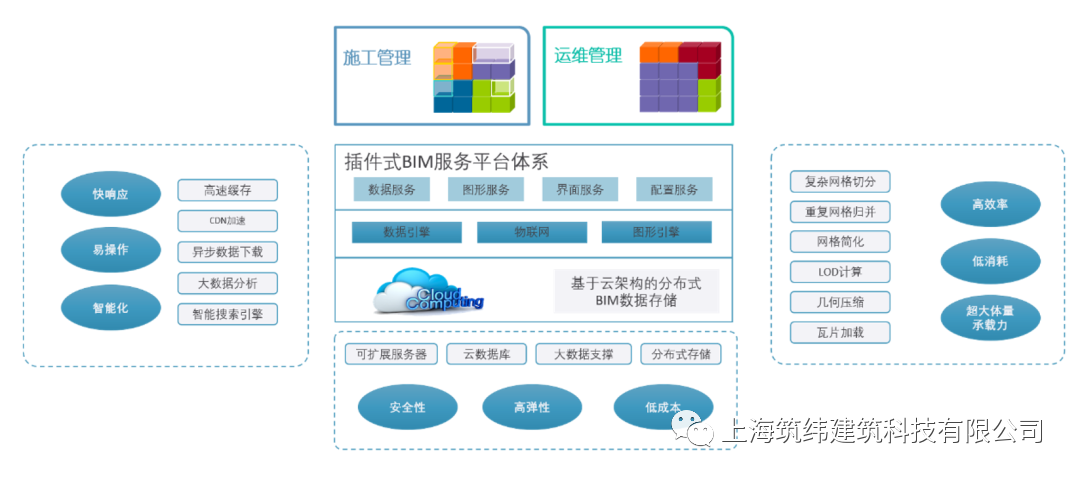
The architecture of the BIM cloud platform developed based on the intelligent BIM concept and technology is shown in Figure 1. Based on underlying big data and cloud computing support technologies—including scalable servers, cloud databases, big data, and distributed storage—the BIM cloud platform can provide secure, highly elastic, and low-cost cloud services, realizing cloud-architecture-based distributed BIM data storage. On this basis, data middle platforms such as a data engine, a graphics engine, and an IoT integration engine have been developed, and, in the form of data services, graphics services, interface services, and configuration services, a modular service system oriented toward design, construction, and O&M applications has been formed. For large-scale data processing, the platform provides algorithms for BIM model lightweighting and efficient processing—such as complex mesh splitting, duplicate mesh merging, mesh simplification, LOD computation, geometry compression, and tile loading—supporting efficient, low-consumption, and smooth loading of large-scale model data; at the same time, the platform applies technologies such as high-speed caching, CDN acceleration, asynchronous data loading, big data analysis, and intelligent search engines, providing rapid response, convenient operation, and intelligent capabilities.
The BIM cloud platform has flexible system integration and device access capabilities, forming intelligent environment support, which includes various data acquisition devices, intelligent sensing devices, multi-terminal operating terminals, external systems and their monitoring devices, and visualization display terminals. It can support and integrate application systems such as construction, smart O&M, smart beam yards, and highway dynamic quantity-and-price systems, as well as integrate data from different projects, giving full play to the advantages of each application.
Figure 1 Architecture diagram of the BIM cloud platform, using Tsinghua University's R&D as an example
3.4 Intelligent BIM Technology Support
The formation and application of the BIM platform and data center provide technical support for further integrating intelligent technologies and using big data to drive intelligent management and decision-making. The integrated application of BIM and intelligent technologies includes data-driven management, dynamic digital monitoring, intelligent sensing and positioning, and “data-plus-algorithm” intelligent decision-making.
(1) Data-Driven Management
Through the BIM cloud platform, users can be provided with data-driven management functions such as a spatiotemporal data search engine and aggregation analysis, automatic model positioning and intelligent association of business data, business linkage and correlation analysis, and multi-level model extraction.
1) Information search and aggregation analysis based on spatiotemporal features: targeting the spatial features of any model object or component, it realizes the search and aggregation analysis of engineering business data and labor, material, and machinery resource data at any specific time, providing professional functional management and decision analysis—for example, calculating the completion of work quantities at any location during any time period, or the cost or the input of labor, materials, and machinery.
2) Automatic model positioning and intelligent association of business data: by establishing mapping rules between model components and business data, it realizes intelligent dynamic association between the model and the business; when the model changes or the business data changes, the association adjusts automatically.
3) Business linkage and correlation analysis: it realizes intelligent linkage and correlation analysis among related business systems. For example, by linking the dynamic quantity-takeoff system with the labor, material, and machinery management system, the work quantities and the demand for labor, materials, and machinery calculated by the takeoff system for a specified location during a specified time period can be automatically associated with the management system, so as to judge whether the pre-dispatch allocation of labor, material, and machinery resources meets the demand and to carry out corresponding resource allocation and handling.
4) Multi-level model extraction: according to application needs, models of different levels of detail are extracted, supporting multi-level management from macro to fine and effectively handling BIM management and display for large-scale, regional, and long-line projects.
(2) Dynamic Digital Monitoring
BIM integrated with digital monitoring achieves polymorphic data growth. Integrating BIM with technologies such as digital monitoring, modern surveying, and 3D laser scanning effectively solves problems of dynamic monitoring and analysis of quality and safety at construction sites, as well as automatic positioning and accuracy analysis for the construction of complex structures. Meanwhile, around the construction site, it realizes real-time on-site environmental monitoring and management, including dust concentration, particulate matter concentration, noise index, and video surveillance.
(3) Intelligent Sensing and Positioning
By integrating BIM with IoT technology, sensing information such as QR codes, RFID, infrared sensing, and laser scanning is associated with BIM, solving intelligent recognition, positioning, tracking, monitoring, and management in BIM applications. IoT devices can be positioned within the model and their operating status dynamically identified, realizing real-time monitoring of IoT device status, tracking real-time data, and providing alarm services. Intelligent sensing and positioning technology has been successfully applied to safety and environmental monitoring of the construction process and site, construction material allocation and logistics tracking, and, in intelligent project O&M, to the operation monitoring of facilities and equipment, fault sensing and recognition, and energy consumption and carbon emission monitoring.
(4) “Data-Plus-Algorithm” Intelligent Decision-Making
Based on cloud-architecture whole-process project data storage, big data search engines, and data fusion and mining mechanisms, which can support analytical algorithms such as deep learning, natural language processing, and sensing and recognition, a “data-plus-algorithm” intelligent decision-making system has been established. Through a series of analytical tools—such as spatiotemporal search and aggregation analysis, trend prediction analysis, frequent pattern mining, anomaly monitoring, and automatic classification and clustering—it can provide analysis and decision-making for the actual needs of the project design, construction, and O&M stages, and can also provide support based on in-depth data analysis for enterprise-level leadership decisions and various business management activities.
4. Problems and Responses
4. Problems and Responses
In accordance with the national digital development strategy and the policy orientation of the construction industry, taking smart construction as the entry point to advance the transformation and upgrading of the construction industry has become the general trend. However, the construction industry still faces problems such as weak data infrastructure and insufficient big data accumulation, resulting in no obvious improvement in the level of digitalization; the application of new-generation artificial intelligence technology is still at an early stage, lacking systematic solutions; and the popularization and application of BIM technology—the cornerstone of digitalization—still faces many problems, such as an imperfect standards system, unsound policies and regulations, key technologies yet to be broken through, and mismatched application software. In particular, the lack of bottleneck technologies such as digital twin model engines and core modeling software hinders BIM design applications, makes BIM integrated application difficult, makes it hard to achieve complete BIM digital modeling, and is insufficient to support whole-process project digitalization and smart construction.
Industry digital transformation and smart construction involve multiple project participants and are deeply affected by policy orientation, the market environment, R&D deployment, promotion mechanisms, and the like; their development has a long way to go. Through the whole-process digitalization of engineering projects, this study explores a technical path for connecting the data chain and business chain of engineering construction. However, connecting the industrial chain and supply chain of engineering requires not only technical support but also all-round transformation and digital empowerment of different links, production systems, organizational methods, business models, and enterprise cooperation. At present, the most urgent tasks are to establish an organizational system and collaborative operating mechanism for advancing smart construction and to improve the data infrastructure; to increase investment in technological breakthroughs and the R&D of platform software, break through “chokehold” key technologies, and form an independent and controllable whole-industry-chain software ecosystem centered on BIM software; and, through complete top-level design, to plan a roadmap for BIM application, digital development, and smart construction implementation, advancing deep BIM application and whole-process project digitalization in phases and steps, so as to drive the rapid development of smart construction through digitalization.
References:
[1] SACKS R, EASTMAN C, LEE G, et al. BIM handbook: A guide to building information modeling for owners, designers, engineers, contractors, and facility managers[M]. John Wiley & Sons, 2018.
[2] LIN J-R. Whole life cycle management technologies and platform for green housing oriented toward industrialization[D]. Tsinghua University, 2016.
[3] LIN J-R, ZHANG J-P. A review of the development status of China's BIM policies and their text analysis[J]. Construction Technology, 2018,47(06):73-78.
[4] ZHANG J-P, LI D, LIN J-R, YAN G-W. Application of BIM in engineering construction[J]. Construction Technology, 2012,41(16):10-17.
[5] LIN J-R, ZHANG J-P. Automatic generation and application of a BIM-based simulation model for construction resource allocation[J]. Construction Technology, 2016,45(18):1-6.
[6] HU Z-Z, PENG Y, TIAN P-L. A review of research and application of BIM-based O&M management[J]. Journal of Graphics, 2015,36(05):802-810.
[7] ZHANG J, LIU Q, HU Z. A Multi-Server Information-Sharing Environment for Cross-Party Collaboration on a Private Cloud[J]. Automation in Construction, 2017, 81: 180–195. DOI:10.1016/j.autcon.2017.06.021.
[8] ZHANG J, HU Z. BIM-and 4D-based integrated solution of analysis and management for conflicts and structural safety problems during construction: 1. Principles and methodologies[J]. Automation in construction, 2011, 20(2): 155–166.
[9] LIN J-R, ZHANG J-P, ZHANG X-Y. Automating Closed-Loop Structural Safety Management for Bridge Construction through Multisource Data Integration[J]. Advances in Engineering Software, 2019, 128: 152–168. DOI:10.1016/j.advengsoft.2018.11.013.
[10] ZHANG Y-Y, KANG K, LIN J-R. Building Information Modeling–Based Cyber-Physical Platform for Building Performance Monitoring:[J/OL]. International Journal of Distributed Sensor Networks, 2020[2020–05–18]. https://journals.sagepub.com/doi/10.1177/1550147720908170. DOI:10.1177/1550147720908170.
[11] ZHOU Y-W, HU Z-Z, LIN J-R. A review on 3D spatial data analytics for building information models[J]. Archives of Computational Methods in Engineering, 2020, 27(5): 1449–1463.
[12] WEN Q, ZHANG J-P, HU Z-Z. A data-driven approach to improve the operation and maintenance management of large public buildings[J]. IEEE Access, 2019, 7: 176127–176140.
About the Author
ZHANG Jianping, PhD, Professor and Doctoral Supervisor, Department of Civil Engineering, Tsinghua University.
He has long been engaged in teaching and research in civil engineering information technology and is one of the earliest researchers and promoters of BIM technology and the IFC standard in China. He has presided over and completed dozens of research projects, including the national “10th Five-Year,” “11th Five-Year,” and “13th Five-Year” programs, the 863 Program, and National Natural Science Foundation projects. He has carried out fruitful research in civil engineering CAD/CAE, 4D-CAD, BIM, building life cycle management, informatization in the construction field, digital disaster mitigation, and intelligent decision-making technology, with deep academic attainments, and his research results hold a leading position both at home and abroad. He has published 6 monographs and more than 200 academic papers. He has won the Huaxia Construction Science and Technology First Prize three times and the Second Prize once, the Beijing Municipal Science and Technology Second and Third Prizes, and the Beijing Higher Education Teaching Achievement Second Prize, among others. He has been named a National Advanced Science and Technology Worker, a Beijing Municipal Higher Education Teaching Master, a Beijing “Education Pioneer” Outstanding Individual, and a person in charge of a National Fine Course, among other honors.
He currently serves concurrently as a member of the Green Construction Professional Committee of MOHURD, an advisory member of the Information Technology Standardization Technical Committee of MOHURD, Deputy Chair of the Board of Supervisors of the Chinese Society for Graphics, an expert advisor to the BIM Technology Academic Committee of the Architectural Society of China, an executive director of the BIM/CIM Professional Committee of the China Association for Engineering Construction Standardization, an executive director of the China BIM Development Alliance, an expert advisor to the Beijing BIM Technology Application Alliance, and a member of the BIM Professional Committee of the International Association for Computing in Civil and Building Engineering, among other positions.
END
The views expressed are the author's own Copyright © Zhuwei Architectural Technology
Reproduction without authorization is prohibited
Please credit the source when reposting: Zhuwei Architectural Technology
Zhuwei Architectural Technology is a new-type technical services company specializing in integrated design optimization, BIM consulting and prefabricated construction design consulting. Our team brings together senior engineers from leading design institutes, former executives of real-estate companies, BIM engineers and prefabrication engineers, delivering integrated design optimization, refined drawing review, BIM consulting with MEP detailing, and prefabricated design services.
Design optimization consulting: Positioned as an extension and complement to the design management of real-estate developers, we focus on consulting and optimization for civil buildings. Across the whole process — or at key stages required by the client — we control the economy, rationality and safety of the design, eliminating unnecessary cost while measurably improving drawing quality, achieving "lower cost, higher efficiency".
BIM consulting: Through digital construction technology we help designers reduce errors and improve quality in the design phase, help contractors save cost and plan high-quality MEP installation in the construction phase, and extend BIM models into facility management for the operation phase — in collaboration with mainstream software vendors.
Prefabricated design consulting: Whole-process design on BIM platforms, using Revit and Tekla for PC detailing. Component geometry and reinforcement are linked parametrically — what you see is what you get. We deliver Industry 4.0-ready drawings with cut-length data for every rebar, and IoT-enabled support for production, storage, transport and installation of PC components.
Our expert team comes from leading design institutes, with deep technical grounding and extensive experience in dual-track design and optimization; its technical capability and control are industry-leading.
—— This article is auto-synced from the WeChat Official Account “Zhuwei Architectural Technology”. Read the original ——