Industry Outlook: How to Achieve Smart Manufacturing of Precast Concrete Composite Slabs
WeChat Sync · Xiaowei · 2023-11-15
The following article is sourced from: Zhiju Prefabricated Green Building
Foreword
Prefabricated buildings, as a new type of building, offer clear advantages over traditional construction in improving building quality, saving resources and accelerating construction speed. Against the current backdrop of the country vigorously promoting prefabricated buildings, achieving the intelligent processing and manufacturing of prefabricated building components has become a key goal of the industry today. This article therefore focuses on the precast concrete composite slab, which is currently the most widely used component in prefabricated buildings, with an emphasis on analyzing the smart manufacturing technology roadmap for precast concrete composite slabs in the future.
How Precast Concrete Composite Slabs Can Achieve Smart Manufacturing
Smart manufacturing is achieved mainly from three aspects:
01
Automated Rebar Processing and Mold Loading
02
Automated Concrete Casting
03
Automated Entry into and Exit from Curing Storage
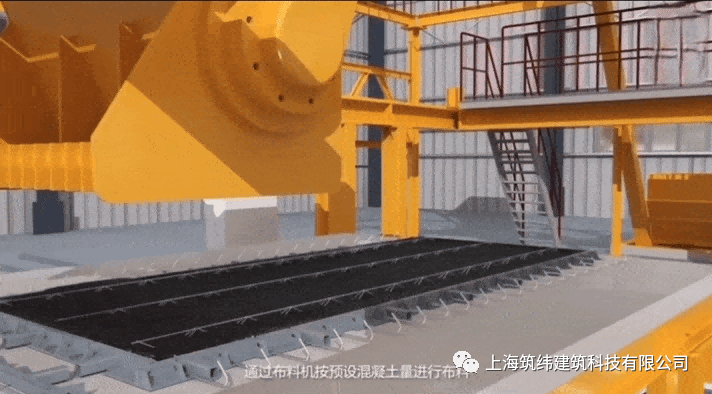
At present, achieving smart manufacturing for concrete composite slabs requires addressing three steps: automated rebar processing and mold loading, automated concrete casting, and automated entry into and exit from curing storage. So far, automated concrete casting and automated curing storage handling have already been implemented on production lines and have essentially achieved smart manufacturing. Therefore, the current difficulty in putting smart manufacturing into practice lies in automated rebar processing and mold loading.
The figure shows the current production line for automated concrete casting and automated curing storage handling
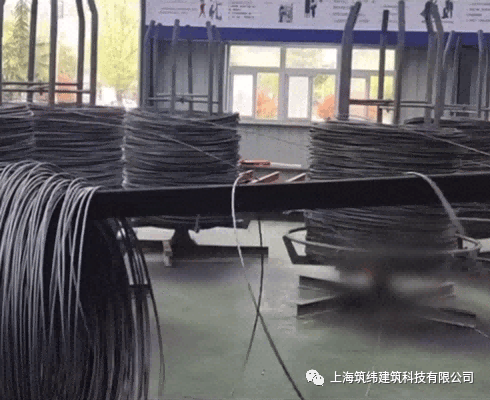
Automated rebar processing can currently be achieved with mesh fabricating machines. A fully automatic rebar mesh welding production line can complete the setting of mesh dimensions and specifications, equipment operating modes and production tasks through its equipment control system, and it supports the continuous automatic production of multiple mesh panels in a variety of specifications.
The figure shows the current fully automatic rebar mesh production line
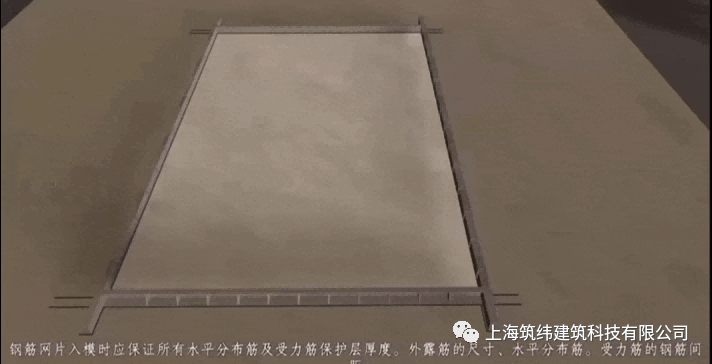
Once the rebar has been processed automatically, it needs to be lifted into the mold. However, because most composite slabs are designed with protruding reinforcement on all four sides, many bars in the composite mold correspond to their own bar-exit holes; dozens of such holes, combined with accumulated processing tolerances, make it very difficult to place the mesh reinforcement precisely into the mold. As a result, automated rebar processing and mold loading cannot be put into practice.
The figure shows the current composite slab process animation: automated mold loading of the reinforcement is difficult
Therefore, to fully realize smart manufacturing of concrete composite slabs, the focus is not on upgrading and iterating the equipment, but on achieving a design with no protruding reinforcement on any of the four sides, that is, a mold that requires no rebar holes on its four sides (with the embedded reinforcement confined within the mold, or with bent-up bars positioned above the mold).
Problem 1 with Protruding Reinforcement on All Four Sides: Difficult Construction
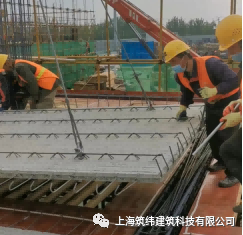
Protruding reinforcement on all four sides is not only the bottleneck for the smart manufacturing of rebar truss composite slabs; it also creates many pain points in on-site installation, severely affecting installation efficiency and quality. The reinforcement of an ordinary truss composite slab must enter the support, so during on-site construction the protruding bars easily clash with the top reinforcement of the beams, creating inconvenience. As shown in the figure, workers often resort to forceful installation by first bending the bars and then straightening them back, which can compromise stiffness and poses a significant safety risk.
Problem 2 with Protruding Reinforcement on All Four Sides: Numerous Joint Issues
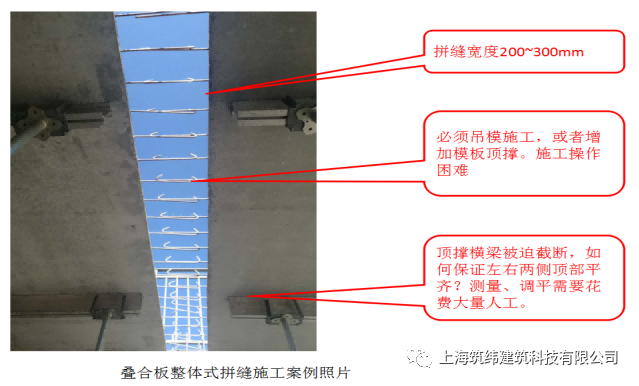
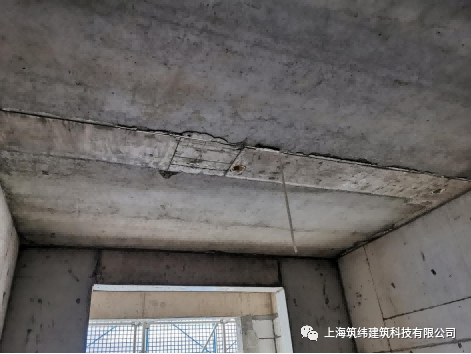
In addition, the practice of using small formwork joints for two-way slabs results in complex on-site shoring and formwork, and after casting, because of grout leakage from the formwork, subsequent grinding or leveling is required, which severely affects the efficiency and quality of on-site construction.
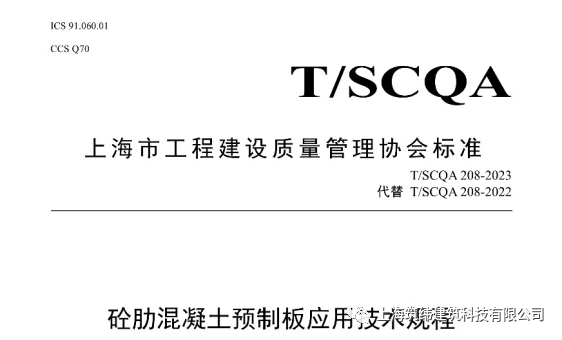
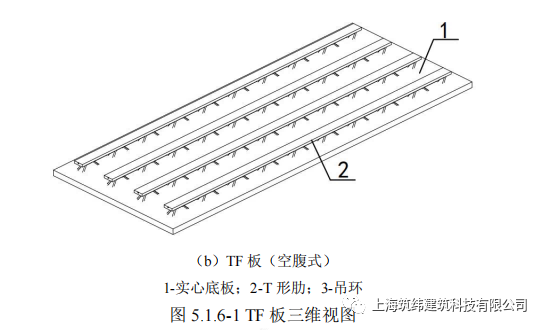
The latest ultra-high performance concrete composite slab (abbreviated as the TF slab), based on T/SCQA 208-2023 Technical Specification for Application of Concrete-Ribbed Precast Slabs, overcomes the pain point of protruding reinforcement on all four sides: it achieves no protruding reinforcement on the top face and tight butt joints for one-way slabs, so that no reinforcement protrudes on any of the four sides.
Achieving No Protruding Reinforcement on the Top Face
According to clause 5.3.2 of T/CECS715-2020 Technical Specification for Application of Concrete Composite Slabs with Rebar Truss, which took effect on December 1, 2020, when a tight butt joint with a monolithic connection is used, the cast-in-situ topping concrete composite layer thickness shall not be less than 1.3 times the thickness of the truss precast slab, and shall not be less than 75mm. Since the bottom slab of the TF slab is only 50mm thick and the cast-in-situ layer is greater than 75mm, reaching 1.3 times the precast thickness, a design with no protruding reinforcement on the top face can be realized through on-site anchorage of additional reinforcement. This avoids the difficulty of mold loading during processing, greatly increases the utilization efficiency of the composite slab rebar mesh welding machine, and achieves industrialization at the rebar tying stage.
Tight Butt Joints for One-Way Slabs: Achieving No Protruding Reinforcement on All Four Sides
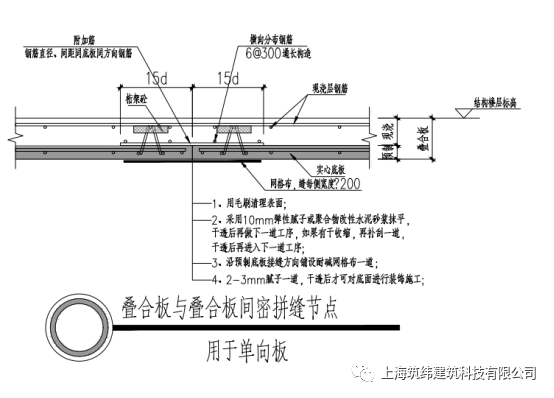
When the one-way slab form is adopted, the ultra-high performance concrete composite slab (TF type) can also achieve no protruding reinforcement on the sides. Additional reinforcement perpendicular to the joint can be placed on the top face at the joint.
Project ExamplesA project in Hainan adopted a design using 125mm-thick TF composite slabs with no protruding reinforcement on any of the four sides, with ideal results.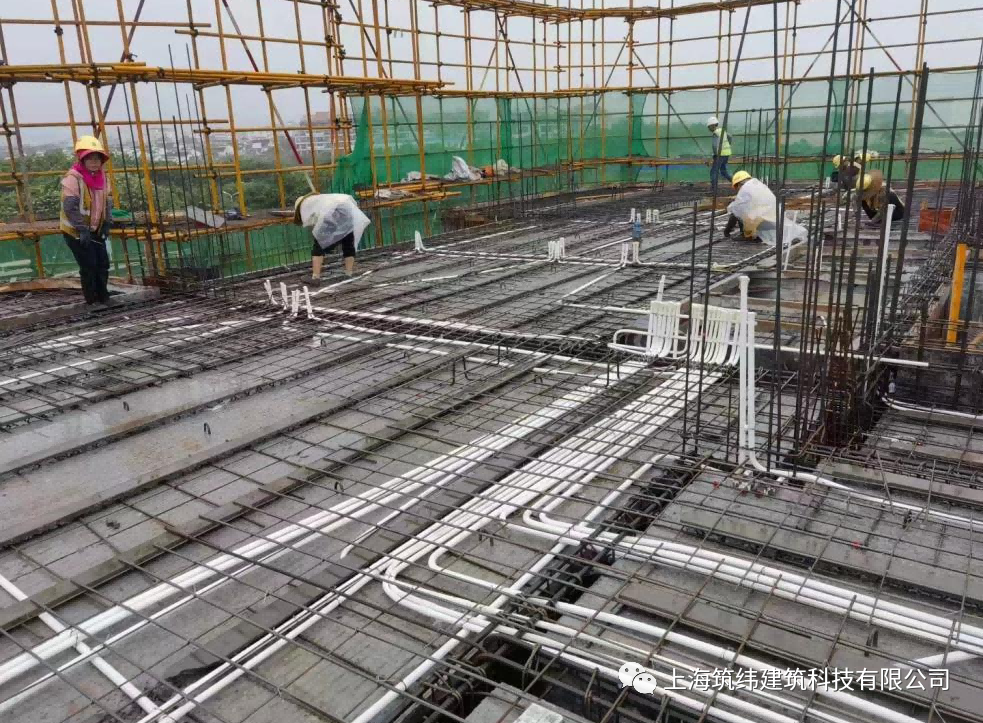
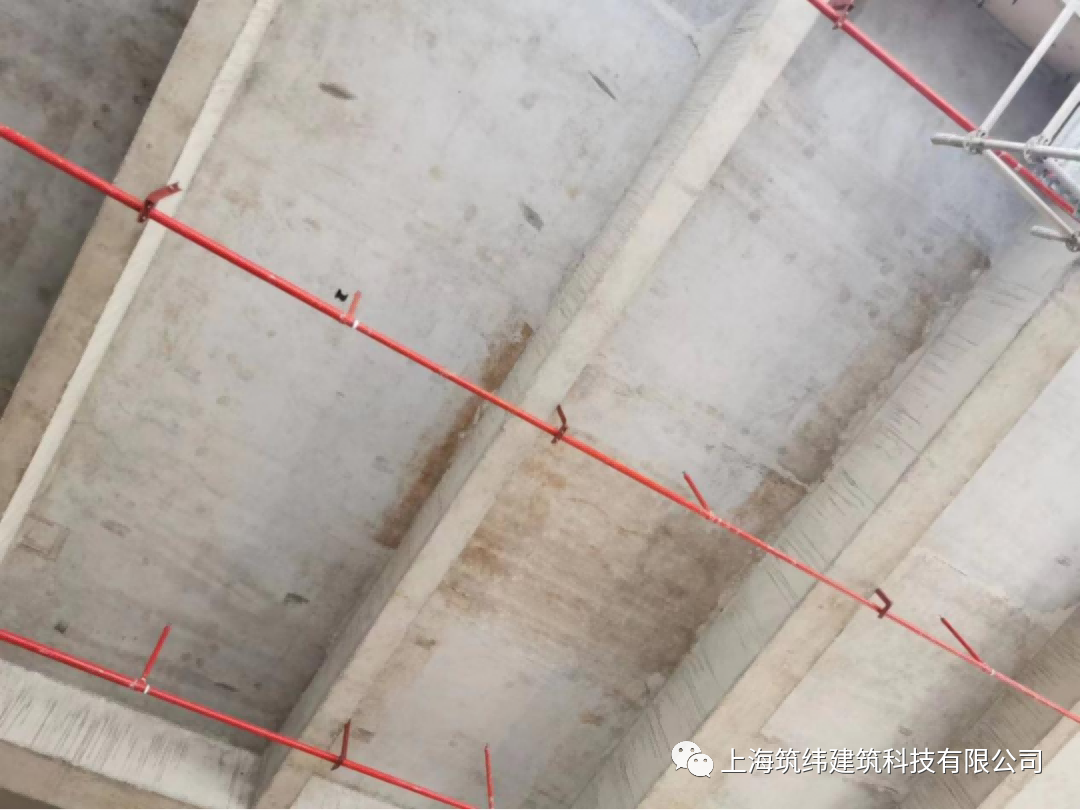
The figure on the left shows the directly formed result of one-way tight butt joints in a project in Shanghai. As can be seen, when the TF slab is used as a one-way slab with tight butt joints, the joints are very small and the result is ideal.
Two-Way Slab Joint Strip Detail:
No Holes in the Mold, Same Bottom Elevation on Site
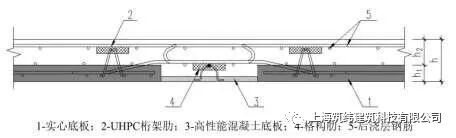
When a two-way TF slab uses a cast-in-situ monolithic joint, a joint strip detail can be adopted, as shown in the figure below: the bars extending from the slab side take the form of bent-up bars, and a joint strip with a permanent bottom formwork is used at the joint. On site, this eliminates formwork installation and removal; in factory production, because the bent-up bars are positioned above the side molds, the slab side molds require no holes, which is economical and efficient.
Summary
The TF slab achieves no protruding reinforcement on the top face; on the sides, for one-way slabs there is no protruding reinforcement, while for two-way slabs it uses bent-up bars, connected on site by joint strips. This makes the composite slab mold free of holes on all four sides, so the rebar mesh produced by the mesh welding machine can be easily lifted into the mold because there are no mold rebar holes to pass through, thereby realizing smart manufacturing.
Other Advantages of the TF Slab
01
First, the greater stiffness of the TF concrete-ribbed slab helps achieve prop-free or reduced propping on site (prop-free within 3 meters), which thereby qualifies for Shanghai's 0.55 high prefabrication rate coefficient for formwork-free and prop-free slabs, raising the prefabrication rate score of the floor slab portion by more than 20%.
02
A type test was carried out on a TF concrete-ribbed concrete composite slab and a rebar truss composite slab of the same specification with overall dimensions of 3.6m*1.5m:
Under a support span of 3m, when the rebar truss composite slab was loaded to 150kg/㎡, the measured deflection was 6.8mm, cracks appeared and plastic deformation occurred.
Under the same conditions, the measured deflection of the TF concrete-ribbed composite slab was 2.1mm, only 1/3 that of the rebar truss composite slab, and it consistently showed a linear trend; after the weights were removed, the slab remained in the elastic stage.
03
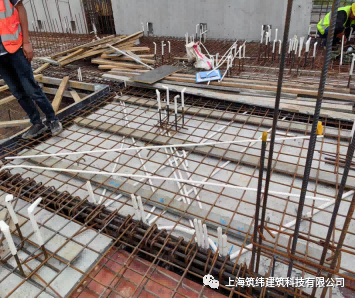
During on-site construction, it can be seen that the top reinforcement of the TF slab is easy to position and support, which avoids displacement of the bars from being trodden on and prevents any impact on stiffness.
04
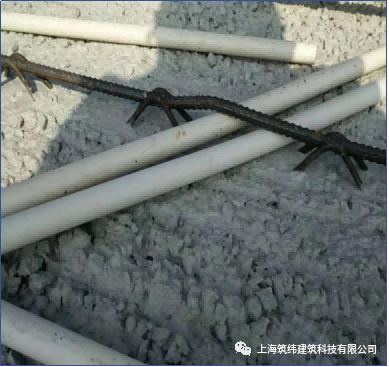
Second, the welded joints between the ribs and the slab surface of the TF slab form trapezoidal openings within the ribs, making it more convenient for pipelines to pass through. This avoids clashes between on-site pipelines and the reinforcement and ensures that the stiffness is not compromised.
Summary
In summary, given that smart manufacturing is a major trend in composite slab production, the current TF composite slab precast bottom panel, which uses tight butt joints or connecting plates to achieve a design with no protruding reinforcement on any of the four sides, largely resolves the difficulties in the smart manufacturing of precast composite slabs. Once no reinforcement protrudes on any of the four sides, the manufacture of composite slabs on the production line can be integrated with smart construction using rebar mesh machines. In this way, the production molds have a high rate of reuse, lifting and demolding are convenient, the process is easier to standardize, while costs are reduced and efficiency is improved.
Therefore, the TF slab lays the foundation for the smart manufacturing of precast concrete composite slabs in the future, solves the challenges facing the smart manufacturing of traditional rebar truss composite slabs, and meets the needs of intelligent industrialized production.
END
The views expressed are the author's own Copyright © Zhuwei Architectural Technology
Reproduction without authorization is prohibited
Please credit the source when reposting: Zhuwei Architectural Technology
Zhuwei Architectural Technology is a new-type technical services company specializing in integrated design optimization, BIM consulting and prefabricated construction design consulting. Our team brings together senior engineers from leading design institutes, former executives of real-estate companies, BIM engineers and prefabrication engineers, delivering integrated design optimization, refined drawing review, BIM consulting with MEP detailing, and prefabricated design services.
Design optimization consulting: Positioned as an extension and complement to the design management of real-estate developers, we focus on consulting and optimization for civil buildings. Across the whole process — or at key stages required by the client — we control the economy, rationality and safety of the design, eliminating unnecessary cost while measurably improving drawing quality, achieving "lower cost, higher efficiency".
BIM consulting: Through digital construction technology we help designers reduce errors and improve quality in the design phase, help contractors save cost and plan high-quality MEP installation in the construction phase, and extend BIM models into facility management for the operation phase — in collaboration with mainstream software vendors.
Prefabricated design consulting: Whole-process design on BIM platforms, using Revit and Tekla for PC detailing. Component geometry and reinforcement are linked parametrically — what you see is what you get. We deliver Industry 4.0-ready drawings with cut-length data for every rebar, and IoT-enabled support for production, storage, transport and installation of PC components.
Our expert team comes from leading design institutes, with deep technical grounding and extensive experience in dual-track design and optimization; its technical capability and control are industry-leading.
—— This article is auto-synced from the WeChat Official Account “Zhuwei Architectural Technology”. Read the original ——