Guangdong: Multimodal Large Models Integrated with BIM, Digital Twin and Other Technologies to Drive Informatization Integration and Design Collaboration Across All Disciplines
WeChat Sync · Xiaowei · 2024-06-12
The following article is sourced fromDigital Twin City
On June 6, the General Office of the People's Government of Guangdong Province issued the Notice on Several Measures of Guangdong Province for Empowering All Industries with Artificial Intelligence. It states that by 2025, the province's computing power scale will exceed 40 EFLOPS and the core AI industry will surpass RMB 300 billion. By 2027, the province's AI industry foundation will be further consolidated, computing power will exceed 60 EFLOPS, and a nationally leading algorithm system and computing power network will be basically formed. It also put forward the following:Advancing smart construction through deep integration. Using multimodal large models as the carrier to integrate Building Information Modeling (BIM),digital twinand other technologies, the measures promote cross-discipline information integration and design collaboration, enabling the automatic completion of design parsing, consistency checks between construction drawings and building models, and data matching. This shortens the time needed to convert design models into construction applications and raises the level of intelligence in project management, quality and safety supervision, and other processes.
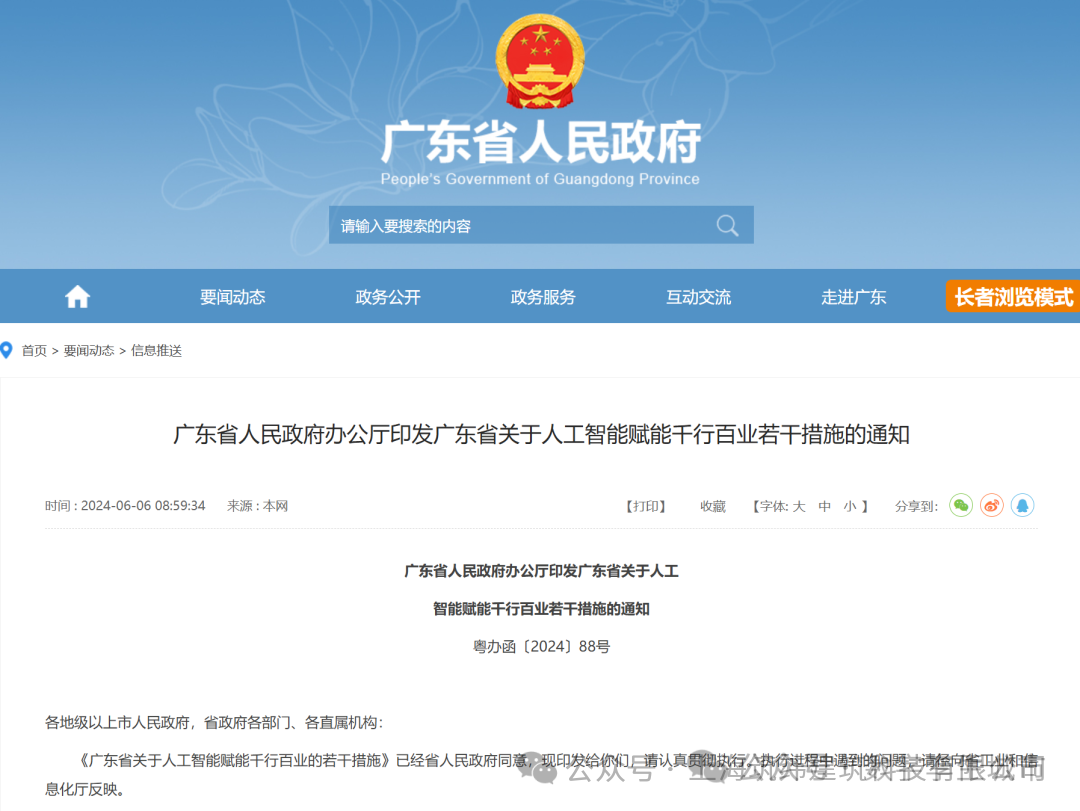
Several Measures of Guangdong Province for Empowering All Industries with Artificial Intelligence
These measures are formulated in order to implement the decisions and arrangements of the CPC Central Committee and the State Council on advancing the development of artificial intelligence, to promote the high-quality development of our province's AI industry, to accelerate the formation of new quality productive forces, to build a modernized industrial system, to empower all industries to improve quality and efficiency, and to create new economic models, new life experiences, and new governance approaches for the intelligent era.
I. Overall Objectives
By 2025, the province's computing power scale will exceed 40 EFLOPS and the core AI industry will surpass RMB 300 billion. By 2027, the province's AI industry foundation will be further consolidated, computing power will exceed 60 EFLOPS, and a nationally leading algorithm system and computing power network will be basically formed; the supply of smart terminal products will be abundant, with more than 100 widely used smart terminal products developed across eight major categories including mobile phones, computers, home products, and robots, and the core AI industry will surpass RMB 440 billion; focusing on fields such as manufacturing, education, and elderly care, more than 500 application scenarios will be created, significantly raising labor productivity across all industries.
II. Strengthening the AI Industry Foundation and Accelerating the Formation of New Quality Productive Forces
(1) Increase the supply of core AI chips and components.
1.Establish an AI chip ecosystem. Build a chip-compatible development ecosystem and step up the development and production of high-performance, low-power device-side chips for home appliances and furnishings, security surveillance, medical equipment, and similar applications. Encourage enterprises to advance the R&D of communication, display, audio, and other modules by integrating processors, RF communication, smart sensors, memory, and more. Foster an ecosystem of chip innovation, explore the R&D and application of chips such as compute-in-memory, brain-inspired computing, chiplets, and instruction sets, promote chip applications for the cloud and for end devices, and popularize high-performance cloud-based intelligent servers. By 2027, an AI chip ecosystem will be preliminarily established.
2.Build an intelligent sensing industry system. Develop smart sensor industry clusters and specialized industrial parks, promote the development and industrialization of image, sound, touch, and other sensors, and accelerate the development and large-scale production of biometric recognition, image sensing, and other sensors for consumer electronics, home appliances and furnishings, and related fields. Foster collaboration across the industrial ecosystem in processing and manufacturing, integration and packaging, and metrology and testing. By 2027, the scale of the high-end smart sensor industry will double.
(2) Advance the iterative upgrading of AI software.
3. Strengthen the R&D and innovation of intelligent software. Develop an engine, framework, and tool system, and create high-performance distributed parallel computing frameworks and platforms for inference acceleration engines and ultra-large-scale deep learning. Advance intelligent operating systems and speed up the R&D of server-grade intelligent operating systems, smart terminal operating systems, and the like with independent intellectual property rights. Encourage enterprises to tap deeply into the needs of key industries such as manufacturing, healthcare, and education, to strengthen the mutual adaptation, performance optimization, and application promotion of AI framework software and hardware, and to build an integrated software-hardware ecosystem. By 2027, the intelligent software industry will reach RMB 27 billion.
4. Broaden the scope of intelligent software applications. Implement an industrial software efficiency program, using AI to improve the R&D efficiency of underlying industrial software technologies such as 3D modeling, parametric design, and solid segmentation. Implement an application software quality program, integrating scenario data, technologies, and processes across industries to provide professional industry software solutions. Implement a terminal software promotion program, supporting software enterprises in developing various AI-oriented commercial apps, office software, and other terminal software. By 2027, the coverage rate of independently developed AI software will reach 50%.
(3) Systematically build an algorithm industry matrix.
5. Build high-quality Chinese-language datasets. Strengthen the integration of data resources in government information systems and build public, public-interest trusted data spaces and public datasets on government networks. Support localities in leveraging AI capabilities to select advantaged industrial fields for piloting public data operations and to promote the efficient integration and use of public and social data. Encourage enterprises to build high-quality, industry-oriented Chinese-language corpus databases and to promote the aggregation, sharing, and use of data from typical industries. By 2027, more than 50 high-quality industry datasets will be built.
6. Accelerate the supply of algorithm products. Around mainstream domestically developed AI frameworks, develop specialized algorithm products and tools. Encourage enterprises to expand algorithm applications and to create a batch of algorithm products and demonstration projects. Speed up the R&D and iteration of general-purpose large models and vertical industry-specific large models, refine dedicated models for specific narrow scenarios, and support lightweight, efficient, and easy-to-deploy small and medium-sized models. Support the R&D of autonomous and controllable large model products and publish catalogs of products and services. By 2027, 100 algorithm products with demonstration and promotion impact will be created.
7. Build open-source communities for large models. Establish a resource pool of original foundational large models, encourage the formation of open-source large model communities, and support free and open access to large models and their derivatives, parameter tuning, and application development. Optimize the environment for large model development and reduce non-technical barriers. Conduct training, knowledge dissemination, and other activities for community members to cultivate large model development talent. By 2027, a one-stop open-source service system for AI research, development, collaboration, deployment, and implementation showcasing will be basically established.
(4) Deploy computing power network construction moderately ahead of demand.
8. Accelerate the construction of intelligent computing infrastructure. Introduce and implement policy measures to speed up the development of the province's computing infrastructure and promote efficient complementarity and coordinated linkage between the Pearl River Delta and eastern, western, and northern Guangdong. Accelerate the construction of data centers at national hub nodes and strengthen urban edge intelligent computing centers around key application scenarios. Enhance government-enterprise cooperation, accelerate the consolidation of existing training computing power, and expand shareable computing power. By 2027, the intelligent computing coverage of key industries will improve significantly.
9. Strengthen the intensive supply of computing power. Promote the coordinated development of intelligent and general-purpose computing power among telecom operators, cloud service providers, and various computing platforms to meet the computing needs of diverse workloads, whether balanced or compute- and storage-intensive. Accelerate the construction of public computing platforms such as the Guangzhou Public AI Computing Center, the Pengcheng Cloud Brain, and the Hengqin Advanced Intelligent Computing Center, and support the Pengcheng Laboratory in developing and building the “China Computing Power Network.” Explore the construction of multi-tier elastic computing scheduling platforms, integrate computing resources through cloud services, and enable cross-domain scheduling and orchestration of diverse heterogeneous computing power. By 2027, efficient sharing, autonomous collaboration, and unified services for computing resources will be basically achieved.
10. Advance the optimization of the computing power network layout. Support the R&D of optical communication products and equipment and build a 400G/800G all-optical, high-speed, low-latency transport network. Promote the deployment of metropolitan optical transmission equipment toward integrated access nodes and the user side, keeping latency between key urban computing infrastructure at no more than 1 ms. Support the upgrading of fiber-optic links at key locations to enhance the service and scheduling capabilities of the transport network. By 2027, the province's support capacity for a high-bandwidth, low-latency computing power network will be greatly enhanced.
III. Building a New Highland for Smart Terminal Products and Shaping a New Image for Guangdong Brands
(1) Enhance intelligence and strengthen high-end equipment.
11. Advance the innovative development of intelligent robots. Accelerate the R&D and production of machine brains, machine limbs, machine bodies, general-purpose products, and the like, and promote the development and application of embodied intelligent robots such as humanoid robots. Develop high-precision industrial robots such as collaborative robots with flexible interaction and dynamic path planning and adaptive robots, and accelerate the application and promotion of service robots with intelligent human-machine interaction and precise multi-degree-of-freedom control. By 2027, the operating revenue of the intelligent robot industry will reach RMB 90 billion.
12. Accelerate the intelligent upgrading of high-end equipment. Promote the intelligent transformation of high-end equipment such as high-end CNC machine tools, marine engineering equipment, aviation equipment, satellites and their applications, and rail transit equipment. Support the development of unmanned surface vessels and unmanned underwater vehicles with high autonomy, high airworthiness, and high reliability. Strengthen equipment R&D and industrialization in fields such as deep-earth resource exploration and mining, urban underground space development and utilization, and polar exploration and operations. By 2027, the operating revenue of the high-end equipment manufacturing industry will reach RMB 380 billion.
13. Support new energy vehicles with intelligent connectivity. Build intelligent connected vehicle terminals that integrate safe travel, smart living, and mobile office functions. Develop intelligent connected terminals such as robotaxis, smart buses, and smart heavy trucks, and encourage intelligent, one-stop transportation and travel service applications. By 2027, the annual output of new energy vehicles will reach more than 3.5 million units.
(2) Empower and expand consumer terminals with intelligence.
14. Innovate operating systems to create AI phones. Support operating systems in deeply integrating efficient, low-loss lightweight large models and promote the application and innovation of device-side model algorithms and architectures. Support enterprises in combining multimodal natural interaction technologies on AI OS to enhance real-time interaction capabilities, expand mobile phone application scenarios, and create personalized digital assistants. By 2027, the output of AI phones will reach more than 100 million units.
15. Deploy dedicated models to create AI computers. Use AI technology to continuously learn users' personal data and habits, forming an on-device personal local knowledge base that stays on the device, does not go to the cloud, and is migratable, inheritable, and able to grow. Combined with lightweight technologies such as model compression, this creates personalized dedicated models and new intelligent productivity tools. By 2027, the output of AI computers will reach more than 30 million units.
16. Focus on “the elderly and the young” to strengthen intelligent care and rehabilitation products. Improve the intelligence and safety of smart daily aids such as home service robots, health monitoring devices, and wheelchairs; of rehabilitation training and health promotion aids such as walkers and incontinence training devices; and of elderly care products such as smart bathing aids, transfer machines, and rehabilitation nursing beds. Support the R&D and production of smart interactive toys that integrate chatting, early education, and entertainment companionship. By 2027, more than 1,500 new specialized products will be added in the care and rehabilitation supplies field.
17. Integrate cross-sector technologies to upgrade smart home appliance products. Deeply integrate and apply new technologies such as learning algorithms, image recognition, and intelligent voice in home appliances, develop high-end new intelligent products, and enhance the international influence of brands. Promote the interconnection of smart home products such as appliances, furniture, and daily necessities, develop smart appliances for personalized customization, special purposes, and specific user groups, and enrich the supply of high-end smart appliance products and services. By 2027, the operating revenue of the strategic smart home appliance industry cluster will reach RMB 1.9 trillion.
18. Enrich virtual reality smart terminals. Deepen the integrated innovation of AI technology with key virtual reality technologies such as near-eye displays, rendering, perception and interaction, network transmission, content production, compression and encoding, and security and trustworthiness. Develop and produce a batch of diverse terminal products, including all-in-one and split-type devices, and achieve breakthroughs in key fields such as industrial production, culture and tourism, converged media, education and training, sports and health, commerce and creative industries, and smart cities. By 2027, more than 3,000 new virtual reality terminals and applications will be added.
IV. Building a New Engine for Intelligent Converged Applications and Forming New Growth Opportunities for the Economy
(1) Empower the real economy with new momentum.
19. Advance the digital and intelligent transformation of industry. Use “machines replacing workers and data replacing minds” to drive the intelligentization of the entire manufacturing process, and deepen the integrated application of AI technology in scenarios such as R&D and design, pilot-scale verification, production and manufacturing, and operations management. Accelerate the empowerment of key industries such as raw materials, equipment manufacturing, consumer goods, and electronic information. Build a large model for carbon emission management, accelerate the green transformation of production, and strengthen energy conservation and carbon reduction in energy-intensive key industries such as steel, non-ferrous metals, and building materials, reaching 700 national-level green factories.
20. Advance smart construction through deep integration. Using multimodal large models as the carrier to integrate Building Information Modeling (BIM),digital twinand other technologies, this promotes cross-discipline information integration and design collaboration, enabling the automatic completion of design parsing, consistency checks between construction drawings and building models, and data matching. It shortens the time needed to convert design models into construction applications and raises the level of intelligence in project management, quality and safety supervision, and other processes.
21. Drive smart agriculture with intelligent systems. Accelerate the application of smart facilities, use intelligent sensors to monitor parameters such as soil moisture and temperature, strengthen the application of AI algorithms in yield estimation, weather forecasting, and market analysis, and build digital farmland and smart farms for farming, animal husbandry, and fisheries. Raise the intelligence level of animal and plant protection and strengthen pest and disease prevention and control. Accelerate the manufacturing and promotion of “large and small” intelligent agricultural machinery and equipment, and encourage new mechanisms and models for the agricultural machinery industry and supply chains.
22. Build a modern transportation system with smart transport. Launch demonstration projects for intelligent railways, highways, waterways, and ports; promote smart hubs, postal services, and maritime affairs; and build a smart operation system for the core road network of the Greater Bay Area. Advance the integrated “vehicle-road-cloud” application of intelligent connected vehicles, build digital and intelligent infrastructure and city-level service management platforms, and explore the safe application of high-definition maps. Efficiently advance the construction of low-altitude economy infrastructure and accelerate the building of production and supply systems. Develop new logistics infrastructure such as smart logistics parks and digital warehouses, and encourage qualified cities to build smart logistics “brains.”
23. Build smart energy through multi-party integration. Accelerate the integrated application of AI with equipment and systems such as electric power, the energy industrial internet, and the province-wide power Internet of Things. Advance the construction of smart substations and multi-energy complementary integrated energy networks, and build a province-wide intelligent power grid that accommodates large-scale new energy access and meets the “plug-and-play” requirements of distributed energy.
(2) Empower smart public services with new experiences.
24. Improve education and teaching with intelligent assistance. Promote the development and application of new resources such as intelligent teaching assistants, smart learning guides, and educational robots, and support burden reduction and efficiency gains through joint human-machine teaching and nurturing, innovating teaching models. Develop intelligent assessment tools and advance reform of education and teaching evaluation methods. Strengthen the provision of equipment such as virtual simulation and intelligent sensing, provide adaptive learning resources and intelligent learning services, and build smart classrooms and smart campuses.
25. Enhance medical service capacity through interconnection and sharing. Build smart hospitals and integrate and connect relevant online service terminals. Establish cross-department and cross-institution public health data sharing and scheduling mechanisms and intelligent multi-point-trigger early warning mechanisms, and strengthen smart monitoring of drug supply security. Create a “smart medical assistant” to help doctors improve diagnostic efficiency and quality and to assist patients in self-checking symptoms, guiding medication use, and interpreting reports. Strengthen the application of robots in the service system for patients' pre-hospital management, in-hospital diagnosis and treatment, and post-hospital rehabilitation tracking.
26. Boost the silver economy with smart elderly care. Strengthen the allocation, integration, and effective connection of health and elderly care resources among individuals, families, communities, and medical institutions, and build a smart elderly care service system of “platform + service + product + response + supervision.” Advance the elderly-friendly intelligent upgrading of internet applications, apps, mobile terminals, and home appliances and furnishings commonly used by older people in fields such as healthcare, civil affairs, and utility bill payment.
27. Promote nationwide fitness with smart customization. Support multimodal large models in integrating professional knowledge in physiology, diet, fitness equipment, and other fields to create personal health coaches. Drive the deep integration of nationwide fitness with AI, develop smart sports products, build smart sports venues and intelligent outdoor fitness facilities, and promote new smart sports technologies, products, and application scenarios such as sports and fitness apps and platforms.
28. Create life assistants with smart domestic services. Promote comprehensive domestic service robots that integrate cleaning, education, catering, shopping, care, entertainment, and other functions. By extracting and parsing the deeper information in human language and generating action instructions, they carry out machine-based replacement of household tasks and provide personalized services.
(3) Empower social governance with new effectiveness.
29. Build a smart government that benefits enterprises and the people. Use government large models to intelligently upgrade the Guangdong Government Services Network and the “Yue series” government service platforms, providing round-the-clock online Q&A and search services. Build a video computing support infrastructure platform for Party and government organs at all levels across the province to raise the intelligence level of video. Integrate economic algorithm models into the “Yue Economy” platform to provide decision support for the government in scenarios such as economic operation monitoring, analysis and assessment, and policy simulation.
30. Unleash new urban vitality through smart development. Advance the application of technology in fields such as community governance, natural resources, and market regulation; expand scenario applications such as digital-real integration on urban information model platforms; and enable the monitoring, early warning, prevention, and handling of ecological risks and urban operational safety risks. Promote smart outreach for basic livelihood security, and support AI products and services that protect the rights and interests of special groups such as the elderly, the weak, the sick, and people with disabilities.
31. Improve judicial efficiency with full-process assistance. Advance the use of AI technology to provide high-level, full-process support for adjudication, enforcement, litigation services, and related work, enabling smart functions such as the automatic generation of evidence guidance and review records, early warning of deviations in case judgments, automatic archiving of electronic case files, and Q&A for litigation and mediation consultations, so as to efficiently safeguard clean and impartial justice.
32. Enhance safety assurance capabilities with smart security. Promote the development of smart food and drug supervision and strengthen intelligent safety regulation of food and drugs. Deepen the application of intelligent prevention and control, sensing, and other technologies in the field of public security, and provide intelligent early warning of natural disasters. Popularize the use of intelligent robots, drones, and the like for rapid emergency response. Advance the intelligent transformation of public safety facilities such as gas, bridges, and underground pipelines, as well as fields such as mining and firefighting, to safeguard production safety.
33. Create a beautiful homeland together through smart environmental protection. Build a diversified smart environmental governance system and comprehensively enhance capabilities in pollution traceability, pollution prevention and control, situation assessment, and decision support. Improve the ecological environment monitoring network and advance the intelligentization of remote sensing monitoring, carbon monitoring, new pollutant monitoring, and environmental monitoring and assessment. Promote smart supervision and law enforcement for the ecological environment.
(4) Empower new forms of digital consumption.
34. Stimulate commercial potential with smart commerce. Advance new commerce and trade services such as precision marketing, smart business districts, and intelligent delivery; develop “unmanned retail stores”; and promote the intelligent transformation of commerce, trade, and distribution services. Based on granular data such as consumers' historical purchase behavior and transaction records, intelligently identify salient consumer characteristics, generate user profiles, predict preferences and interests, and enhance the user experience through personalized marketing.
35. Improve financial services with smart finance. Embed intelligent models throughout every step of products and services, and use technologies such as robotic process automation, natural language processing, and intelligent character recognition to reconstruct digital processes end to end. Build diversified and integrated service channels and promote the upgrading of physical branches into multimodal, interactive smart branches. Focus on the daily, high-frequency financial scenarios of groups such as the elderly, people with disabilities, and ethnic minorities to build an intelligent service system.
36. Upgrade the tourism development model with innovative experiences. Build smart scenic areas and develop application scenarios such as smart guided tours, VR/AR immersive tourism, and cloud tourism at scale. Expand the ability of tourist attractions to apply large model technologies in visitor flow statistics, consumption analysis and forecasting, and emergency response, and broaden marketing channels for tourism products.
37. Enrich cultural and entertainment life with intelligent interaction. Build smart libraries and museums, and create information digitization service platforms such as smart broadcasting and digital film program management. Encourage enterprises to use intelligent technology to transform and upgrade industrial chains, create intelligence-driven digital humans, and promote the modernization of content production and dissemination methods such as text-to-video. Cultivate immersive and interactive business formats and build a batch of new scenarios and applications.
(5) Empower new fields across all industries.
38. Comprehensively advance the application of intelligent scenarios. Actively leverage the role of AI in scientific research fields such as drug design and discovery, materials science, and physics and chemistry simulation to drive scientific progress and innovation. Accelerate the diversified application of AI across fields such as biomanufacturing, commercial aviation, catering, and real estate; speed up the formation of new consumption scenarios, business formats, models, and brands; further liberate labor; and significantly increase new jobs related to AI applications.
V. Safeguard Measures
39. Establish and improve the organizational coordination mechanism for AI industry development. Under the overall guidance of the Provincial Party Committee's Science and Technology Commission, the provincial leading group for the high-quality development of manufacturing will strengthen the organizational coordination of empowering all industries with AI, give play to the role of the expert advisory committee, and study and resolve difficulties and problems in industrial development. Establish province-city linkage and government-enterprise cooperation mechanisms, and encourage qualified cities to include the AI industry among their key strategic emerging industries. Support the establishment of an inclusive and prudent fault-tolerance and error-correction mechanism, and organize various market entities to implement partnership cooperation programs.
40. Strengthen policy supply with multi-party participation. Coordinate various provincial and municipal funds to increase financial support for the AI industry and support project construction in the AI field. Study and promote the formulation of laws, regulations, and rules related to the supply of trusted AI products and services. Regularly publish lists of application scenarios, establish incentive mechanisms for innovative products, and compile catalogs of recommended innovative products. Encourage cities to provide relevant policy support for first-set equipment, first-version software, first-batch new materials, and first purchases and orders, and to deploy and use them in application scenario units.
41. Gradually establish an industry standards system. Build patent databases in key AI technology fields, conduct patent navigation, form patent alliances in specialized sub-fields, and promote the transfer and commercialization of intellectual property. Accelerate the layout of standards, specifications, and tools in areas such as large model security and compliance certification, lightweight technologies, and performance evaluation, and support enterprises in participating in their formulation. Establish institutional norms to safeguard the healthy and safe development of AI. Explore the establishment of an indicator system for AI industry empowerment.
42. Innovate talent cultivation. Increase the intensity of various policy measures to attract and gather talent, focus on cultivating and bringing together high-level talent, and drive the training of a batch of AI innovation teams. Build bases for continuing education, practical training, and high-skilled talent development, and conduct training for urgently needed professional and technical AI talent and high-skilled composite talent. Implement the “Smart Craftsman” and “Chief Algorithm Officer” programs in advantaged industries, explore the classified statistics of AI talent, and regularly publish talent industry standards.
43. Strengthen innovative demonstration applications. Support a batch of key projects with a high degree of innovation, great application value, and good market prospects; forge AI “long-board” enterprises with standout strengths; summarize demonstration results and excellent cases in a timely manner; and give priority to promotion opportunities. Organize AI innovation and entrepreneurship competitions to showcase innovative products, excellent cases, and application scenarios, provide matchmaking services such as investment promotion and project presentations, and build supply-demand platforms for new products and technologies.
44. Foster an industry ecosystem atmosphere. Give full play to the role of Guangzhou and Shenzhen in building national innovation and development pilot zones for the new generation of AI and national pioneer zones for AI innovation applications, and accelerate the construction of national and provincial open innovation platforms for AI. Encourage cities to lay out key industry clusters according to local conditions and to build a batch of industrial bases such as AI characteristic towns and smart terminal specialized industrial parks. Intelligently upgrade the industrial support services and operating systems of parks to create smart parks. Support the construction of AI industry innovation centers, empowerment centers, cloud computing service platforms, and the like to provide one-stop, ecosystem-based services.
45. Strengthen international exchange and cooperation. Encourage foreign-invested enterprises to set up AI laboratories and R&D centers in Guangdong. Actively expand into international markets, encourage the domestic commercialization of offshore innovation achievements, and support them on an equal footing with domestic innovation achievements. Encourage original design manufacturers to pursue international development and enhance smart product design capabilities. Deepen domestic and international exchange and cooperation, improve multi-level communication and cooperation mechanisms with international organizations, industry alliances, and well-known enterprises, and organize and introduce high-level international AI academic conferences.
END
The views expressed are the author's own Copyright © Zhuwei Architectural Technology
Reproduction without authorization is prohibited
Please credit the source when reposting: Zhuwei Architectural Technology
Zhuwei Architectural Technology is a new-type technical services company specializing in integrated design optimization, BIM consulting and prefabricated construction design consulting. Our team brings together senior engineers from leading design institutes, former executives of real-estate companies, BIM engineers and prefabrication engineers, delivering integrated design optimization, refined drawing review, BIM consulting with MEP detailing, and prefabricated design services.
Design optimization consulting: Positioned as an extension and complement to the design management of real-estate developers, we focus on consulting and optimization for civil buildings. Across the whole process — or at key stages required by the client — we control the economy, rationality and safety of the design, eliminating unnecessary cost while measurably improving drawing quality, achieving "lower cost, higher efficiency".
BIM consulting: Through digital construction technology we help designers reduce errors and improve quality in the design phase, help contractors save cost and plan high-quality MEP installation in the construction phase, and extend BIM models into facility management for the operation phase — in collaboration with mainstream software vendors.
Prefabricated design consulting: Whole-process design on BIM platforms, using Revit and Tekla for PC detailing. Component geometry and reinforcement are linked parametrically — what you see is what you get. We deliver Industry 4.0-ready drawings with cut-length data for every rebar, and IoT-enabled support for production, storage, transport and installation of PC components.
Our expert team comes from leading design institutes, with deep technical grounding and extensive experience in dual-track design and optimization; its technical capability and control are industry-leading.
—— This article is auto-synced from the WeChat Official Account “Zhuwei Architectural Technology”. Read the original ——