BIM Going Global: Build These Four Overseas Project Capabilities to Become an International Professional!
WeChat Sync · Xiaowei · 2025-11-06
Hello, this is BIMBOX.
Over the past two years, the domestic engineering industry environment has been poor, and many friends have started to focus on going overseas to make money. Quite a few companies are also working to build teams with overseas project capabilities, especially for projects in Belt and Road regions such as the Middle East, South America, and Southeast Asia, where BIM enjoys high recognition and strong demand.
We won't analyze the broader backdrop of international development trends; let's look directly at two sets of real data:
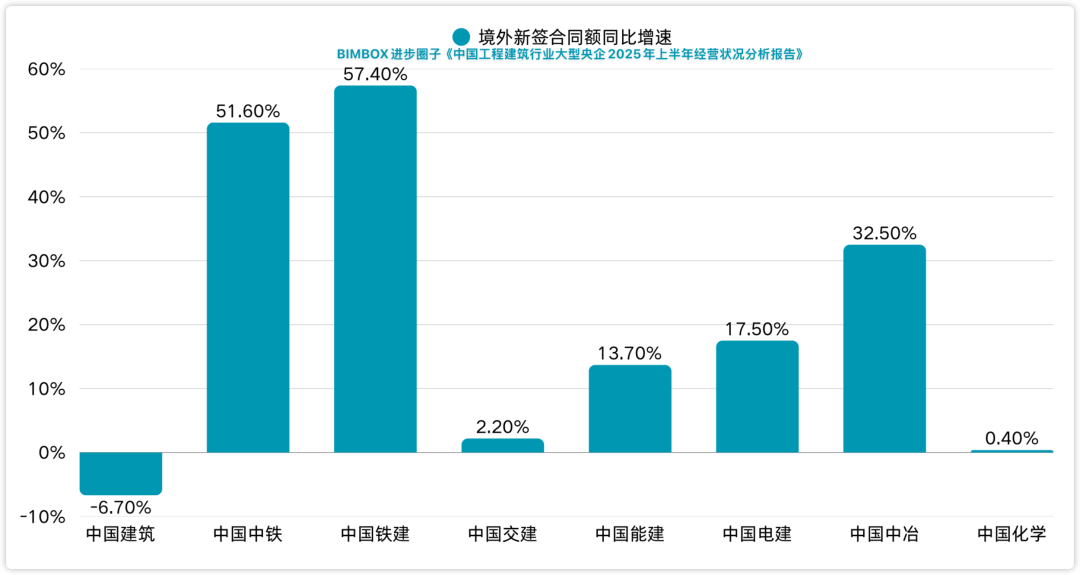
In the first half of 2025, seven of China's eight major central construction state-owned enterprises saw year-on-year growth in newly signed overseas contracts, and the year-on-year growth rates of China Railway Group and China Railway Construction Corporation evenexceeded 50%.
Among them, four central state-owned enterprises had overseas contracts accounting for more than 20% of their total contract value.
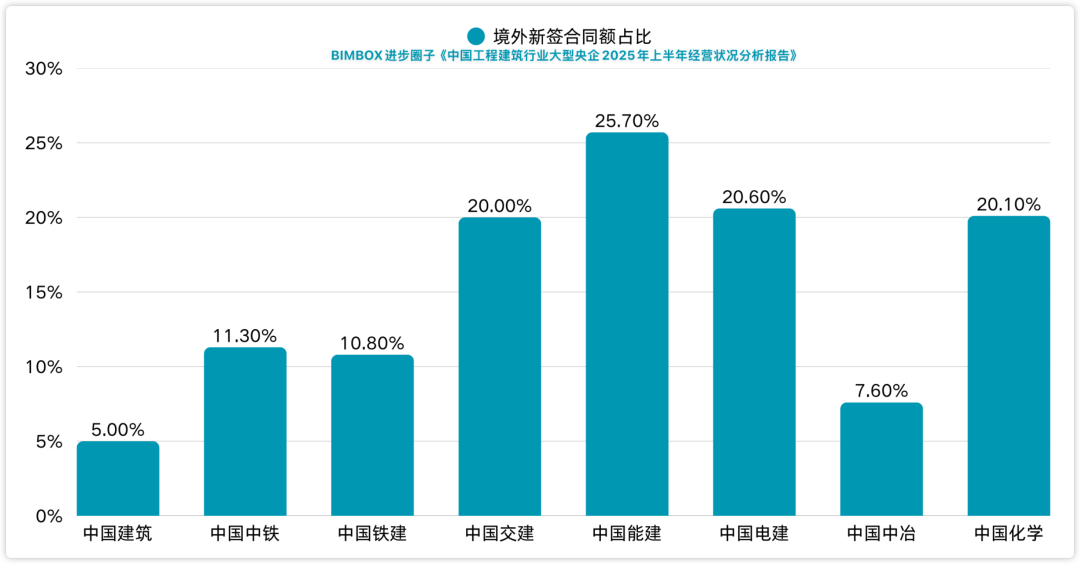
These are only the figures published for the first half of the year. Judging from the situation in the domestic construction industry, these numbers will rise further in the second half.
And because overseas projects widely recognize BIM technology, going overseas to work on projects is an opportunity for those familiar with BIM to leverage their strengths.

Going-overseas capability is not just about “making quick money”

We have been closely following everyone's real experiences of working overseas and have collected a great deal of information. Whether you actually go overseas to work, or stay in China to help others liaise on foreign projects, there are several opportunities worth seizing that can change the situation for your career development and your team's survival.
Higher personal income
The most direct reason for going overseas is the increase in income.
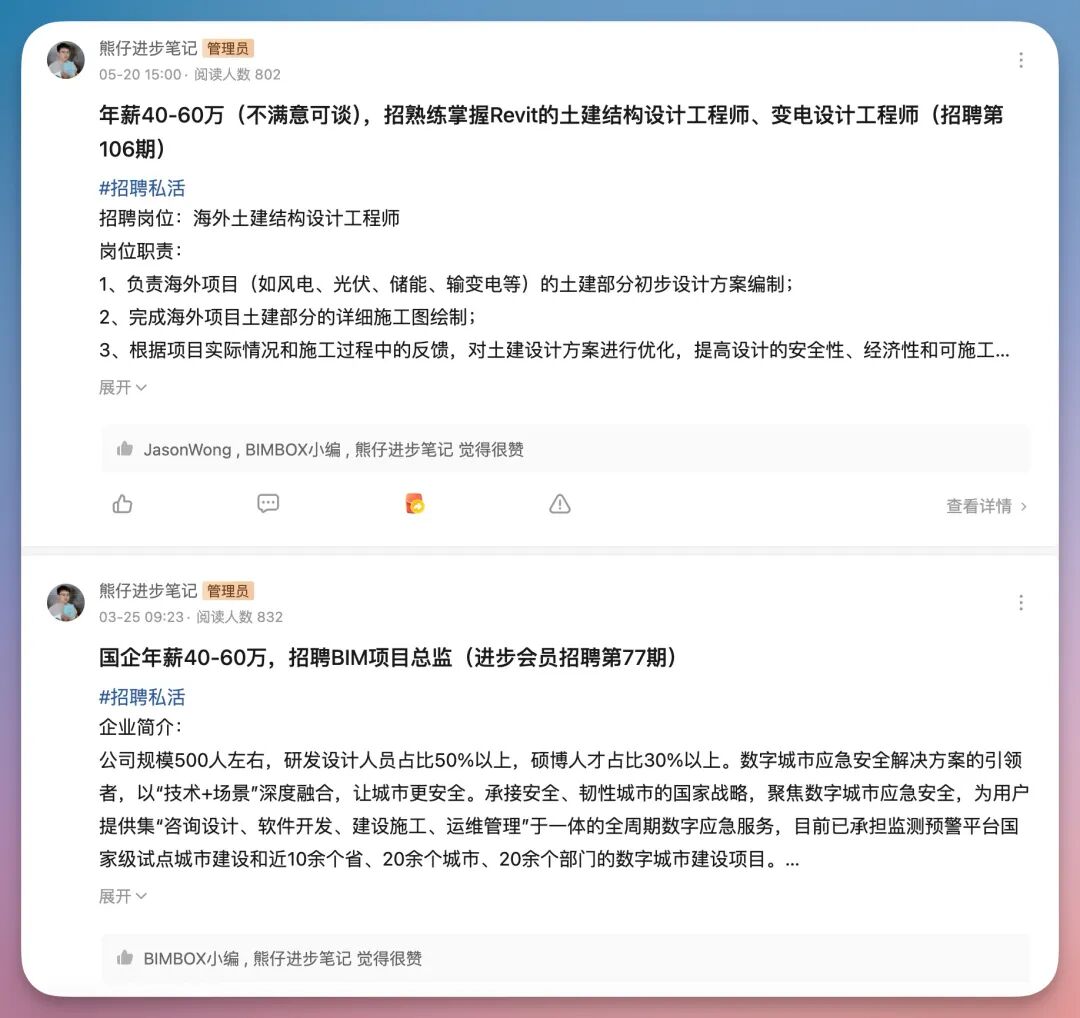
This year, quite a lot of companies have come to us looking for BIM talent to work overseas. In our Progress Community, we have posted overseas job opportunities with annual salaries as high as RMB 400,000–600,000, and friends have already connected with them and started work.
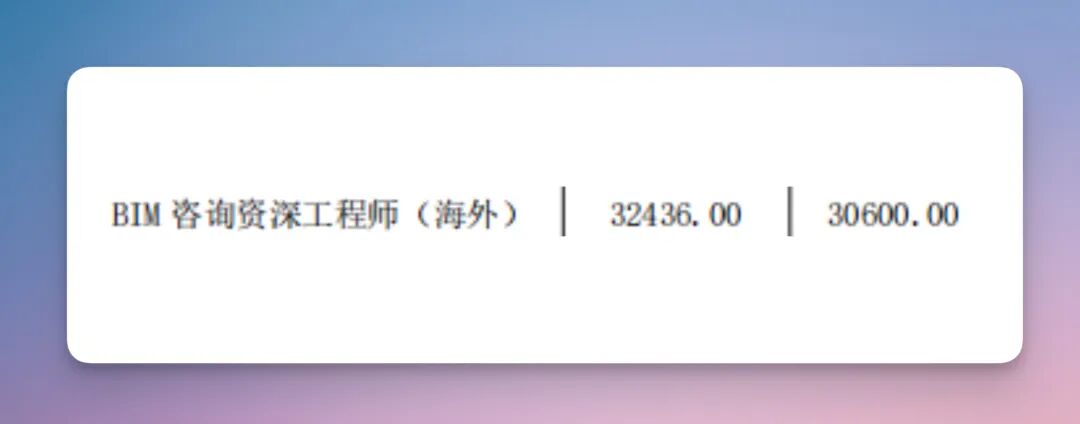
Aside from these projects with relatively high requirements and pay, for the more common BIM-related positions, stable incomes of RMB 20,000–30,000 are plentiful in the group. Below is an income statement shared by a group member for an overseas BIM consulting engineer.
A better workplace environment
At present, the domestic engineering industry is indeed hyper-competitive: working overtime has become the norm, room for promotion is limited, and you also face the risk of being “optimized” (laid off).
Feedback from friends overseas shows that although ordinary overseas jobs no longer offer the exaggerated income gap of a few years ago, employers overseas greatly respect labor laws. People basically leave work on time, rarely work overtime on weekends, and have plenty of time for themselves. One friend even sent drawings to the client on a weekend, only to be told, “I'm off duty—don't disturb me.”
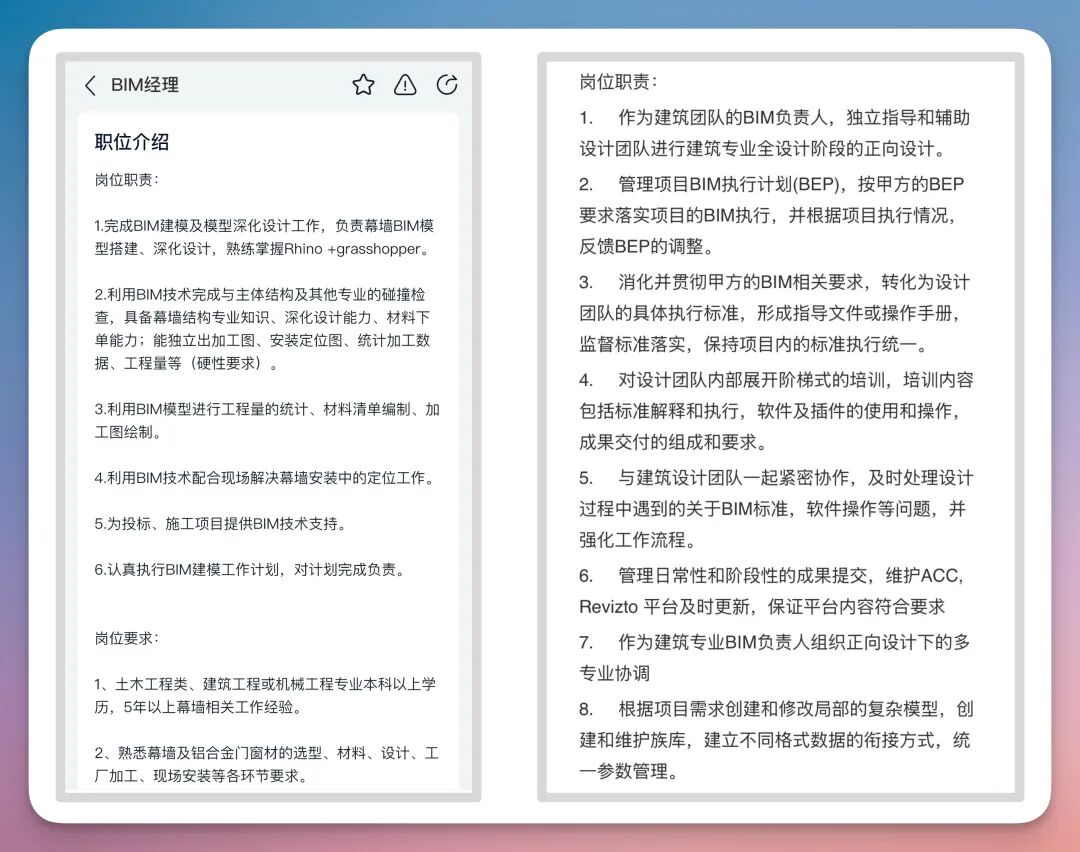
In addition, overseas career paths from engineer to BIM manager are relatively mature. As long as you are willing to keep learning, you won't worry about your skills going to waste. There are also quite a few overseas BIM manager positions posted in the group, offering considerable room for development.
Boosting the competitiveness of individuals and teams in China
Even if, for various reasons, you don't plan to actually go abroad, people in China who understand how overseas projects work, what software they use, and what standards they follow are also in high demand.
Most directly, we have introduced several friends to serve as project consultants for companies without needing to travel; the more capable ones can charge several thousand RMB a day. Helping others review tender documents, examine contracts, and write BEP documents is also a good freelance side job.
This is because the industry currently lacks “middlemen” who connect domestic and overseas projects. When overseas teams liaise with domestic teams, they badly need a “translator” in the middle—not only for language translation, but also for coordinating standards, responding to tender documents, delivering work outputs, and other aspects.
For teams, having the capability to go overseas is even more important.
Several friends working in Southeast Asia, the Middle East, and other regions have told us that many overseas projects do not look for local teams, but instead outsource to China. Indeed, after years of experience on high-intensity projects, the BIM capabilities and service capabilities of domestic teams surpass those of foreign teams, which has also become the best springboard for many domestic teams to “go global.”
Close your gaps, and everyone has a chance
The current, excessively “involution”-driven environment in China has made everyone lose a bit of confidence and feel that their own abilities are inadequate. As a result, many friends and teams doing BIM projects in China want to go overseas to make money, but always worry that their abilities fall far short, and don't dare to take that step.
In fact, when it comes to the “hard skills” that require years of accumulation, many friends in China already meet or even exceed international standards. We know many friends who have gone overseas to work, and they found that once they actually stepped out and saw the level of overseas BIM hard skills, they realized that they themselves were the true champions.
For many people, what is often missing is only a few “soft skills” that can be mastered through intensive short-term study, such as English reading, writing, and communication skills, familiarity with foreign standards, and an understanding of overseas project software, delivery, and acceptance methods.
It's like being a veteran chef whose skills have reached the pinnacle: tossing the wok, seasoning, and controlling the heat—these “hard skills” already far exceed the basic requirements of international restaurants. Now, to open a restaurant abroad, you only need to translate the ingredient names on the menu into English, understand the taste preferences of local diners, and get familiar with overseas hygiene and quarantine procedures. These skills can be picked up through a short, intensive effort; there is no need to relearn your core cooking skills from scratch.
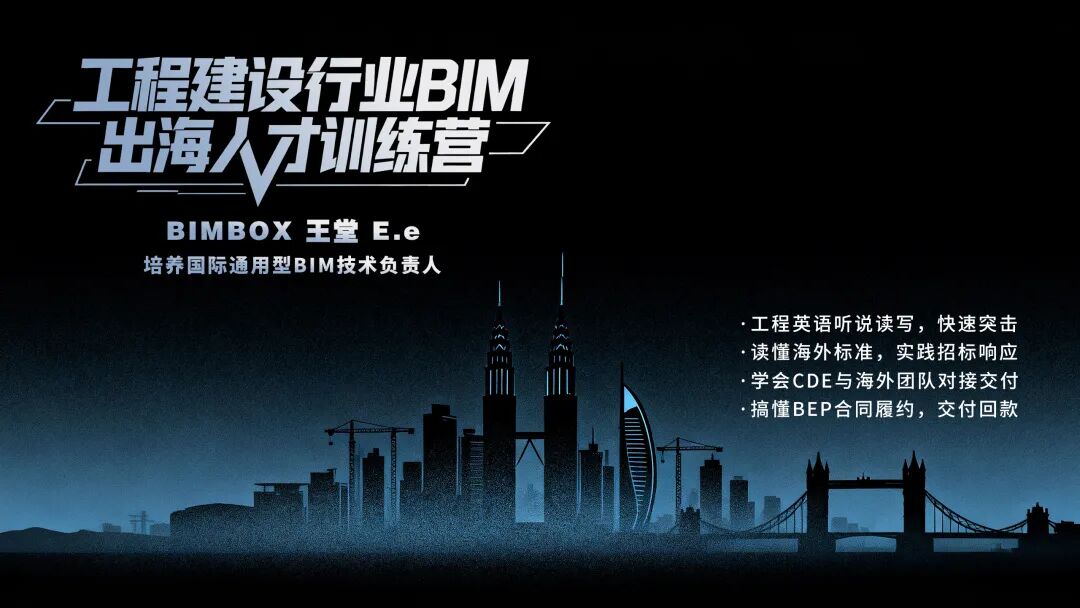
To help friends who wish to go overseas, or who hope to stay in China but want to get involved in overseas projects, we have teamed up with two highly experienced friends to launch the “BIM Overseas Talent Training Camp for the Engineering and Construction Industry”.
As the first hands-on training camp in China focused on “taking BIM technology overseas,” its core goal is to develop the ability of companies and individuals to undertake overseas projects, and to help everyone grasp, in a short time, the “vital points” for improving overseas project capabilities—knowing where to direct your efforts, how to close your gaps, and how to quickly become an “internationally versatile BIM technical lead.” It also helps people build a mutual-support network of overseas-going talent.
What overseas problems does it solve
What core needs of overseas projects does this training camp address, and how does it solve these problems? We have summarized four “vital points” for taking BIM overseas, namelyEnglish communication, standards application, collaborative coordination, and responsive delivery.
Take an important step: an intensive crash course in engineering English
Most people in the engineering industry have at least passed CET-4, but their communication skills have long since been forgotten. When it comes to English listening, speaking, reading, and writing for the engineering field in particular, it can feel impossibly difficult.
But from our conversations with friends working overseas, the English requirements for overseas projects are not that “out of reach.” We are going out to work, not to study abroad, so we don't need English as advanced as IELTS. On top of that, with AI now available, and the fact that most day-to-day contact on foreign projects is still with Chinese people, English preparation for going overseas follows the 80/20 rule: intensively mastering 20% of high-frequency scenarios can cover 80% of the needs.
We certainly can't start from memorizing “abandon”—that would take forever and be far too late. The difficulty lies in knowing what that 20% is.
Our training camp designs the English portion of the curriculum around exactly this goal.
Reading skills:A particularly important skill for starting overseas projects is being able to read the project's tender documents, especially the EIR (Employer's Information Requirements) in the ISO 19650 standard. We will show you how to read quickly with the help of AI tools, and—because all accountability is based primarily on the original tender documents, so you cannot rely purely on AI translation—we will also teach you how to build, over the long term, the ability to read engineering codes, technical measures, and academic papers directly in their original English.
Writing skills:To find a career advancement path beyond modeling in overseas projects, knowing how to write a BEP (BIM Execution Plan)—combining standards and tender requirements—is an absolutely essential skill. During project implementation, the scope of work will not go beyond the BEP. We will not only explain how to write a BEP and what related English skills you need to master, but also actually guide you in writing a BEP document, after which the two instructors will review and comment on both the document itself and your English ability. In addition, we will explain how to write an English BIM project promotion article, helping you take your international award submission materials and client-facing promotional presentations to the next level.
Listening and speaking skills:The training camp centers on the most high-frequency scenarios in overseas engineering projects—job interviews, introducing BIM to clients, delivering BIM plan briefings to construction teams in meetings, and so on. Starting from practical needs, it helps you fill in the most-needed spoken English knowledge in a short time.
Most importantly, throughout the process we will let everyone actually experience that, with the help of many modern tools, overseas engineering English is not that difficult, helping you break through your “fear of English.”
Understand overseas standards and apply them in real projects
Whether it's recruitment or outsourcing, overseas projects cannot avoid the ISO 19650 standard. The name has been repeated so often it's practically worn smooth, yet most people still don't understand it, and are even more baffled when they see concepts in project tender documents such as “Organizational Information Requirements (OIR)” and “Asset Information Requirements (AIR).”
Most online content explaining the ISO 19650 standard is filled with theory from start to finish; after reading it you feel you only half-understand, let alone know how to combine it with actual project operations. When you actually land a project, whether the submitted information will be rejected for not meeting international standards, and whether you can respond and revise quickly—these are among the most important criteria for judging whether an individual or team is competent to handle international projects.
This training camp focuses on the core logic of the ISO 19650 standard, stepping out of obscure theory and directly using an “information management flowchart.” From a hands-on working perspective, it helps you understand what should be done at each stage, who is responsible, and what the deliverables are, so you can easily grasp the essence of the code and ensure that the information management of the projects you handle fully conforms to international standards.
Learn to use a CDE to connect with overseas teams
Talking with quite a few overseas clients, they all say that when it comes to modeling and getting the work done, domestic teams are every one of them experts. But in terms of delivery and collaboration, the habits of domestic BIM teams don't adapt well once they go overseas. For example:
Project file versions are chaotic, sent back and forth by email, and the final version can never be found;
Team collaboration is still stuck at the stage of exchanging files rather than managing information, making cross-discipline collaboration extremely inefficient;
They are unfamiliar with the CDE platforms commonly used abroad and don't know how to complete delivery on a CDE platform, making it impossible to connect seamlessly with overseas teams.
The BIM modeling skills of people in China are already very strong, but the value of BIM is by no means finished once a model is built. Overseas projects also place great emphasis on CDE-based collaborative workflows.
This training camp will take you from “knowing about the CDE” to “being able to use the CDE,” targeting BIM 360 (which can connect seamlessly to the ACC platform), the CDE platform most commonly used in international projects. Through group exercises that simulate different teams, it will guide the whole class in hands-on practice on site, letting you personally experience how to use digital tools to ensure the execution of the ISO 19650 workflow.
Understand the BEP and contract performance, and secure delivery and payment
The biggest difference between overseas and domestic BIM projects lies in performance—that is, what should be done at each staged delivery step. Not understanding the performance process leads to:
The model is built well, but the outputs at each delivery stage always fail to meet the client's requirements;
Not understanding the audit and validation of BIM deliverables in overseas projects, causing the project to fail acceptance;
In overseas projects that place great emphasis on “performance capability,” it is hard to win the client's trust.
In the training camp, starting from the very first step of writing the BEP, we will explain how to prepare each meeting process, meeting minutes, periodic deliveries, and monthly reports. And of course, the most important part is the “last mile” of overseas projects—that is, what to pay attention to when delivering at each stage.
In terms of building long-term capabilities, we will teach you how to systematically manage, review, and deliver high-quality BIM outputs, becoming someone the client trusts more and thereby increasing your professional value.
Instructors and content arrangement
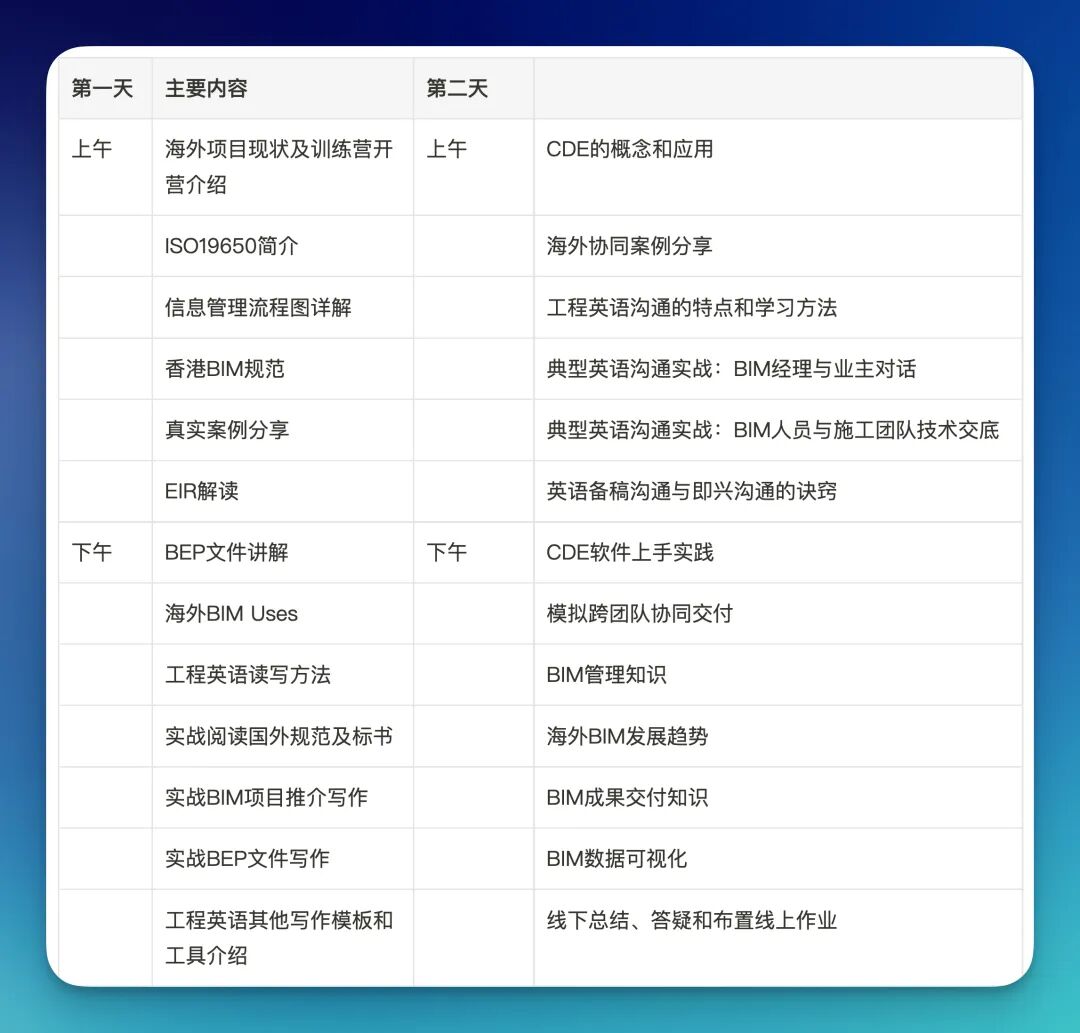
So that the training goes beyond theory and helps everyone gain hands-on experience of overseas project work scenarios, this training camp adopts an offline + online format. Over the course of one weekend of intensive offline training, through real cases, it introduces everyone to mastering international standards and codes, reading tender documents together, writing BEP documents, operating CDE software, simulating real project collaboration, practicing English communication scenarios such as meetings, briefings, and reporting, and understanding overseas BIM management and delivery.
Afterwards, we make further use of flexible online live sessions to improve everyone's communication skills, interview skills, and ability to write BIM execution plans, through practice, Q&A, and assignment review.
The instructors leading everyone in this training are two old friends we trust greatly.
Wang Tang
Holder of a master's degree in Digital Transformation and Corporate Strategy from the University of Hong Kong, with 9 years of BIM engineering experience and a Certified BIM Manager (CCBM) accredited by the Hong Kong Construction Industry Council. He once built a 50-person team at a large state-owned construction contractor, and has a deep understanding of the strengths and shortcomings of domestic practitioners when carrying out overseas projects, having trained several practitioners to work in Hong Kong. In his spare time, he also provides paid overseas consulting services to companies, including bidding advice, on-site presentation coaching, implementation plan writing, and job-seeking consultation.
In this training camp, Instructor Wang Tang will be responsible for explaining the ISO 19650 standard, BIM codes, tender document and BEP document rules, CDE collaboration, project management, and delivery.
E.e
A registered HVAC engineer with 10 years of experience, she graduated from a UK university ranked in the QS World Top 100 with a major in Building Environment and Equipment Engineering, and currently works as an HVAC engineer at a leading provincial state-owned enterprise. She is proficient in English listening, speaking, reading, and writing in the engineering field, has rich hands-on experience with engineering English, and is also the lead instructor of the BIMBOX course “Practical Engineering English Field Guide”.
In this training camp, Instructor E.e will be responsible for reading English codes and tender documents, writing BEP documents, engineering English writing techniques, and spoken English knowledge for a range of communication scenarios.
Plan for the training camp's offline sessions
After the offline training, all participants will be assigned homework to write a BEP document for a real project. Based on the participants' homework, we will arrange a separate online live session to review and comment online, helping everyone continue to improve.
In addition, all friends who take part in this training camp will receive, free of charge, the “Practical Engineering English Field Guide” course co-produced by Instructor E.e and BIMBOX.
For questions that arise during the learning process—such as overseas projects your company is actually working on, or overseas positions you are interviewing for—we will also arrange an online live consultation and Q&A session.
The training camp's offline event will be held in Beijing from November 22, 2025 (Saturday) to November 23 (Sunday). The online live session times will be announced in the training camp's WeChat group.
Because the offline training venue and the number of people the instructors can attend to are limited, this session of the training camp is enrolling only30offline participants and 30 online participants, on a first-come, first-served basis.
Scan the QR code below to sign up.
END
The views expressed are the author's own Copyright © Zhuwei Architectural Technology
Reproduction without authorization is prohibited
Please credit the source when reposting: Zhuwei Architectural Technology
Zhuwei Architectural Technology is a new-type technical services company specializing in integrated design optimization, BIM consulting and prefabricated construction design consulting. Our team brings together senior engineers from leading design institutes, former executives of real-estate companies, BIM engineers and prefabrication engineers, delivering integrated design optimization, refined drawing review, BIM consulting with MEP detailing, and prefabricated design services.
Design optimization consulting: Positioned as an extension and complement to the design management of real-estate developers, we focus on consulting and optimization for civil buildings. Across the whole process — or at key stages required by the client — we control the economy, rationality and safety of the design, eliminating unnecessary cost while measurably improving drawing quality, achieving "lower cost, higher efficiency".
BIM consulting: Through digital construction technology we help designers reduce errors and improve quality in the design phase, help contractors save cost and plan high-quality MEP installation in the construction phase, and extend BIM models into facility management for the operation phase — in collaboration with mainstream software vendors.
Prefabricated design consulting: Whole-process design on BIM platforms, using Revit and Tekla for PC detailing. Component geometry and reinforcement are linked parametrically — what you see is what you get. We deliver Industry 4.0-ready drawings with cut-length data for every rebar, and IoT-enabled support for production, storage, transport and installation of PC components.
Our expert team comes from leading design institutes, with deep technical grounding and extensive experience in dual-track design and optimization; its technical capability and control are industry-leading.
—— This article is auto-synced from the WeChat Official Account “Zhuwei Architectural Technology”. Read the original ——