Sichuan Provincial People's Government: Innovate and Expand Smart Construction Technologies Such as BIM and Construction Robots and AI Application Scenarios, Develop New Industrialized Building Technologies, and Accelerate Energy Conservation and Carbon Reduction in the Building Sector
WeChat Sync · Xiaowei · 2024-12-06
The following article is sourced from the Sichuan Provincial People's Government; author: Baimu Lianchuang BIM Services
Construction News Flash
To thoroughly implement the decisions and deployments of the CPC Central Committee and the State Council, build an energy-conservation and carbon-reduction system for Sichuan Province's construction sector, and promote the high-quality development of the construction sector, the Sichuan Provincial Department of Housing and Urban-Rural Development and the Provincial Development and Reform Commission jointly drafted the Implementation Plan for Accelerating Energy Conservation and Carbon Reduction in the Building Sector of Sichuan Province, which was issued and put into effect in November 2024.
The Plan sets out measures for green and low-carbon technology development in Sichuan Province and requirements for scientific and technological innovation in the province's construction sector, from three aspects: promoting green and low-carbon technological innovation, strengthening the green building materials industry chain, and developing new industrialized construction technology:
Develop new industrialized construction technology. Vigorously develop prefabricated buildings, focusing on projects such as affordable housing, schools, hospitals, sports venues, office buildings, and industrial plants, and actively promote Grade-A prefabricated buildings. Support the vigorous promotion and application of prefabricated products in the construction of main temporary facilities such as site-office enclosures and roads on construction sites. Actively promote prefabricated interior fit-out, encouraging the use of prefabricated fit-out technologies and new building materials in newly built buildings and the renovation of old residential communities. Accelerate the expansion, upgrading, and innovation of smart construction pilots, and expand building-industry internet platforms, Building Information Modeling (BIM) technology, smart monitoring equipment, construction robots, and other smart construction technologies and artificial-intelligence application scenarios. Promote energy-efficient construction equipment, and coordinate the comprehensive utilization of temporary construction facilities and permanent facilities. Standardize construction-site management, advance the sorted disposal and resource utilization of construction waste, improve the market-promotion mechanism for recycled construction-waste products, and, on the premise of meeting requirements, encourage the priority use of recycled products.(The Department of Economy and Information Technology, the Department of Housing and Urban-Rural Development, and other departments are responsible according to their division of duties)
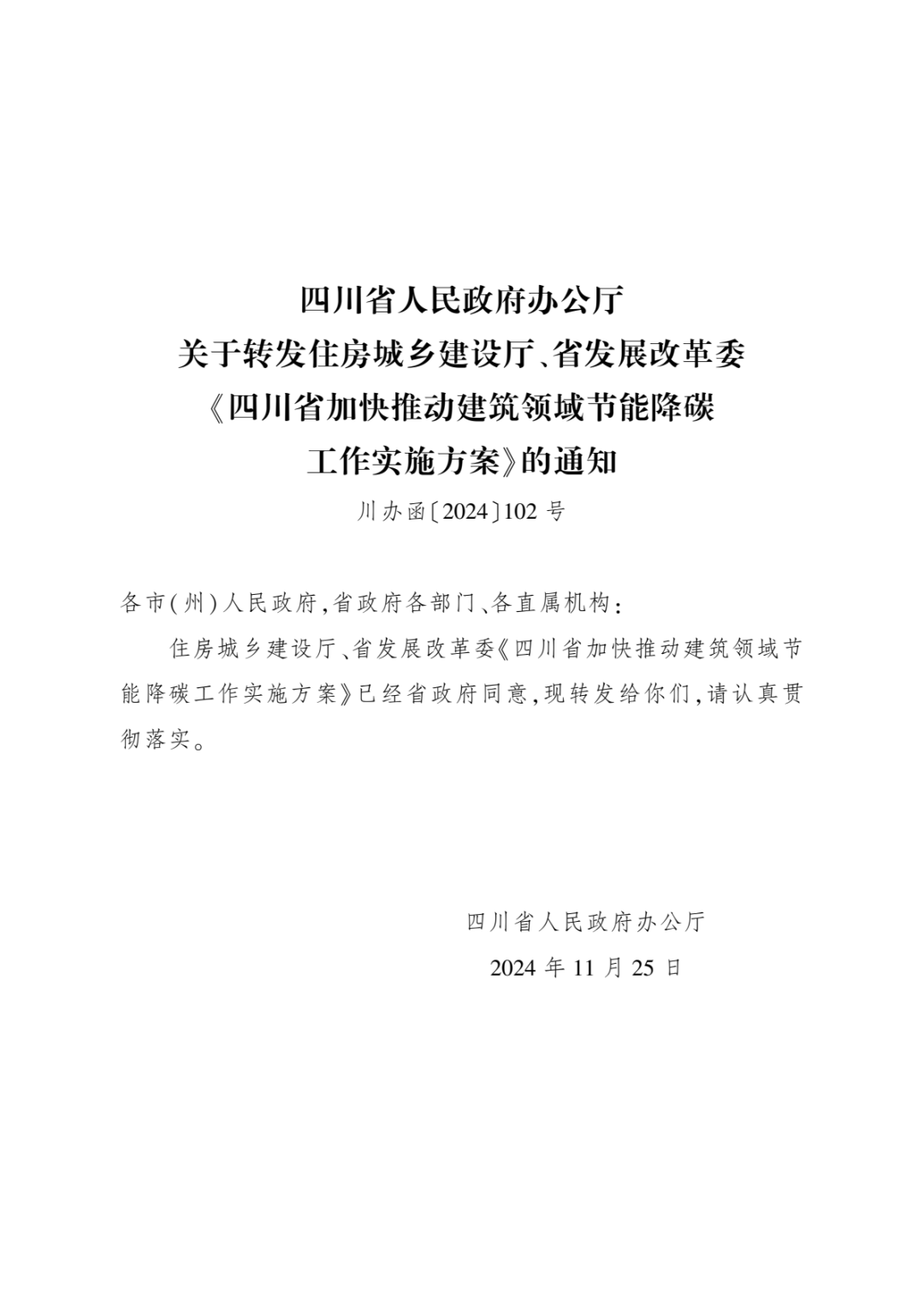
General Office of the Sichuan Provincial People's Government
Chuan Ban Han [2024] No. 102
General Office of the Sichuan Provincial People's Government
November 25, 2024
Interpretation
I. Background of Drafting
On March 12, 2024, the General Office of the State Council forwarded the Work Plan for Accelerating Energy Conservation and Carbon Reduction in the Building Sector from the National Development and Reform Commission and the Ministry of Housing and Urban-Rural Development (Guo Ban Han [2024] No. 20), which, focusing on improving energy-utilization efficiency and reducing carbon-emission levels in the construction sector, systematically deployed 12 key tasks. On July 31, the CPC Central Committee and the State Council issued the Opinions on Accelerating the Comprehensive Green Transformation of Economic and Social Development, putting forward requirements for the green transformation of urban and rural construction and development in terms of vigorously developing green and low-carbon buildings and optimizing the building energy-consumption structure. To thoroughly implement the decisions and deployments of the CPC Central Committee and the State Council, build an energy-conservation and carbon-reduction system for the province's construction sector, and promote the high-quality development of the construction sector, the Department of Housing and Urban-Rural Development and the Provincial Development and Reform Commission jointly drafted the Implementation Plan for Accelerating Energy Conservation and Carbon Reduction in the Building Sector of Sichuan Province (hereinafter referred to as the Work Plan), which was issued and put into effect in November 2024.
II. Main Content
(I) Overall Requirements.
Guided by Xi Jinping Thought on Socialism with Chinese Characteristics for a New Era and led by the work of peaking carbon emissions and achieving carbon neutrality, continuously improve energy-utilization efficiency and reduce carbon-emission levels in the construction sector, accelerate the enhancement of the quality of green and low-carbon development in the construction sector, and continually meet the people's needs for a better life.
The main goals are as follows: By 2025, the institutional system for energy conservation and carbon reduction in the province's construction sector will be more sound. New urban buildings will fully implement green-building standards. The floor area of newly added ultra-low-energy and near-zero-energy buildings will exceed 800,000 square meters, and the floor area of newly added energy-efficient retrofits of existing buildings will exceed 6 million square meters. Electricity will account for more than 55% of building energy consumption, the renewable-energy substitution rate in urban buildings will reach 8%, and positive progress will be made in energy conservation and carbon reduction in the construction sector. By 2027, the mechanisms and policy system for energy conservation and carbon reduction in the province's construction sector will be continuously improved, ultra-low-energy buildings will achieve large-scale development, energy-efficient retrofits of existing buildings will be further advanced, the building energy-consumption structure will be further optimized, a batch of green, low-carbon, high-quality buildings will be completed, and remarkable results will be achieved in energy conservation and carbon reduction in the construction sector.
(II) Main Measures. The Implementation Plan puts forward specific requirements from three aspects: comprehensively improving the level of building energy conservation and carbon reduction, continuously promoting the optimization of the building energy-consumption structure, and vigorously developing green and low-carbon technologies. First, based on the actual conditions of urban and rural construction in the province, it proposes specific measures for the design, construction, and O&M of urban and rural construction in the province from five aspects: giving play to the leading role of planning, strengthening energy-conservation management of new buildings, advancing energy-efficient retrofits of existing buildings, promoting energy-efficient and low-carbon rural housing construction, and optimizing building-operation energy-conservation management. Second, based on the province's climate-resource endowment, it formulates specific measures for optimizing the building energy-consumption structure in the province's urban and rural construction, focusing on three aspects: the management mechanism for renewable-energy application, the low-carbon transformation of building energy use, and the high-quality development of building-integrated photovoltaics. Third, from three aspects—promoting green and low-carbon technological innovation, strengthening the green building materials industry chain, and developing new industrialized construction technology—it puts forward measures for green and low-carbon technology development and requirements for scientific and technological innovation in the province's construction sector.
(III) Safeguard Measures. Specific measures are defined from three aspects—strengthening organizational leadership, improving the policy system, and reinforcing policy guarantees—to ensure that all work is implemented and put into practice.
II. Main Features and Highlights
First, it highlights the upfront review of project planning. It clearly moves building energy-conservation and carbon-reduction requirements forward to the project-planning stage, incorporates green-building requirements into construction-land planning conditions, and includes them in construction-project planning review and completion planning verification, ensuring that projects meet green and low-carbon requirements. Second, it defines energy-conservation and carbon-reduction pathways suited to local conditions. Making full use of renewable energy, and drawing on years of meteorological data from 156 weather stations across the province, it takes the lead nationwide in refining county-level (city, district) solar-energy resource conditions from three dimensions—annual total solar radiation and annual irradiation grade, stability grade, and direct-radiation ratio grade—thereby promoting the application of renewable energy in the construction sector. Third, it promotes the coordinated development of the green building materials industry. It implements the 'build circles and strengthen chains' action for the green building materials industry, incorporates green building materials into building energy-conservation and carbon-reduction work, and clarifies the relevant requirements for the promotion and application of green building materials in the construction sector.
Download the Plan Document
END
The views expressed are the author's own Copyright © Zhuwei Architectural Technology
Reproduction without authorization is prohibited
Please credit the source when reposting: Zhuwei Architectural Technology
Zhuwei Architectural Technology is a new-type technical services company specializing in integrated design optimization, BIM consulting and prefabricated construction design consulting. Our team brings together senior engineers from leading design institutes, former executives of real-estate companies, BIM engineers and prefabrication engineers, delivering integrated design optimization, refined drawing review, BIM consulting with MEP detailing, and prefabricated design services.
Design optimization consulting: Positioned as an extension and complement to the design management of real-estate developers, we focus on consulting and optimization for civil buildings. Across the whole process — or at key stages required by the client — we control the economy, rationality and safety of the design, eliminating unnecessary cost while measurably improving drawing quality, achieving "lower cost, higher efficiency".
BIM consulting: Through digital construction technology we help designers reduce errors and improve quality in the design phase, help contractors save cost and plan high-quality MEP installation in the construction phase, and extend BIM models into facility management for the operation phase — in collaboration with mainstream software vendors.
Prefabricated design consulting: Whole-process design on BIM platforms, using Revit and Tekla for PC detailing. Component geometry and reinforcement are linked parametrically — what you see is what you get. We deliver Industry 4.0-ready drawings with cut-length data for every rebar, and IoT-enabled support for production, storage, transport and installation of PC components.
Our expert team comes from leading design institutes, with deep technical grounding and extensive experience in dual-track design and optimization; its technical capability and control are industry-leading.
—— This article is auto-synced from the WeChat Official Account “Zhuwei Architectural Technology”. Read the original ——